On eBird ↗
Buff-breasted Buttonquail
Live sightings near you, the range map, bar charts of when it is seen, and Macaulay Library photos and recordings.
Buff-breasted Buttonquail
Turnix olivii
The buff-breasted buttonquail (Turnix olivii) is the largest and possibly the rarest of the buttonquail. This species is endemic to Cape York Peninsula, in Queensland, Australia.
From the article Buff-breasted buttonquail on Wikipedia (CC BY-SA), quoted section by section
Description
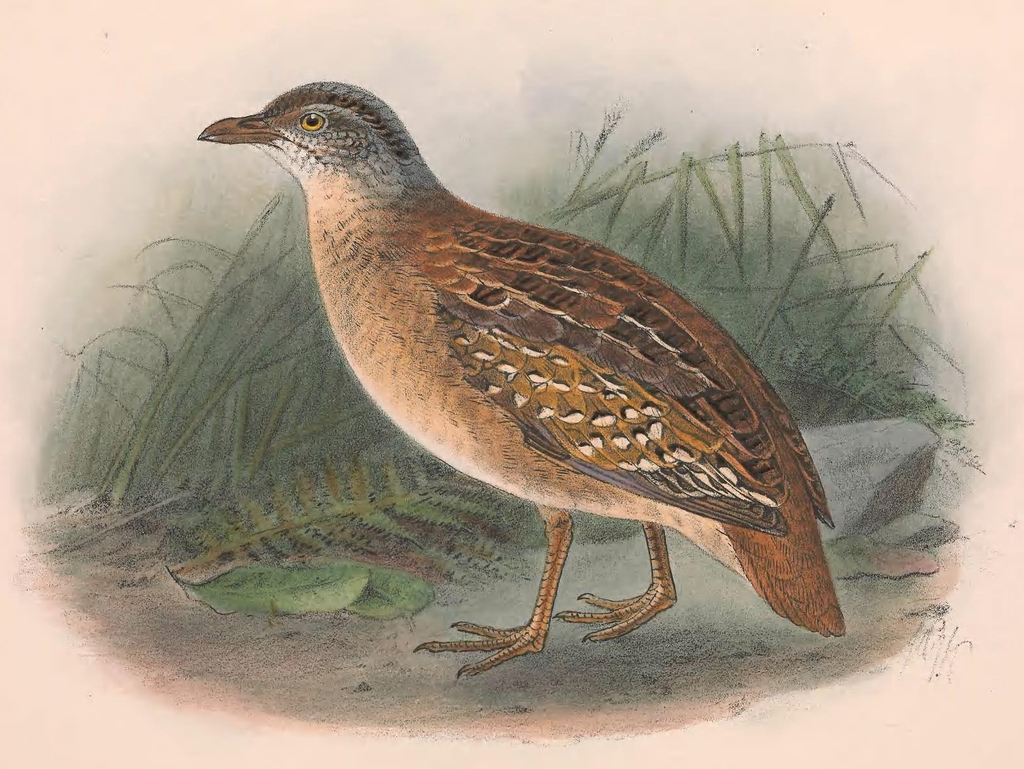
The buff-breasted buttonquail measures from 18–23 cm (7.1–9.1 in) and usually weighs over 110 g (3.9 oz). Both the tail and wings are short. The back is chestnut. The sides of the head are marked with chestnut on an otherwise plain gray head; while the breast is warm buff-colored. The painted buttonquail and the brown quail both coexist with this species. The buff-breasted is larger (and longer-legged) than either and is quite different from the all-dark quail. The painted species is almost totally mottled, with bold white spotting on the breast and no warm buff coloration. The most similar species to the buff-breasted is the chestnut-backed buttonquail, which does not overlap in the wild. The advertising (or booming) call made by the female is ooom-oom-oom, repeated up to 20 times. The notes are almost inaudible initially, then become gradually louder, higher-pitched and shorter until they are far-carrying. The males will respond with a deep, rapid chu-chu-chu whistle. Other calls, perhaps in reaction to danger, include gug-gug-gug, a soft chirp-chirp-chirp and a loud kwaare-kwaare.
Range & habitat
These birds favor lowland, subcoastal grasslands or woodlands. They may be found at any elevation to 400 m (1,300 ft). Reports describe this species as dependent on grassy woods made up of Melaleuca, Acacia, Alphitonia and Tristania. They have been seen in area of heavy scrub ground cover, up to 1 m (3.3 ft) high in some cases, but can also be seen in rocky areas where almost no scrub cover is present.
Important Bird Areas. Sites identified by BirdLife International as being important for buff-breasted buttonquail conservation are the Iron and McIlwraith Ranges, and the Morehead River of Far North Queensland.
Wikipedia: “Distribution and habitat”
What it does
Very few people see the buff-breasted buttonquail due to its tiny range and inconspicuous disposition. The buttonquail usually walk or run in areas where they are well camouflaged, almost never leaving the ground except when absolutely necessary. They are usually sedentary, but local movements have been recorded, probably in response to seasonal habitat changes.
Diet. Details of their diet are little known, but (like most buttonquail) they probably eat insects and seeds, with sand used as a digestion aid.
Breeding. These birds are known to be solitary breeders. The breeding season is January through March. The nest is a shallow depression with a dome of grasses and a side entrance, which itself is lined with grasses and leaves. Usually the nest site is well obscured behind grasses, low scrubs or tussock. Two to four round eggs (usually 3) are laid. The eggs are whitish and speckled with chestnut, bluish-gray or black. The incubation period is unknown, but the male is thought to assume all incubation and chick-care activities. The young are precocial and nidifugous.
Wikipedia: “Behaviour”
Listen
Looking for field recordings…
Where it lives
Recorded sightings
—
geo-referenced records in GBIF, from museums, herbaria and field observers.
Drag the globe to turn it. Dots are where records exist, not a range map; darker means more records.
In the stacks
Searching the stacks…
Every page naming Turnix olivii in the Biodiversity Heritage Library →
This page is assembled live from iNaturalist, GBIF, Wikipedia, the Source Library and the Internet Archive. It is not yet part of the hand-edited codex. iNaturalist taxon 20902.