On eBird ↗
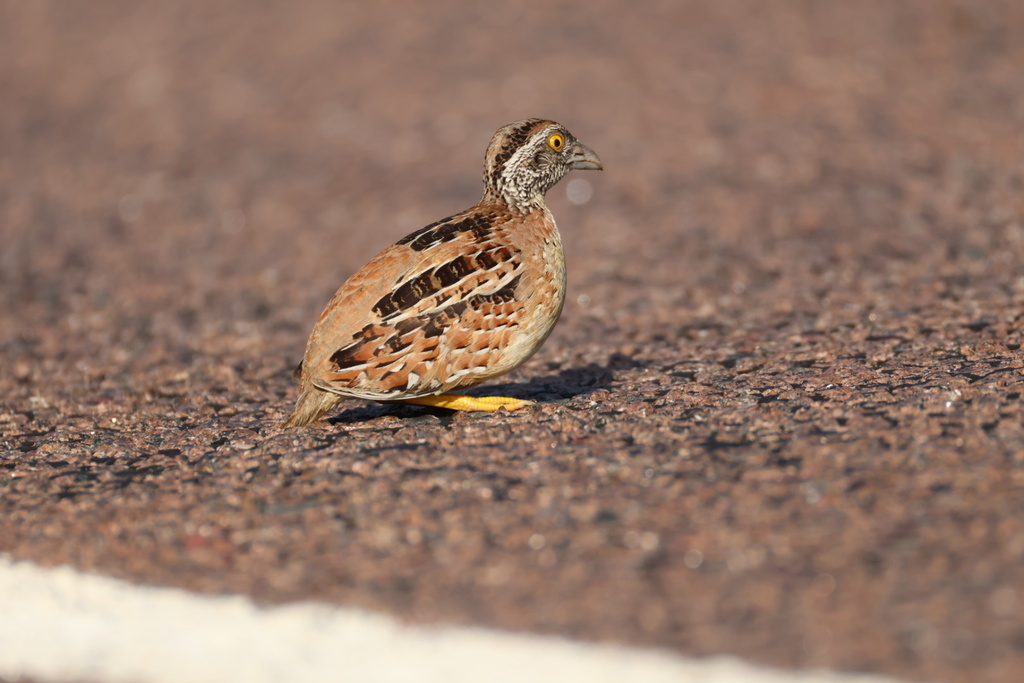
Chestnut-backed Buttonquail
Live sightings near you, the range map, bar charts of when it is seen, and Macaulay Library photos and recordings.
Chestnut-backed Buttonquail
Turnix castanotus
The chestnut-backed buttonquail (Turnix castanotus) is a species of bird in the family Turnicidae. It is endemic to Australia.
From the article Chestnut-backed buttonquail on Wikipedia (CC BY-SA), quoted section by section
Range & habitat
Native to northern Australia, the species ranges from the Dampier Peninsula in Western Australia across to Westmoreland Station in the Gulf Country of northwestern Queensland, with possible records from Gregory Downs and Augustus Downs further east. It is also native to Melville Island and Groote Eylandt. It was common around Borroloola and McArthur River, but not currently. Its existence in Queensland was only confirmed in 2020. Its natural habitats are low grasslands and Eucalyptus forests and woodland, favouring quartzite-sandstone ridges, plateaus and escarpments, mostly (but not always) in areas that receive over 800 mm (31 in) summer rainfall.
Wikipedia: “Distribution and habitat”
What it does
The usual sex roles are reversed in the buttonquail genus (Turnix), as the larger and more brightly-coloured female mates with multiple male partners and leaves them to incubate the eggs. The female lays a clutch of 1–5 (usually 4) pyriform eggs, which are glossy-white with sparse small dark blotches.
== References ==
Wikipedia: “Behaviour”
In human culture
"Chestnut-backed buttonquail" has been designated the official name by the International Ornithologists' Union (IOC). The species name is derived from the Ancient Greek words kastanon "chestnut" and noton "back". Gould called it "chestnut-backed hemipode" in 1848, noting the colonists called it "thick-billed quail". The buttonquail species were generally known as "quail" (hence "chestnut-backed quail" ) until the RAOU promoted the current usage of "buttonquail" in 1978, which was then universally adopted.
Wikipedia: “Etymology”
Listen
Looking for field recordings…
Where it lives
Recorded sightings
—
geo-referenced records in GBIF, from museums, herbaria and field observers.
Drag the globe to turn it. Dots are where records exist, not a range map; darker means more records.
In the stacks
Searching the stacks…
Every page naming Turnix castanotus in the Biodiversity Heritage Library →
This page is assembled live from iNaturalist, GBIF, Wikipedia, the Source Library and the Internet Archive. It is not yet part of the hand-edited codex. iNaturalist taxon 20865.