On eBird ↗
Bare-cheeked Trogon
Live sightings near you, the range map, bar charts of when it is seen, and Macaulay Library photos and recordings.
Bare-cheeked Trogon
Apaloderma aequatoriale
The bare-cheeked trogon (Apaloderma aequatoriale) is a species of bird in the family Trogonidae. It is found in Cameroon, Central African Republic, Republic of the Congo, Democratic Republic of the Congo, Equatorial Guinea, Gabon, and Nigeria.
From the article Bare-cheeked trogon on Wikipedia (CC BY-SA), quoted section by section
Description
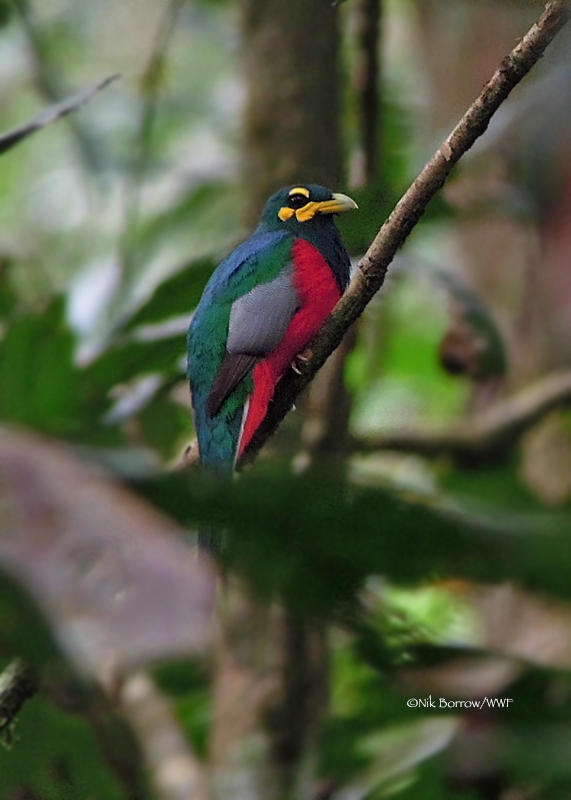
The bare-cheeked trogon physically resembles the narina trogon, but it has bright yellow facial skin while narina trogons have green facial skin. They also differ from narina trogons in smaller size and shorter tail. Bare-cheeked trogons are sexually dismorphic. The male's back, head and upper breast is green blueish; and its lower breast is pinkish red. Its wings are pale grey and finely barred; and it has a yellow bare facial patch. The female shares the same wing coloration and also has that distinct yellow facial patch, however its whole breast is pinkish red and only the back and the back of its head are bluish-green. Both sexes have a white undertail and a yellow bill, and measure 28-31 cm. They have heterodactyl feet which is a distinctive feature only Trogons share.
Range & habitat
Bare-cheeked trogons are found year-round across central west Africa and do not typically migrate. It is found in Cameroon, Central African Republic, Republic of the Congo, Democratic Republic of the Congo, Equatorial Guinea, Gabon, and Nigeria.
Wikipedia: “Distribution”
What it does
Bare-cheeked trogons can be easily differentiated from narina trogon by their songs. They have a distinct song described as a series of 6-8 "chuu"s repeated every 15–20 seconds. When adults arrive at the nest with food, they emit low grunting calls. It has been reported that bare-cheeped trogons engage in singing aggregations. This calling assemblage involves a group of 3 to 10 adult males, with occasional instances of up to 20, continuously calling as they pursue each other from one perching spot to another. Male narina trogons may also join this aggregation. These calling assemblages happen during brood period so they may be related to reproduction, but it still remains uncertain as they do not lead to copulation. This behaviour is common to several trogon species.
Wikipedia: “Vocal behaviour”
Listen
Looking for field recordings…
Where it lives
Recorded sightings
—
geo-referenced records in GBIF, from museums, herbaria and field observers.
Drag the globe to turn it. Dots are where records exist, not a range map; darker means more records.
In the stacks
Searching the stacks…
Every page naming Apaloderma aequatoriale in the Biodiversity Heritage Library →
This page is assembled live from iNaturalist, GBIF, Wikipedia, the Source Library and the Internet Archive. It is not yet part of the hand-edited codex. iNaturalist taxon 20841.