On eBird ↗
Elegant Trogon
Live sightings near you, the range map, bar charts of when it is seen, and Macaulay Library photos and recordings.
Elegant Trogon
Trogon elegans
The elegant trogon (Trogon elegans) (formerly the "coppery-tailed" trogon), is a near passerine bird in the trogon family. Along with the eared quetzal, it is the most poleward-occurring species of trogon in the world, ranging from Guatemala in the south as far north as the upper Gila River in Arizona and New Mexico. The most northerly populations of subspecies ambiguus are partially migratory, and the species is occasionally found as a vagrant in southeasternmost and western...
From the article Elegant trogon on Wikipedia (CC BY-SA), quoted section by section
Description
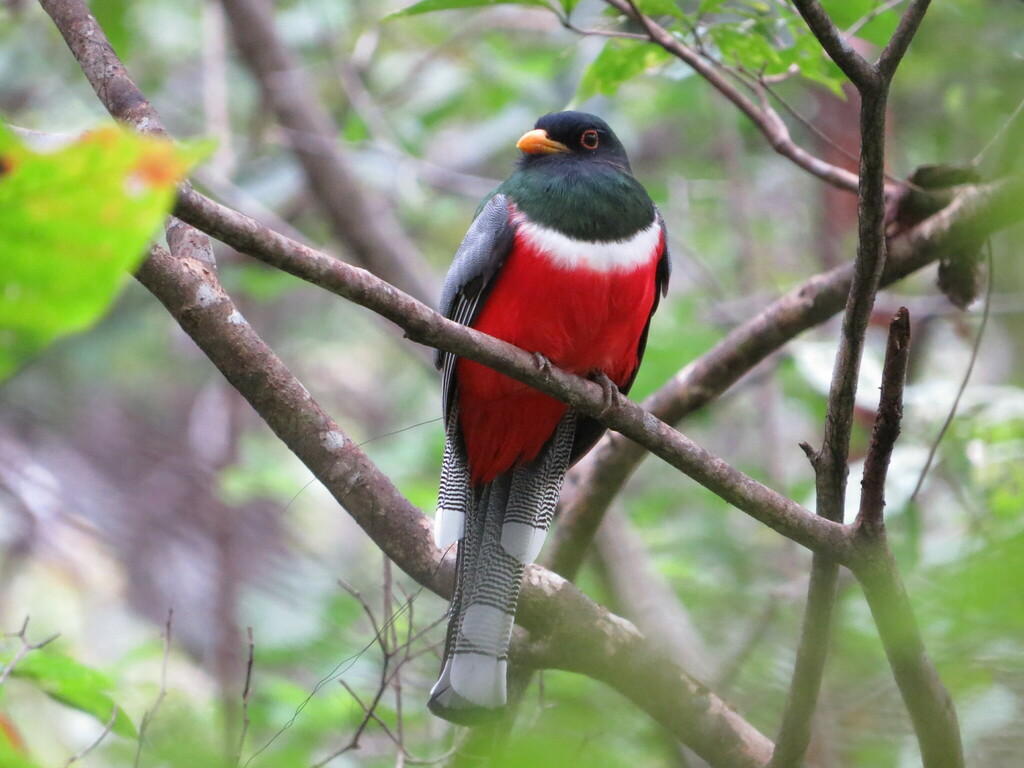
This species is a medium-sized bird, measuring 28–30 centimetres (11–12 in) long and weighing 60–78 grams (2.1–2.8 oz) (average 68 grams (2.4 oz)). Like other trogons, elegant trogons display sexual dimorphism, where males and females have different plumages. Males are often brightly colored. They have red-orange lower chest and belly and metallic deep green back. They get their old name from the copper shade on their backsides. Their face and throat are a dark black and they have a white band going across the chest. Their upperwings are grey and their long square tipped tail feathers are usually brown on the upper side and white undertail with and black horizontal stripes. The color on the upper part of the tail may very amongst subspecies. Females and immature males look similar. They have the same patterns as mature males, but they have different colorations. Their coloration is duller, usually a brownish grey, and they have a white ring around their eyes. The usual call is a croaking "co-ah co-ah co-ah". The trogon will also include some chattering notes. Males tend to be more vocal than females. In males, the frequency of calls does not vary according to the seasons, but females call more often during incubation than during feeding season.
Range & habitat
Along with the eared quetzal, it is the northernmost species of trogon in the world. The species is endemic to Central America, ranging from Guatemala in the south as far north as the mountains of southeast Arizona. Elegant trogons are short distance migrators, usually only getting as north as Arizona, where they spend the breeding season. The most northerly populations of the subspecies T. e. ambiguus are partially migratory, and the species is occasionally found as a vagrant in southeasternmost and western Texas. It is a resident of the lower levels of semi-arid open woodlands and forests. The elegant trogon is fond of dry, arid woodlands. It can be found in pine forests, deciduous forests, second growth forests and around scrubs. The elegant trogon is not fond of humid regions, and chooses to live on hillsides near cliff edges. In Arizona, they are present in canyons covered with riparian and edge vegetation. Plants such as junipers, oaks, sycamores, and Pinus edulis can be a good indication of suitability for the trogon.
Wikipedia: “Distribution and habitat”
What it does
Interactions between individuals are not rare. Research found that other than producing calls, tail movement is also a method of communication among individuals. Tail rising could be a sign of dominance or aggression to communicate status, or associated with mating. Tail raising is also used as an alarm or deterrent to let a predator know that it has been spotted.
Food and feeding. The elegant trogon is a frugivore and insectivore, meaning they consume fruits and insects. Their broad bills and weak legs reflect their diet and arboreal habits. Their diet consists of grapes, cherries, figs, chokecherry, and buckthorn as well as grasshoppers, mantids, caterpillars, moths and beetles. Very occasionally it will also prey upon small vertebrates, usually lizards. Although their flight is fast, they are reluctant to fly any distance. They typically perch upright and motionless. To hunt their prey, they remain motionless on a perch, then jump into flight. To grab fruits, they will hover over the berries to pluck them
Breeding. It nests 2–6 metres (7–20 ft) high in an unlined shallow cavity, usually selecting an old flicker hole, with a typical clutch of two to three eggs. Incubation periods last an average of 17 days with both parents taking turns to incubate. Elegant trogons display biparental care, where both the males and females are responsible of taking care of their offspring. …
Wikipedia: “Behavior”
Listen
Looking for field recordings…
Where it lives
Recorded sightings
—
geo-referenced records in GBIF, from museums, herbaria and field observers.
Drag the globe to turn it. Dots are where records exist, not a range map; darker means more records.
In the stacks
Searching the stacks…
Every page naming Trogon elegans in the Biodiversity Heritage Library →
This page is assembled live from iNaturalist, GBIF, Wikipedia, the Source Library and the Internet Archive. It is not yet part of the hand-edited codex. iNaturalist taxon 20781.