On eBird ↗
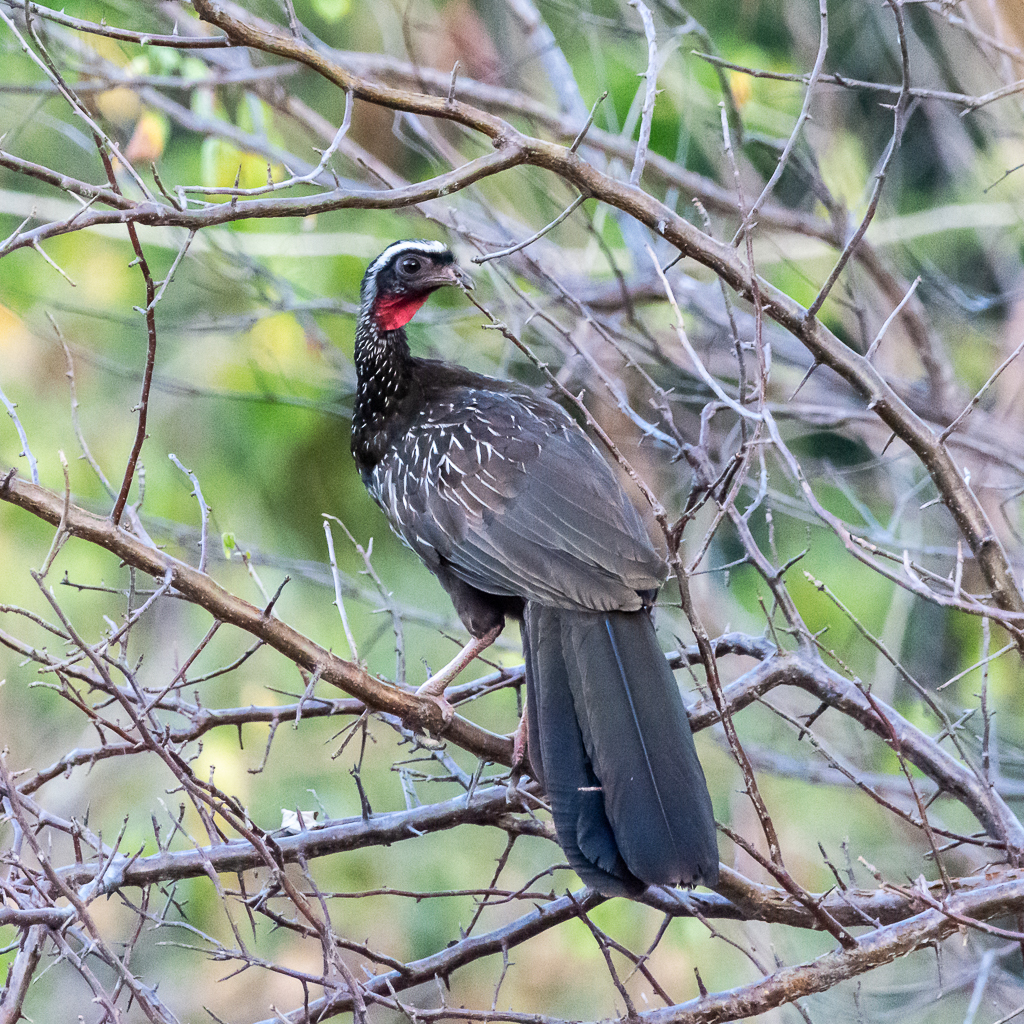
White-browed Guan
Live sightings near you, the range map, bar charts of when it is seen, and Macaulay Library photos and recordings.
White-browed Guan
Penelope jacucaca
The white-browed guan (Penelope jacucaca) is a species of bird in the Cracidae family. It is endemic to the Caatinga in north-eastern Brazil. It is threatened by habitat loss and hunting.
From the article White-browed guan on Wikipedia (CC BY-SA), quoted section by section
Description
The white-browed guan is 65 to 70 cm (2.1 to 2.3 ft) long. It gets its name from the prominent white supercilium, which has a black line separating it from the bare grayish skin around the eye. The adult plumage is overall blackish brown, with prominent white streaks on the upper wing. It has the red dewlap that is typical of the genus. Juveniles do not have the dewlap, their facial skin is yellowish, and the white streaks are fainter.
Range & habitat
The white-browed guan is found in northeastern Brazil in an area roughly bounded by southern Maranhão, northeastern Minas Gerais, and the Atlantic coast. It inhabits several dry forest types including open angical, caatinga, restinga, and sometimes campo rupestre grassland. It appears to tolerate some habitat degradation. In elevation it ranges from sea level to 1,000 m (3,300 ft).
Wikipedia: “Distribution and habitat”
What it does
The white-browed guan typically feeds on the ground in groups of up to seven birds. Its diet has not been detailed but is thought to include fruits, seeds, and insects. It visits water sources to drink.
Wikipedia: “Feeding”
Listen
Looking for field recordings…
Where it lives
Recorded sightings
—
geo-referenced records in GBIF, from museums, herbaria and field observers.
Drag the globe to turn it. Dots are where records exist, not a range map; darker means more records.
In the stacks
Searching the stacks…
Every page naming Penelope jacucaca in the Biodiversity Heritage Library →
This page is assembled live from iNaturalist, GBIF, Wikipedia, the Source Library and the Internet Archive. It is not yet part of the hand-edited codex. iNaturalist taxon 2074.