On eBird ↗
Red-faced Guan
Live sightings near you, the range map, bar charts of when it is seen, and Macaulay Library photos and recordings.
Red-faced Guan
Penelope dabbenei
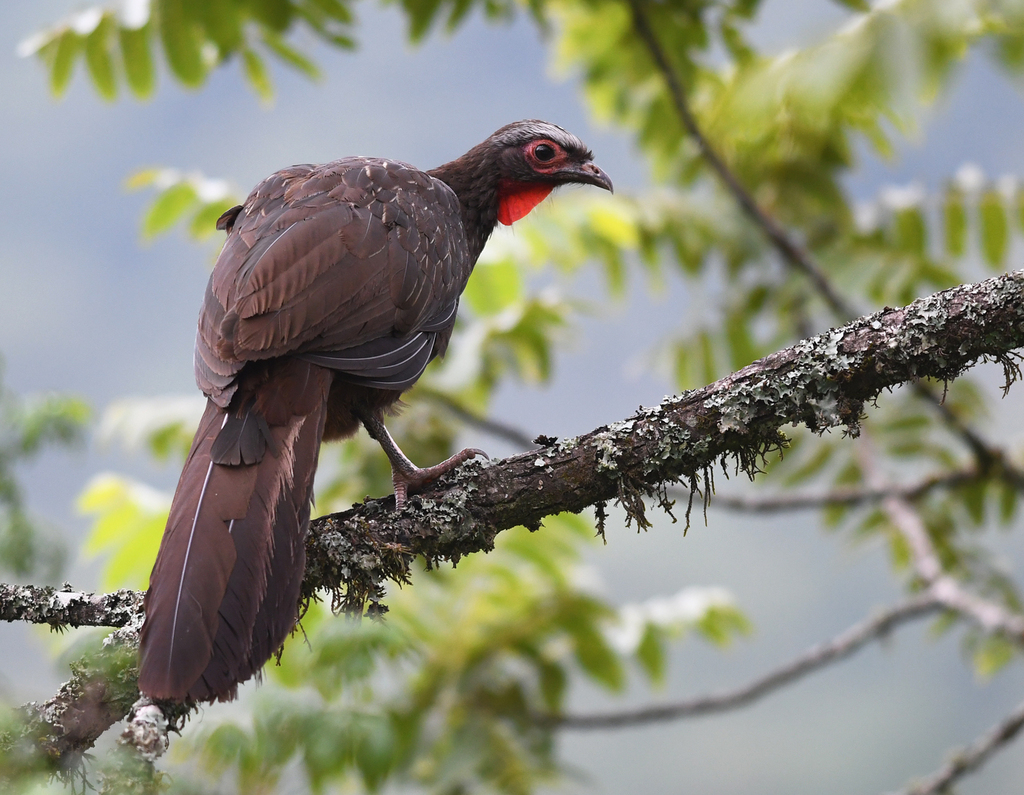
The red-faced guan (Penelope dabbenei) is a species of bird in the Cracidae family. It is found in the border region of northern Argentina and in the southern border region of Bolivia. Its natural habitat is subtropical or tropical moist montane forests.
From the article Red-faced guan on Wikipedia (CC BY-SA), quoted section by section
Description
The red-faced guan is 63 to 69 cm (2.1 to 2.3 ft) long. One female weighed 1,230 g (2.7 lb). It is rich brown overall with white or silvery flecking on the head, breast, and upper back. It has an obvious whitish supercilium, bare pinkish red facial skin, and the red dewlap that is typical of its genus.
Range & habitat
The red-faced guan is found in a narrow band on the east side of the Andes of southern Bolivia and northwestern Argentina. It inhabits the cloudforest of the Yungas region and prefers extensive tracts of large trees. It does occasionally occur in smaller patches or in young secondary forest. In elevation it mainly ranges between 1,800 and 2,500 m (5,900 and 8,200 ft) but sometimes as low as 1,300 m (4,300 ft).
Wikipedia: “Distribution and habitat”
What it does
The red-faced guan usually forages in pairs but larger groups have been reported. It mostly forages in trees but also feeds on the ground. Its diet is mostly fruits and it also eats leaves and arthropods.
Wikipedia: “Feeding”
Listen
Looking for field recordings…
Where it lives
Recorded sightings
—
geo-referenced records in GBIF, from museums, herbaria and field observers.
Drag the globe to turn it. Dots are where records exist, not a range map; darker means more records.
In the stacks
Searching the stacks…
Every page naming Penelope dabbenei in the Biodiversity Heritage Library →
This page is assembled live from iNaturalist, GBIF, Wikipedia, the Source Library and the Internet Archive. It is not yet part of the hand-edited codex. iNaturalist taxon 2069.