On eBird ↗
White-winged Guan
Live sightings near you, the range map, bar charts of when it is seen, and Macaulay Library photos and recordings.
White-winged Guan
Penelope albipennis
The white-winged guan (Penelope albipennis) is a bird in the chachalaca, guan and curassow family Cracidae. It is endemic to northwestern Peru.
From the article White-winged guan on Wikipedia (CC BY-SA), quoted section by section
Description
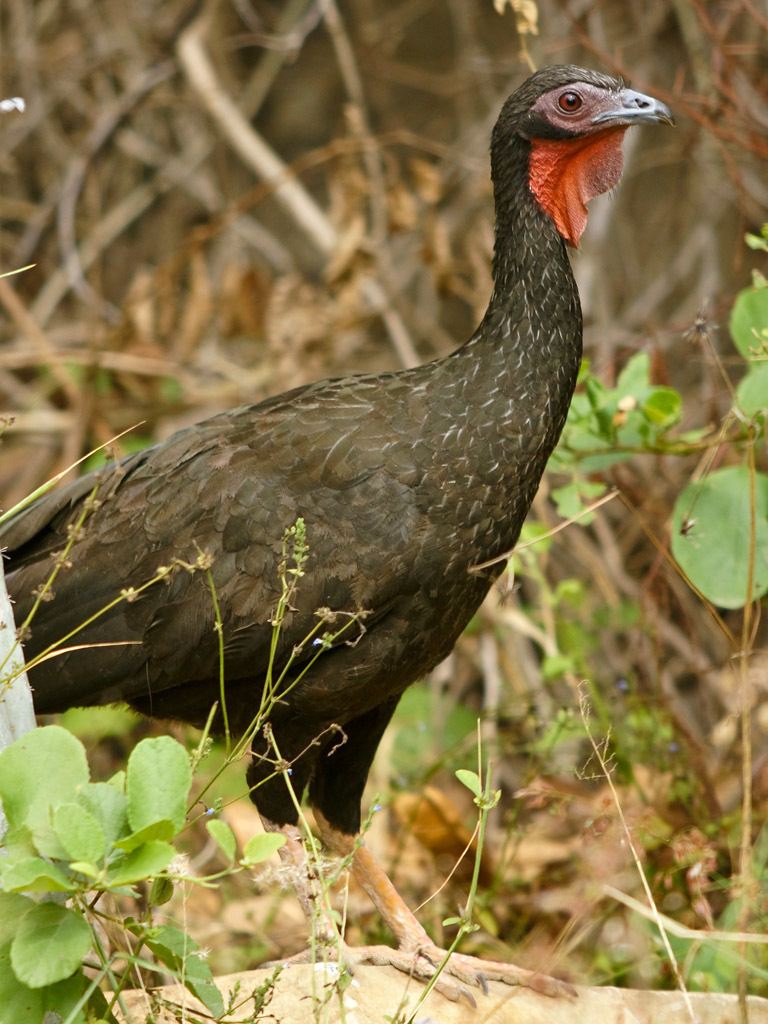
The white-winged guan has an average length of 85.2 cm (2.8 ft) and average weight of 1.6 kg (3.5 lb). It has blackish brown plumage overlain by a green gloss. Much of its forepart has short whitish or pale gray streaks. Its white primaries show as a slash on the folded wing. Its reddish eye is surrounded by bare purple skin, its bill is dark gray with a black tip, and it has an orange dewlap.
Range & habitat
The white-winged guan is now found only in the departments of Lambayeque, Cajamarca, and Piura in northwestern Peru. It is confined to an area that is at most 190 km (120 mi) long and 40 km (25 mi) wide and is divided by a major road and its accompanying human settlement. The 1876 specimen had been collected much further north than the current known area. The white-winged guan inhabits a very specialized landscape, small, forested ravines and nearby slopes on the west side of the Andes. In elevation it generally ranges between 500 and 1,100 m (1,600 and 3,600 ft) but has been reported as low as 300 m (980 ft) and as high as 1,385 m (4,540 ft).
Wikipedia: “Distribution and habitat”
What it does
The white-winged guan is usually found in pairs or family groups, though several groups commonly will feed in one fruiting tree. It eats fruits, flowers, leaves, and seeds. Fruits of Ficus figs and Cordia lutea are the most important part of the diet because they are available during most of the year.
Wikipedia: “Feeding”
In human culture
The white-winged guan was originally known from three specimens collected in 1876 and 1877. It was not positively seen again until 1977, though there had been hints of its continued existence in 1969. Surveys from about 1980 on found individuals in many other locations than the 1977 sightings, though still within a small area.
Wikipedia: “History”
Listen
Looking for field recordings…
Where it lives
Recorded sightings
—
geo-referenced records in GBIF, from museums, herbaria and field observers.
Drag the globe to turn it. Dots are where records exist, not a range map; darker means more records.
In the stacks
Searching the stacks…
Every page naming Penelope albipennis in the Biodiversity Heritage Library →
This page is assembled live from iNaturalist, GBIF, Wikipedia, the Source Library and the Internet Archive. It is not yet part of the hand-edited codex. iNaturalist taxon 2065.