On eBird ↗
Wattled Curassow
Live sightings near you, the range map, bar charts of when it is seen, and Macaulay Library photos and recordings.
Wattled Curassow
Crax globulosa
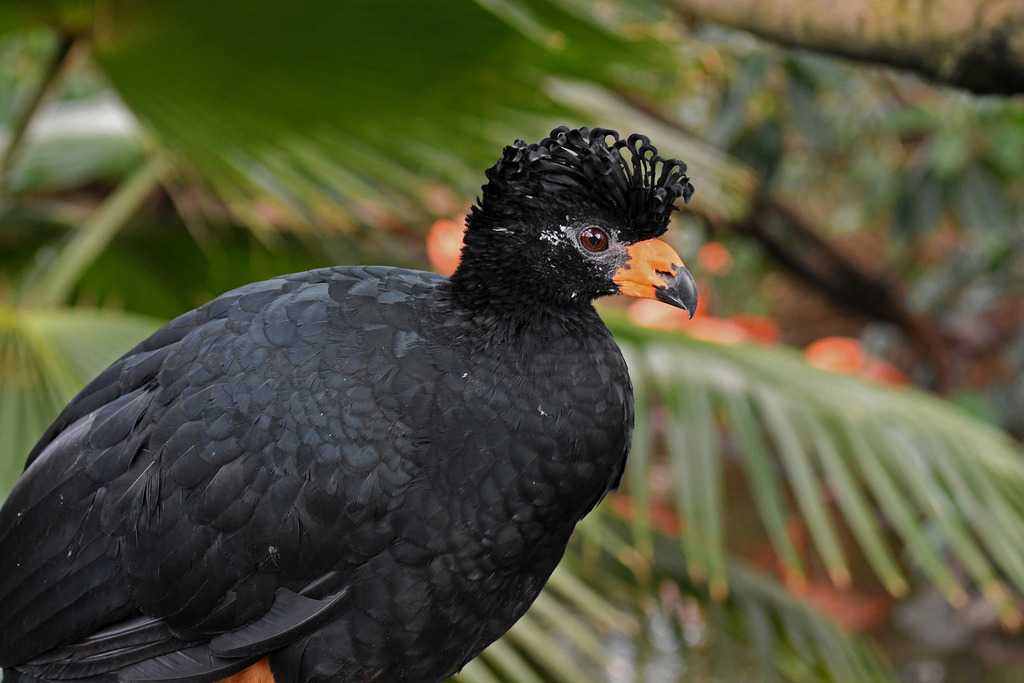
The wattled curassow (Crax globulosa) is a threatened member of the family Cracidae, the curassows, guans, and chachalacas. It is found in remote rainforests in the western Amazon basin in South America. Males have black plumage, except for a white crissum (the area around the cloaca), with curly feathers on the head and red bill ornaments and wattles. Females and juveniles are similar but lack the bill ornamentation and have a reddish-buff crissum area. The wattled curassow is sister to other southern Crax curassows. In captivity, it sometimes hybridises with the blue-billed curassow.
The habitat of the wattled curassow is gallery forests and seasonally-flooded forests where it feeds in small groups on the ground. The diet is largely fruit, but invertebrates and some small vertebrates are opportunistically taken. Little is known of its breeding habits, but it is known that the nest is built of sticks and leaves and two eggs are usually laid. The population of this species is declining. It is threatened by loss of habitat, as the rainforest is progressively cleared, and by hunting, and the International Union for Conservation of Nature has rated its conservation status as "endangered".
From the article Wattled curassow on Wikipedia (CC BY-SA), quoted section by section
Description
The wattled curassow is about 82–89 cm (32–35 in) long, and weighs around 2,500 g (88 oz). It is a large curassow lacking the white tail-tips found in many of these birds; the feathers along the crest of its head are curled forwards. Males have black plumage all over except for the white crissum. The irides are dark brown; legs, feet and bill are blackish. It has conspicuous crimson bill ornaments—a round red knob with bony core adorns the maxilla base, while the cere extends apically at least halfway under this knob and below the mandible base forms a small fleshy wattle. Females have black plumage just like the male, but their crissal area is reddish buff. In some, the remiges and sometimes the wing coverts have faint brownish marbling. Their bills and irides are also blackish, but their feet and legs are a greyish flesh color. They lack the bill knob and wattles, and their cere is bright orange-red. Young males have less well-developed facial ornaments, usually with a more yellowish hue like females do. The hatchlings are covered in brown down above and whitish down below.
Similar species. Adults look very much like those of the red-billed curassow (C. blumenbachii), whose males have only an indistinct maxilla knob. Its females have a blackish cere, rather pale legs and feet, and their wings—particularly the remiges—usually have distinct chestnut brown marbling. …
Range & habitat
It has been found from the western and southwestern Amazon Basin of Brazil west to the Andes foothills of southeastern Colombia, eastern Ecuador and Peru, and northern Bolivia. Its area of occurrence is essentially delimited by the Caquetá-Japurá, Solimões, Amazon and Madeira Rivers, and the 300 meter contour line towards the Andes. But its precise distribution is very little-known; most populations were observed by people travelling along the rivers in its range. Most of the northern limit of its range runs along the middle Amazon River, or Solimões. In northern Peru where the Marañón River becomes the Amazon River (Solimões for Brazilians), close to Nauta, the range continues upstream towards eastern Amazonian Ecuador along the Caquetá-Japurá; it has been recorded from the Yavarí and middle Napo Rivers. It is probably not found anymore in Ecuador proper, and apart from two small populations—Isla Mocagua in the Amazon River and near the Caquetá—it is also absent from Colombia. To the eastern limit of its range, the Madeira River, upstream in Bolivia, the wattled curassow occurs patchily across most of northern Bolivia in a 700 km region surrounding the confluences to the Madeira's tributaries, four major rivers of northern Bolivia. …
Wikipedia: “Distribution”
What it does
The habitat preference of the wattled curassow is not well studied either. Some have found it in terra firme rainforest on higher ground, but it probably occurs there in any numbers only in the wet season when the lowlands are flooded. Most sightings were in gallery forest along rivers and streams (particularly blackwater), seasonally flooded várzea forest, around lakes, and on river islands. Várzea seems to be key habitat for this species, at least seasonally. Mated pairs probably defend a territory as other curassows do, and many seem to be entirely sedentary for their whole life. Young birds would thus have to disperse a bit after growing up, if their parents are still alive. But even then they probably stay in the same general area, moving perhaps a few km/miles from their place of birth at most. As almost all Galliformes do, it eats mostly plant matter, supplemented by some small (typically invertebrate) animals—including at least on occasion crustaceans and fish—but hardly any actual data exists. When foraging, it has been observed to rummage around on the ground less often than other Crax curassows, indicating that it may favor different food items (e.g. …
Wikipedia: “Ecology”
Listen
Looking for field recordings…
Where it lives
Recorded sightings
—
geo-referenced records in GBIF, from museums, herbaria and field observers.
Drag the globe to turn it. Dots are where records exist, not a range map; darker means more records.
In the stacks
Searching the stacks…
Every page naming Crax globulosa in the Biodiversity Heritage Library →
This page is assembled live from iNaturalist, GBIF, Wikipedia, the Source Library and the Internet Archive. It is not yet part of the hand-edited codex. iNaturalist taxon 2049.