On eBird ↗
Indian Scops-Owl
Live sightings near you, the range map, bar charts of when it is seen, and Macaulay Library photos and recordings.
Indian Scops-Owl
Otus bakkamoena
The Indian scops owl (Otus bakkamoena) is a resident species of owl found in the southern regions of Asia from eastern Arabia through the Indian Subcontinent, except the far north, east across much of Southeast Asia to Indonesia. This species formerly included what has been split out as the collared scops owl (Otus lettia). The species epithet is derived from "bakamuna", the Sinhalese name for the white barn owl (Tyto alba), and the brown fish owl...
From the article Indian scops owl on Wikipedia (CC BY-SA), quoted section by section
Description
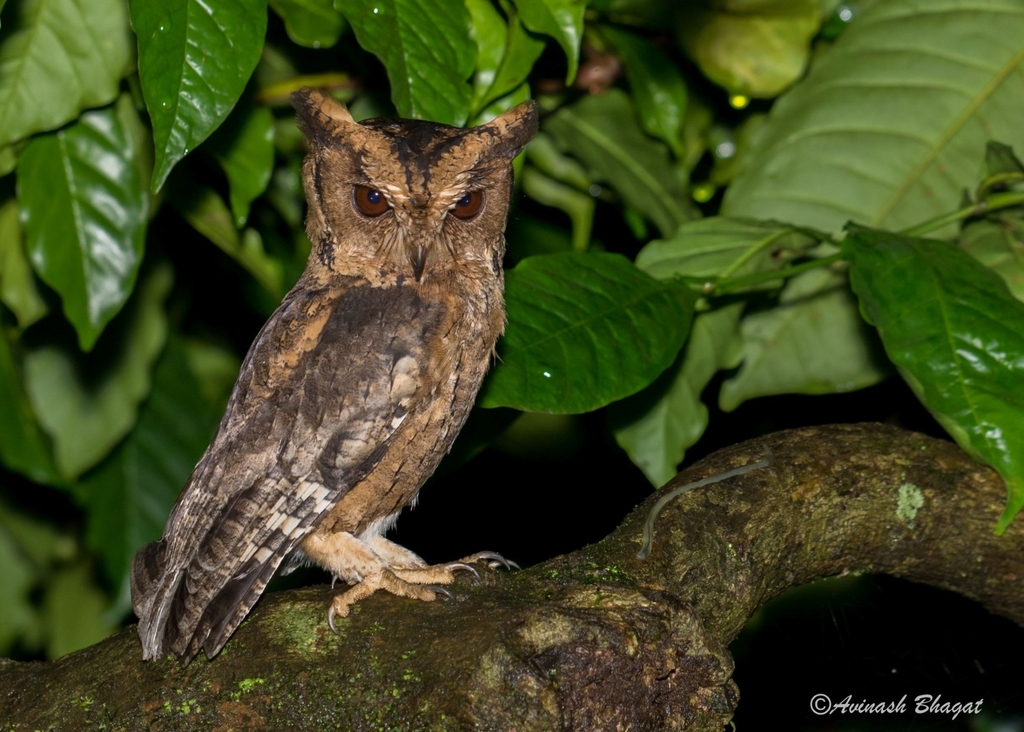
The Indian scops owl is a small 23–25 cm (9.1–9.8 in) owl, although it is one of the largest of the scops owls. Like other scops owls, it has small head tufts, or ears. The upperparts are grey or brown, depending on the morph, with faint buff spotting. The underparts are buff with fine darker streaking. The facial disc is whitish or buff, and the eyes are orange or brown. There is a buff neckband. Sexes are similar. The flight is deeply undulating. This species is very similar to the slightly larger partially migratory collared scops owl (Otus lettia) and the oriental scops owl (Otus sunia). They can be separated on call and eye colour.
Range & habitat
The species occurs from eastern Arabia through the Indian subcontinent, except the far north.
Wikipedia: “Distribution and habitat”
What it does
The Indian scops owl is nocturnal. Through its natural camouflage, it is very difficult to see in daytime, but may sometimes be located by the small birds that mob it while it is roosting in a tree. It feeds mainly on insects. The call is a soft single note ("whuk?"). It nests in tree cavities, laying 3–5 eggs.
Wikipedia: “Ecology”
In human culture
This species formerly included the collared scops owl (Otus lettia). The species epithet is derived from "bakamuna", the Sinhalese name for the eastern barn owl (Tyto javanica), and the brown fish owl (Ketupa zeylonensis).
Wikipedia: “Taxonomy and etymology”
Listen
Looking for field recordings…
Where it lives
Recorded sightings
—
geo-referenced records in GBIF, from museums, herbaria and field observers.
Drag the globe to turn it. Dots are where records exist, not a range map; darker means more records.
In the stacks
Searching the stacks…
Every page naming Otus bakkamoena in the Biodiversity Heritage Library →
This page is assembled live from iNaturalist, GBIF, Wikipedia, the Source Library and the Internet Archive. It is not yet part of the hand-edited codex. iNaturalist taxon 204559.