- Animals
- ›Chordates
- ›Vertebrates
- ›Birds
- ›Hawks, Eagles, Kites, and Allies
- ›Hawks, Eagles, and Kites
- ›Typical Eagles and Hawk-Eagles
- ›Nisaetus
On eBird ↗
Philippine Hawk-Eagle
Live sightings near you, the range map, bar charts of when it is seen, and Macaulay Library photos and recordings.
Philippine Hawk-Eagle
Nisaetus philippensis
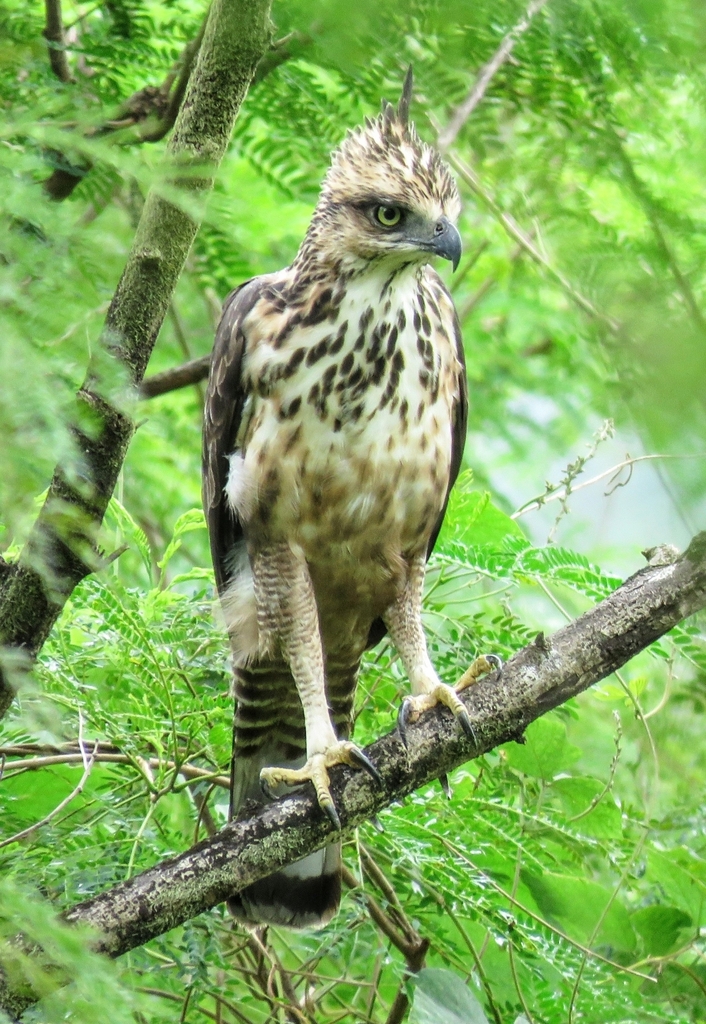
The Philippine hawk-eagle or north Philippine hawk-eagle (Nisaetus philippensis), earlier treated under Spizaetus, is a species of bird of prey in the family Accipitridae. Many taxonmists consider the Pinsker's hawk-eagle, a former subspecies, raised to full species status. It is endemic to the Philippines. Its natural habitat is subtropical or tropical moist lowland forests. It is threatened by habitat loss.
From the article Philippine hawk-eagle on Wikipedia (CC BY-SA), quoted section by section
Description
The Philippine hawk-eagle is a large raptor with a dark brown upper plumage and a pale brown belly. Head and chest are streaked and the lower belly is finely barred. The species has a conspicuous backwards crest. Juveniles are paler. The call a high, screeching "week wik!" or single "week!". It was formerly conspecific with the Pinsker's hawk-eagle but has a shorter crest, larger size, browner plummage and plain markings on the belly. This split was supported by molecular analysis. In terms of size, it is a smaller eagle with a length of 56 to 67 cm, and a wingspan of 105 to 125 cm. One female weighed 1.16 kg. This species is monotypic and has no subspecies.
Wikipedia: “Description and taxonomy”
What it does
The first comprehensive study was conducted of a nesting pair in Rizal in 2020. This nest was livestreamed daily on Facebook. This breeding pair nested in a Bombax ceiba tree in secondary forest with a territory spanning 3.3 square kilometers. Not much information of its diet in the wild but believed to feed mostly on birds and small mammals. The nest in 2020 revealed the diet to consist of 35% birds, 32% mammals, 6% reptiles and the remaining 27% to be unknown. It perches high up in the cannopy but is mostly seen at forest edge or soaring over the forest. Incubation took approximately 3 weeks, in the first to third week the body size doubled every week. In the 4th to 7th week, the development of the feathers and juvenile plummage was observed. Fledging took approximately two months.
Wikipedia: “Ecology and behavior”
Listen
Looking for field recordings…
Where it lives
Recorded sightings
—
geo-referenced records in GBIF, from museums, herbaria and field observers.
Drag the globe to turn it. Dots are where records exist, not a range map; darker means more records.
In the stacks
Searching the stacks…
Every page naming Nisaetus philippensis in the Biodiversity Heritage Library →
This page is assembled live from iNaturalist, GBIF, Wikipedia, the Source Library and the Internet Archive. It is not yet part of the hand-edited codex. iNaturalist taxon 204551.