On eBird ↗
Large-tailed Nightjar
Live sightings near you, the range map, bar charts of when it is seen, and Macaulay Library photos and recordings.
Large-tailed Nightjar
Caprimulgus macrurus
The large-tailed nightjar (Caprimulgus macrurus) is a species of nightjar in the family Caprimulgidae. It is found along the southern Himalayan foothills, eastern South Asia, Southeast Asia and northern Australia. This species is a resident of the countries of Australia, Bangladesh, Bhutan, Brunei, Cambodia, China, India, Indonesia, Laos, Malaysia, Myanmar, Nepal, Pakistan, Papua New Guinea, Philippines, Singapore, Thailand, Timor-Leste and Vietnam. Its natural habitats are subtropical or tropical moist lowland forests, subtropical or tropical mangrove forests,...
From the article Large-tailed nightjar on Wikipedia (CC BY-SA), quoted section by section
Description
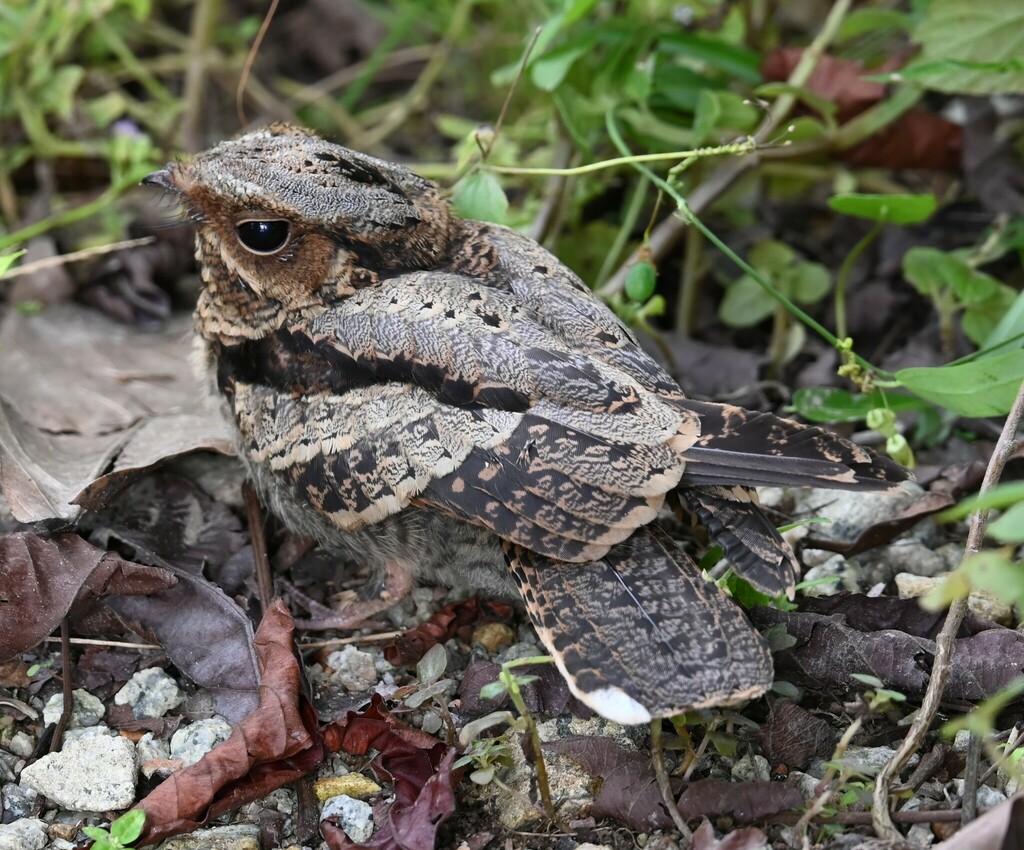
The large-tailed nightjar measures approximately 31.5 to 33 cm in length. The cryptic plumage and colouration of large-tailed nightjars provide effective camouflage within its natural habitat. Males exhibit distinctive markings, characterized by a pale crown with a dark median stripe. A prominent row of black scapular feathers, bordered by broad buff or whitish-buff fringes, enhances their striking appearance. Additionally, males possess a white throat patch and along, broad brown tail marked with uneven dark bars. Large white patches on its primaries and outer tail feathers can be observed in flight. In contrast, females display a paler and greyer plumage compared to males. They have smaller buff-coloured wing patches and less vibrant tail patches, resulting in a drabber appearance.
Range & habitat
The large-tailed nightjar is found across a diverse range of habitats within subtropical and tropical zones. This species is a resident of the countries of Australia, Bangladesh, Bhutan, Brunei, Cambodia, China, India, Indonesia, Laos, Malaysia, Myanmar, Nepal, Pakistan, Papua New Guinea, Philippines, Singapore, Thailand, Timor-Leste and Vietnam. Its distribution spans a wide geographical area, extending from northern India through eastern China and Indonesia to northern Australia. This species commonly inhabits secondary forests, forest edges, plantations, and wooded parks. It has also been observed in agricultural landscapes, where its presence may be of significant economic interest to farmers, as large-tailed nightjars are believed to play a role in the biological control of insect pests.
Wikipedia: “Habitat and distribution”
What it does
The large-tailed nightjar's remarkable camouflage and nocturnal lifestyle pose significant challenges for studying their behaviour and ecology. Similar to other nightjar species, they depend primarily on acoustic communication rather than visual cues for inter-specific and intra-specific communication.
Vocalizations. Songs can be heard year-round, but vocal activity may vary depending on breeding activity, population density, and moon phase. The large-tailed nightjar has a distinctive, monotonous song that it uses to assert its territory. Territorial songs are typically given by males, but there are also reports of females giving these songs. Singing is most notable during courtship and early breeding, primarily taking place from perches or occasionally in pursuit-flights. Long-tailed nightjars also perform grunting calls, which are very different from territorial songs. They are best described as a series of deep, low-pitched "wroww" calls or a series of fast-repeated "wrrrog" or "grrrog" notes.
Diet. Large-tailed nightjars are aerial insectivores. Their diets are primarily composed of beetles, moths, and other flying insects consumed while the bird is in flight. However, there have been a few observations of the large-tailed nightjar walking and pecking at the ground, apparently preying on terrestrial ants. …
Wikipedia: “Behaviour”
Listen
Looking for field recordings…
Where it lives
Recorded sightings
—
geo-referenced records in GBIF, from museums, herbaria and field observers.
Drag the globe to turn it. Dots are where records exist, not a range map; darker means more records.
In the stacks
Searching the stacks…
Every page naming Caprimulgus macrurus in the Biodiversity Heritage Library →
This page is assembled live from iNaturalist, GBIF, Wikipedia, the Source Library and the Internet Archive. It is not yet part of the hand-edited codex. iNaturalist taxon 204476.