- Animals
- ›Chordates
- ›Vertebrates
- ›Birds
- ›Hawks, Eagles, Kites, and Allies
- ›Hawks, Eagles, and Kites
- ›Buteonine Hawks, Kites, and allies
- ›Buteo
On eBird ↗
Common Buzzard
Live sightings near you, the range map, bar charts of when it is seen, and Macaulay Library photos and recordings.
Common Buzzard
Buteo buteo
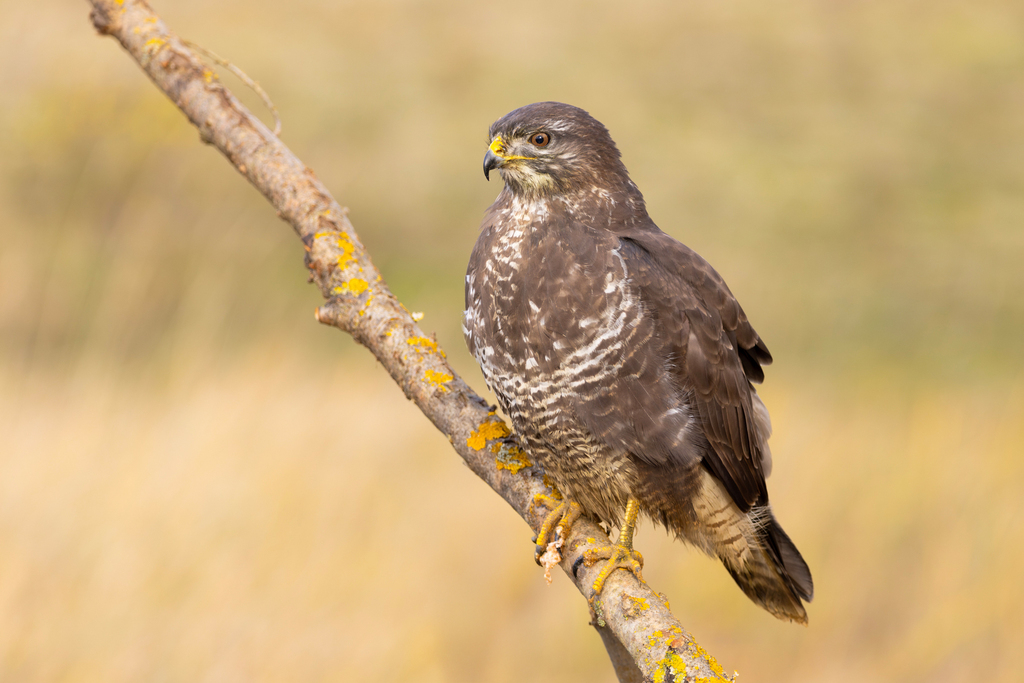
The common buzzard (Buteo buteo) is a medium-sized bird of prey with a large range. It is a member of the genus Buteo in the family Accipitridae. The species lives in most of Europe and extends its breeding range across much of the Palearctic as far as northwestern China (Tian Shan), far western Siberia and northwestern Mongolia. Over much of its range, it is a year-round resident. However, buzzards from the colder parts of the Northern Hemisphere as well as those that breed in the eastern part of their range typically migrate south for the northern winter, many journeying as far as South Africa.
The common buzzard is an opportunistic predator that can take a wide variety of prey, but it feeds mostly on small mammals, especially rodents such as voles. It typically hunts from a perch. Like most accipitrid birds of prey, it builds a nest, typically in trees in this species, and is a devoted parent to a relatively small brood of young. The common buzzard appears to be the most common diurnal raptor in Europe, as estimates of its total global population run well into the millions.
From the article Common buzzard on Wikipedia (CC BY-SA), quoted section by section
Description
The common buzzard is a medium-sized raptor that is highly variable in plumage. Most buzzards are distinctly round headed with a somewhat slender bill, relatively long wings that either reach or fall slightly short of the tail tip when perched, a fairly short tail, and somewhat short and mainly bare tarsi. They can appear fairly compact in overall appearance but may also appear large relative to other more common raptorial birds such as kestrels and sparrowhawks. The common buzzard measures between 40 and 58 cm (1 ft 4 in and 1 ft 11 in) in length with a 109–140 cm (3 ft 7 in – 4 ft 7 in) wingspan. Females average about 2–7% larger than males linearly and weigh about 15% more. Body mass can show considerable variation. Buzzards from Great Britain alone can vary from 427 to 1,183 g (15 oz to 2 lb 10 oz) in males, while females there can range from 486 to 1,370 g (1 lb 1 oz to 3 lb 0 oz).
In Europe, most typical buzzards are dark brown above and on the upperside of the head and mantle, but can become paler and warmer brown with worn plumage. The flight feathers on perched European buzzards are always brown in the nominate subspecies (B. b. buteo). …
Range & habitat
The common buzzard is found throughout several islands in the eastern Atlantic islands, including the Canary Islands and Azores and almost throughout Europe. It is today found in Ireland and in nearly every part of Scotland, Wales and England. In mainland Europe, remarkably, there are no substantial gaps without breeding common buzzards from Portugal and Spain to Greece, Estonia, Belarus and Ukraine, though are present mainly only in the breeding season in much of the eastern half of the latter three countries. They are also present in all larger Mediterranean islands such as Corsica, Sardinia, Sicily and Crete. Further north in Scandinavia, they are found mainly in southeastern Norway (though also some points in southwestern Norway close to the coast and one section north of Trondheim), just over the southern half of Sweden and hugging over the Gulf of Bothnia to Finland where they live as a breeding species over nearly two-thirds of the land. The common buzzard reaches its northern limits as a breeder in far eastern Finland and over the border to European Russia, continuing as a breeder over to the narrowest straits of the White Sea and nearly to the Kola Peninsula. In these northern quarters, the common buzzard is present typically only in summer but is a year-around resident of a hearty bit of southern Sweden and some of southern Norway. …
Wikipedia: “Distribution and habitat”
What it does
The common buzzard is a typical Buteo in much of its behaviour. It is most often seen either soaring at varying heights or perched prominently on tree tops, bare branches, telegraph poles, fence posts, rocks or ledges, or alternately well inside tree canopies. Buzzards will also stand and forage on the ground. In resident populations, it may spend more than half of its day inactively perched. Furthermore, it has been described a "sluggish and not very bold" bird of prey. It is a gifted soarer once aloft and can do so for extended periods but can appear laborious and heavy in level flight, more so nominate buzzards than steppe buzzards. Particularly in migration, as was recorded in the case of steppe buzzards' movement over Israel, buzzards readily adjust their direction, tail and wing placement and flying height to adjust for the surrounding environment and wind conditions. In Israel, migrant buzzards rarely soar all that high (maximum 1,000–2,000 m (3,300–6,600 ft) above ground) due to the lack of mountain ridges that in other areas typically produce flyways; however tail-winds are significant and allow birds to cover a mean of 9.8 m/s (35 km/h; 22 mph; 32 ft/s).
Migration. The common buzzard is aptly described as a partial migrant. …
Wikipedia: “Behaviour”
Listen
Looking for field recordings…
Where it lives
Recorded sightings
—
geo-referenced records in GBIF, from museums, herbaria and field observers.
Drag the globe to turn it. Dots are where records exist, not a range map; darker means more records.
In the old herbals & bestiaries


In the stacks
Searching the stacks…
Every page naming Buteo buteo in the Biodiversity Heritage Library →
This page is assembled live from iNaturalist, GBIF, Wikipedia, the Source Library and the Internet Archive. It is not yet part of the hand-edited codex. iNaturalist taxon 204472.