On eBird ↗
Spotted Eagle-Owl
Live sightings near you, the range map, bar charts of when it is seen, and Macaulay Library photos and recordings.
Spotted Eagle-Owl
Bubo africanus
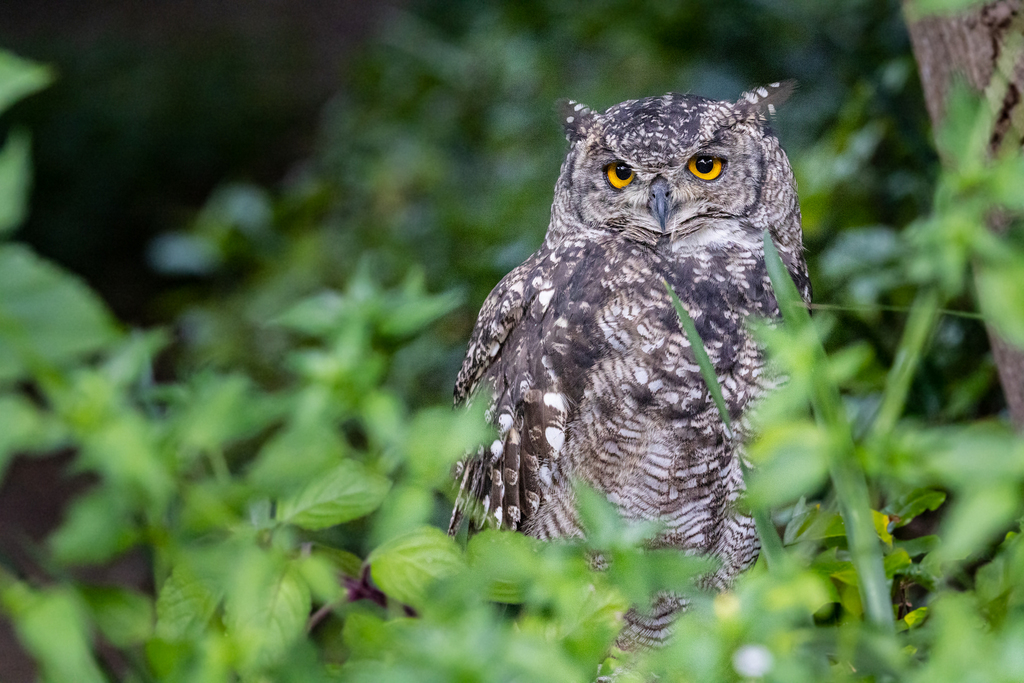
The spotted eagle-owl (Bubo africanus), also known as the African spotted eagle-owl and the African eagle-owl, is a medium-sized species of owl, one of the smallest of the eagle owls. Its length is 45 cm (18 in) and its weight is from 454 to 907 grams (1.0 to 2.0 lb). It has a 100 to 140 cm (39 to 55 in) wingspan. The facial disk is off-white to pale ochre and the eyes are yellow. It has prominent ear-tufts, and the upper body is dusky brown, the lower parts off-white with brown bars. Prior to 1999 the spotted eagle-owl was considered conspecific with the greyish eagle-owl, but now it is classed as a separate species.
From the article Spotted eagle-owl on Wikipedia (CC BY-SA), quoted section by section
Range & habitat
Spotted eagle-owls are the most common species of owl found in Southern Africa. They have a healthy population in most parts of the region. They are often referred to as urban owls and will live in close proximity to human habitation. They occur throughout Sub-Saharan Africa and the Arabian Peninsula. They can also be found in thorn savanna and in suburban gardens, such as the outskirts of Harare, Zimbabwe.
Wikipedia: “Distribution”
What it does
Its prey mainly consists of rodents, small mammals, birds (up to the size of terns and falcons), insects (such as beetles), other arthropods (such as termites, spiders and scorpions), reptiles, frogs and carrion, although it has a dietary preference for small mammals such as rodents, shrews, bats, hedgehogs and young hares. It often swallows its prey whole, with much head-jerking, pausing and resting in between, while a portion of the prey remains inside the mouth, until the prey can finally be swallowed down completely. Undigested substances such as feathers and bone are regurgitated within the next 24 hours of ingestion in the form of a pellet. For prey too large to swallow whole, the owl will tear pieces of meat from the prey, and will also tear shreds to feed nestlings. The male will hunt and bring food when the female cannot leave the nest. Sometimes, even in conditions verging on starvation, he will tear the head off a mouse, but bring the body for the female to feed to the young, or to eat herself if the eggs have not yet hatched. The species is a more generalist feeder, in contrast to say, the barn owls (Tyto) and is accordingly itinerant, remaining in a given region to hunt for a few weeks or months, then moving on when the local prey is no longer plentiful or easy to catch. Typically it will return at odd intervals of a year or two, depending on local conditions. …
Wikipedia: “Diet”
Listen
Looking for field recordings…
Where it lives
Recorded sightings
—
geo-referenced records in GBIF, from museums, herbaria and field observers.
Drag the globe to turn it. Dots are where records exist, not a range map; darker means more records.
In the stacks
Searching the stacks…
Every page naming Bubo africanus in the Biodiversity Heritage Library →
This page is assembled live from iNaturalist, GBIF, Wikipedia, the Source Library and the Internet Archive. It is not yet part of the hand-edited codex. iNaturalist taxon 204470.