- Fungi Including Lichens
- ›Basidiomycete Fungi
- ›Higher Basidiomycetes
- ›Mushrooms, Bracket Fungi, Puffballs, and Allies
- ›Agaricomycetidae
- ›Common Gilled Mushrooms and Allies
- ›Hygrophorineae
- ›Waxcaps and Allies
- ›Hygrocyboideae
- ›Hygrocybeae
- ›Hygrocybe
- ›Pseudohygrocybe
- ›Coccineae
- ›Coccineae
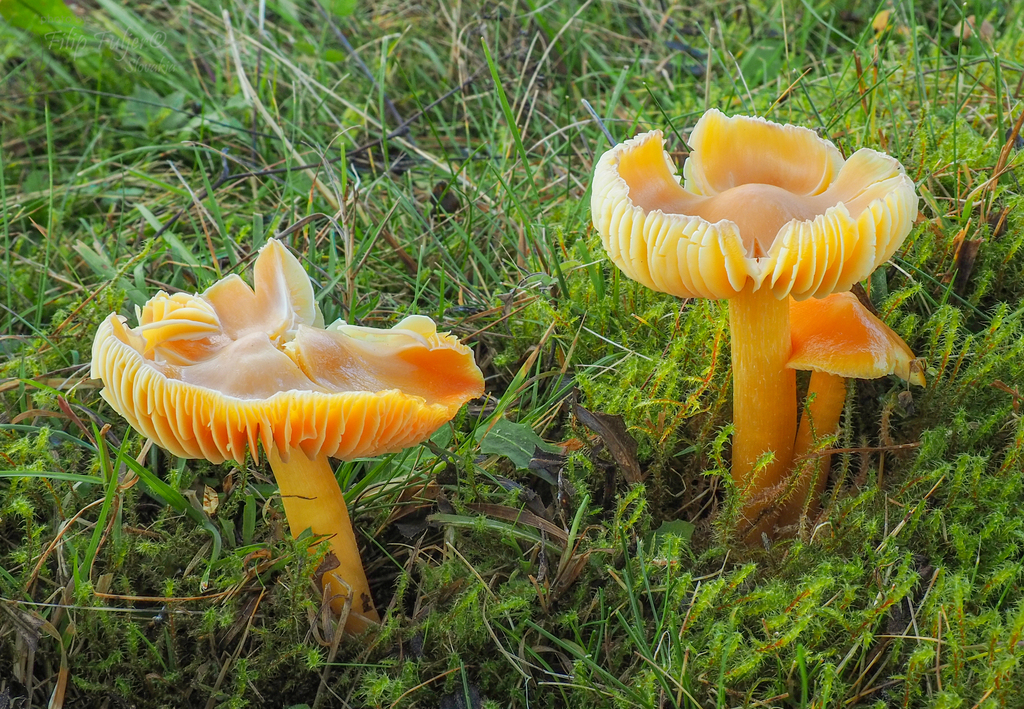
Orange Waxcap
Hygrocybe aurantiosplendens
Hygrocybe aurantiosplendens is an agaric (gilled fungus) in the family Hygrophoraceae. In the United Kingdom, it has been given the recommended English name of orange waxcap. The species has a European distribution and typically occurs in grassland where it produces basidiocarps (fruit bodies) in the autumn. Threats to its habitat have resulted in the species being assessed as globally "vulnerable" on the IUCN Red List of Threatened Species. It has also been reported on both the East and West coasts of North America, but it is uncertain if the American ecotypes are in fact conspecific and they may represent distinct species.
From the article Hygrocybe aurantiosplendens on Wikipedia (CC BY-SA), quoted section by section
Description
The basidiocarps are agaricoid, the cap initially broadly conical maturing to broadly umbonate, yellow-orange to orange-red, turning yellow with age, 2 to 5 cm (1 to 2 in) across, smooth, waxy to viscid when wet, with translucent margins. The lamellae (gills) are cap-coloured or paler, narrowly adnate. The stipe (stem) is yellow, white at base, sometimes tapering from the base, lacking a ring, 3 to 9 cm (1.5 to 3.5 in) long, 0.5 to 1 cm (0.2 to 0.4 in) thick. Microscopically, the spores are 7.5 to 9 by 4 to 5 μm, ellipsoid to oblong, often constricted in the middle, smooth, inamyloid, and the 4-spored basidia are up to 60 μm long. No distinct smell or taste.
Similar Species. Hygrocybe punicea can be similar to H. aurantiosplendens in shape and size, but is distinguished when young by its dark red colour and, when older or faded, by having a rougher stem and larger spores. The commoner Hygrocybe chlorophana is typically smaller, more consistently yellow, and has adnexed gills (narrowly attached to the stipe), not adnate; additionally, fruit bodies often develop pruina near the top of the stipe.
Range & habitat
Like most other European Hygrocybe species, the orange waxcap typically grows in old, nutrient-poor, short-sward grassland (pastures and lawns). Although Hygrocybe species have been thought of as saprotrophic, new evidence points to a biotrophic or symbiotic association with moss. Hygrocybe aurantiosplendens is widespread in Europe yet is rare to uncommon throughout its range. The British Isles and Scandinavia appear to be the regions with the greatest abundance of H. aurantiosplendens, but it also occurs in Finland, Iceland, Western Russia and high elevations in Southern Europe. The American "H. aurantiosplendens" is more typical of woodlands. In Eastern North America its range extends sporadically from Maine south to Florida and west to Northern Wisconsin. On the West Coast it is largely restricted to coastal regions from Northern Washington to Central California, however this western taxon may be distinct enough to be considered its own species.
Wikipedia: “Habitat and distribution”
Where it lives
Recorded sightings
—
geo-referenced records in GBIF, from museums, herbaria and field observers.
Drag the globe to turn it. Dots are where records exist, not a range map; darker means more records.
In the stacks
Searching the stacks…
Every page naming Hygrocybe aurantiosplendens in the Biodiversity Heritage Library →
This page is assembled live from iNaturalist, GBIF, Wikipedia, the Source Library and the Internet Archive. It is not yet part of the hand-edited codex. iNaturalist taxon 203849.