- Animals
- ›Arthropods
- ›Chelicerates
- ›Arachnids
- ›Spiders
- ›Typical Spiders
- ›Entelegyne Spiders
- ›Orbweavers and Allies
- ›Orbweavers
- ›Argiopinae
- ›Argiope
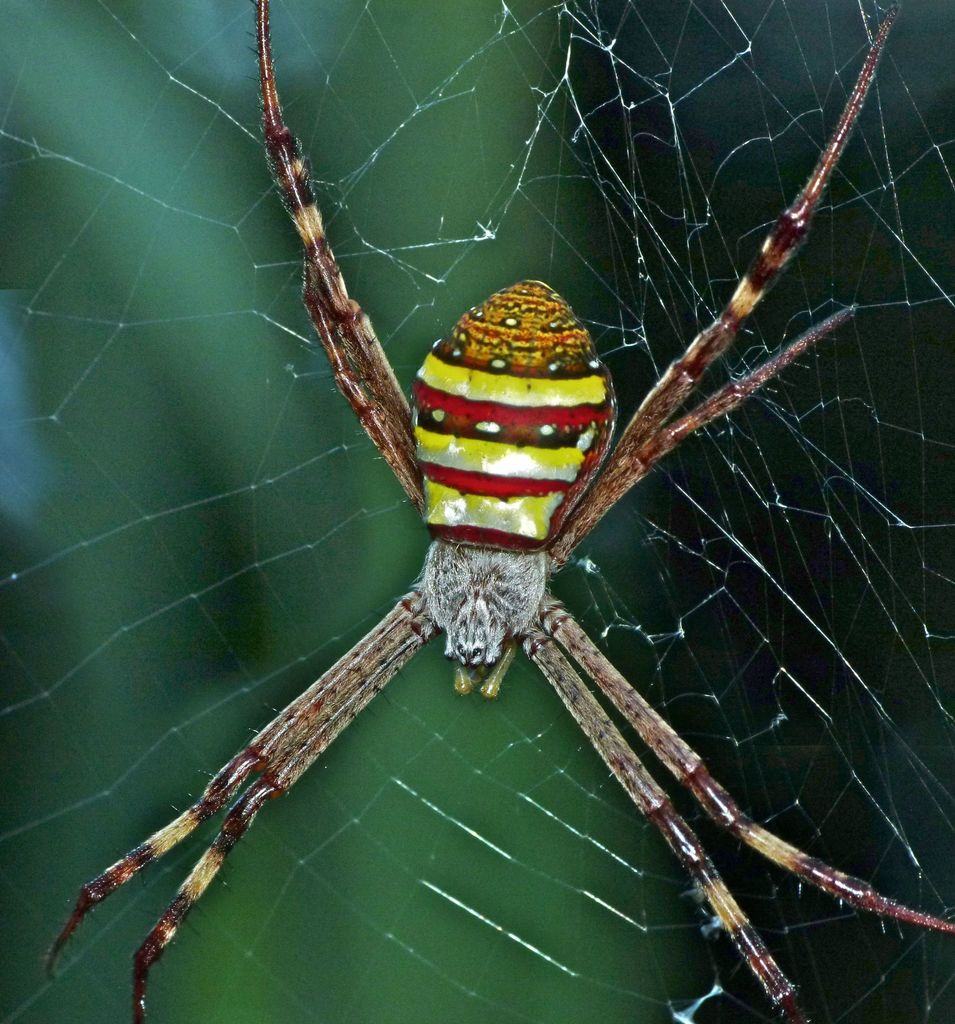
Saint Andrew's Cross Spider
Argiope keyserlingi
Argiope keyserlingi is a species of orb-web spider found on the east coast of Australia, from Victoria to northern Queensland. It is very similar in appearance to a closely related north Queensland species, Argiope aetherea. A. keyserlingi is commonly found in large populations in suburban parks and gardens, particularly among the leaves of Lomandra longifolia. Like many species of orb-web spiders, A. keyserlingi shows considerable sexual dimorphism, with the females being many times larger than the males. Mature females can be seen during the summer, and seeing multiple males on the web of one female is not uncommon.
A. keyserlingi is commonly known as the St. Andrew's cross spider, due to the construction of bands of silk forming the arms of an X-shaped cross, similar to the one upon which St. Andrew is traditionally said to have been crucified. Juveniles of this species sometimes build a spiral-shaped pattern of silk. Referred to as web decorations or stabilimenta, these bands are thought to increase the species' prey capture rate, but as in other species, they have been found to protect the spider against predators.
From the article Argiope keyserlingi on Wikipedia (CC BY-SA), quoted section by section
Description
Females of the species vary from 10 to 16 mm in size. Their glossy carapaces consist of silver, yellow, red, and black bands on their upper segment with two horizontal yellow belts beneath. Males of the species generally vary from 3 to 4 mm in size. They are brown and pearly coloured. St. Andrew's cross spiders rest with their legs oriented in pairs.
Range & habitat
The St Andrew's cross spider can be found mostly in rainforest margins, open forests, and heathlands of eastern Australia. They can also be found in the northern segment of the Northern Territory, in the northern segment of Tasmania, in the western segment of Western Australia, near Tedi River of Papua New Guinea, on the Malakula island of Vanuatu, and on Lord Howe Island. They construct medium-sized webs on low, shrubby vegetation. Individuals tend to prefer closed habitats, with preferences being determined by foliage density and predator density. They avoid placing their webs within or between trees when there is bird presence. Juveniles are exclusively found in closed habitats, likely to avoid insectivores like birds and lizards and to find more favourable vegetation for building webs. A. keyserlingi may move into open habitats as subadults or adults, possibly due to requiring larger prey to sustain growth.
Wikipedia: “Distribution and habitat”
What it does
Prey of the St Andrew's cross spider include flies, moths, butterflies, bees, and other insects. The orb-weaver wraps its prey immaculately with silk before digesting, and smaller prey may be prioritized.
Wikipedia: “Diet”
Where it lives
Recorded sightings
—
geo-referenced records in GBIF, from museums, herbaria and field observers.
Drag the globe to turn it. Dots are where records exist, not a range map; darker means more records.
In the stacks
Searching the stacks…
Every page naming Argiope keyserlingi in the Biodiversity Heritage Library →
This page is assembled live from iNaturalist, GBIF, Wikipedia, the Source Library and the Internet Archive. It is not yet part of the hand-edited codex. iNaturalist taxon 202557.