- Fungi Including Lichens
- ›Basidiomycete Fungi
- ›Higher Basidiomycetes
- ›Mushrooms, Bracket Fungi, Puffballs, and Allies
- ›Russulales
- ›Peniophoraceae
- ›Peniophora
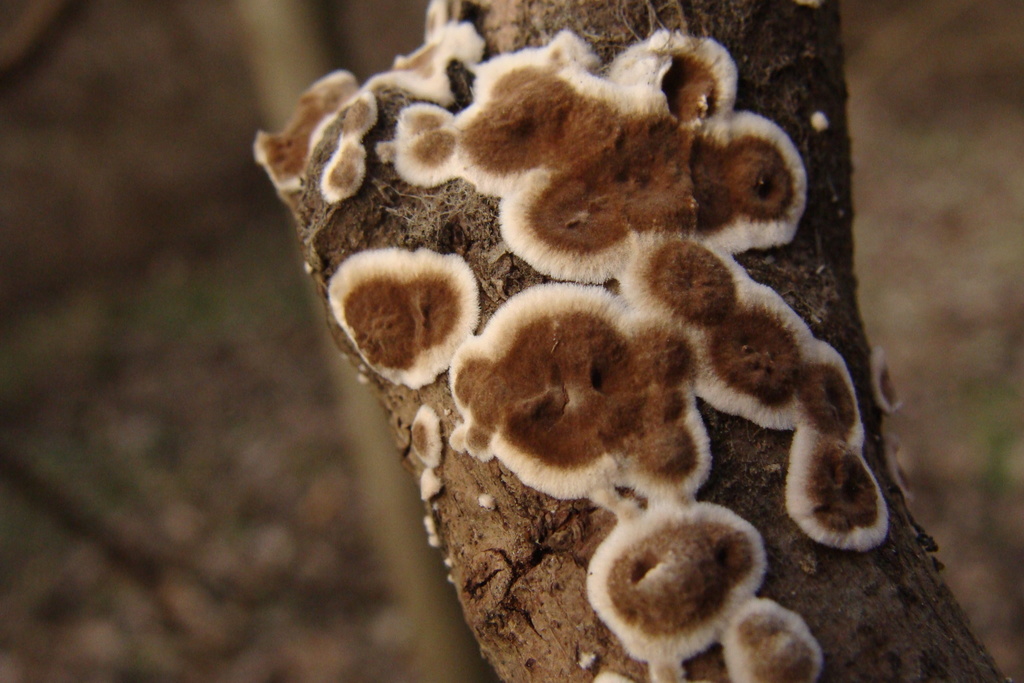
Giraffe Spots
Peniophora albobadia
Peniophora albobadia is a species of crust fungus in the family Peniophoraceae. It is a plant pathogen that affects stone fruits. First described scientifically by Lewis David de Schweinitz in 1822, it was transferred to the genus Peniophora by Jacques Boidin in 1961.
From the article Peniophora albobadia on Wikipedia (CC BY-SA), quoted section by section
Description
The fruiting body is 1–12 centimetres (1⁄2–4+1⁄2 in) across, with brown zones in the center and a fuzzy white margin.
Similar species. A similar-looking species Duportella malenconii has brown caps that peel away. There are few other lookalikes in North America.
What it does
It is a saprobic fungus, forming spreading crusts on the bark of decaying twigs and fallen branches of many hardwood species.
== References ==
Wikipedia: “Ecology”
In human culture
The species epithet is derived from albo-, white, and badi- meaning reddish-brown, the epithet accurately describing the vivid contrast between the fertile area and the margin. The common name, giraffe spots, was coined by a member of the New York Mycological Society, based on specimens found during surveys of the boroughs of New York City.
Wikipedia: “Etymology”
Where it lives
Recorded sightings
—
geo-referenced records in GBIF, from museums, herbaria and field observers.
Drag the globe to turn it. Dots are where records exist, not a range map; darker means more records.
In the stacks
Searching the stacks…
Every page naming Peniophora albobadia in the Biodiversity Heritage Library →
This page is assembled live from iNaturalist, GBIF, Wikipedia, the Source Library and the Internet Archive. It is not yet part of the hand-edited codex. iNaturalist taxon 202437.