On eBird ↗
Melanesian Megapode
Live sightings near you, the range map, bar charts of when it is seen, and Macaulay Library photos and recordings.
Melanesian Megapode
Megapodius eremita
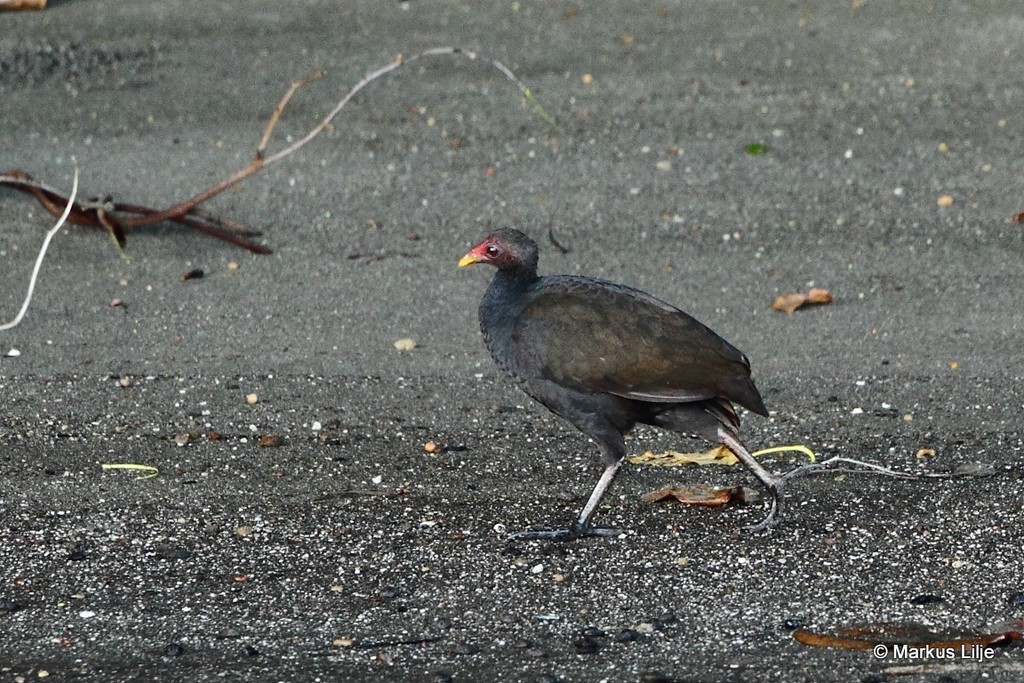
The Melanesian scrubfowl or Melanesian megapode (Megapodius eremita) is a megapode species that is endemic to islands within Melanesia. The Melanesian scrubfowl has a unique strategy of egg incubation in which it relies on environmental heat sources. This bird species is culturally important for Indigenous peoples in Melanesia.
From the article Melanesian megapode on Wikipedia (CC BY-SA), quoted section by section
Description
Similar to other megapodes, Melanesian scrubfowl have a stout body shape, characteristically large feet, and rounded wings. Scrubfowl, including M. eremita, also have very short tails, giving the birds a distinctive silhouette lacking a visible tail. Adult Melanesian scrubfowl measure around 34 to 39 cm and have a short crest. The Melanesian scrubfowl has three different plumage types during its lifecycle: the juvenile plumage of chicks, a second immature plumage, and adult plumage. Adult birds have a brown back; dark grey head, neck and underparts; brown-, grey- or olive-coloured legs; red patches of bare skin on the face (notably on the forehead); and a yellow bill-tip. Females and males cannot easily be distinguished visually but the female may have lighter-coloured legs and a brighter brown colour. The plumage of M. eremita chicks is dark brown with paler underparts, obvious barring on their upperparts and includes flight feathers. Megapode hatchlings are relatively large (proportionally to adults) (no average sizes are reported for M. eremita chicks but Jones et al. (1995) observed an 11 cm hatchling). The second immature plumage closely resembles the adult but often has darker colours. …
Range & habitat
All megapodes are found in Australasia, and, within this region, the Melanesian scrubfowl has an island distribution encompassing the Bismarck Archipelago and Solomon Islands. The Melanesian scrubfowl lives on small and large islands, and is fairly common (although more or less so throughout its range). The Melanesian scrubfowl moves between different habitat types required for breeding and for foraging. With its specialised nesting behaviour (see § Reproduction, below), the Melanesian scrubfowl uses breeding grounds where the substrate can be or is heated by environmental heat sources. Common breeding grounds include sandy beaches warmed by the sun, geothermal sites (i.e., heat from Earth's interior surfacing around volcanoes), and in soils with decaying organic matter. The Melanesian scrubfowl preferably forages in lowland rainforests with large trees, an open understorey, a thick surface layer of dead plant material and deep soils. In some parts of its range, the Melanesian scrubfowl travels between and uses different habitats as a response to seasonal changes. For example, in West New Britain, scrubfowl use north coast breeding grounds during the local dry season (from late March and December) and avoid these areas during the local rainy season when the site becomes flooded.
Wikipedia: “Distribution and habitat”
What it does
The Melanesian scrubfowl is thought to be socially monogamous but their social behaviour, including pair bonds, is not well documented. However, the family Megapodiidae are well known for their unique nesting strategies in which they lay eggs in mounds or burrows where heat from the environment and not from the body ensures the development of embryos. The nesting behaviour of the Melanesian scrubfowl varies considerably throughout its range with the species using either burrows or mounds, and relying on heat from various sources including decomposition, volcanism, and sunshine. The use of mounds by the Melanesian scrubfowl is poorly studied while the burrowing activity of Melanesian scrubfowl has been more widely documented. Where mound-nesting occurs, Melanesian scrubfowl build large, volcano-shaped mounds with soil or sand, and leaves. Information specific to M. eremita is unavailable, but studies on other megapodes show that the heating of mounds depends primarily on the decomposition of the organic matter (and, sometimes, partly on solar radiation) and that one or both sexes tend the mound, regularly adding in more organic matter. In contrast, burrow-nesters choose nesting sites that are already heated through geothermal energy, solar radiation or the decomposition of tree roots. …
Wikipedia: “Reproduction”
Listen
Looking for field recordings…
Where it lives
Recorded sightings
—
geo-referenced records in GBIF, from museums, herbaria and field observers.
Drag the globe to turn it. Dots are where records exist, not a range map; darker means more records.
In the stacks
Searching the stacks…
Every page naming Megapodius eremita in the Biodiversity Heritage Library →
This page is assembled live from iNaturalist, GBIF, Wikipedia, the Source Library and the Internet Archive. It is not yet part of the hand-edited codex. iNaturalist taxon 2024.