- Animals
- ›Chordates
- ›Vertebrates
- ›Mammals
- ›Therians
- ›Placental Mammals
- ›Afromammals
- ›Proboscideans
- ›Elephants
- ›Mammuthus
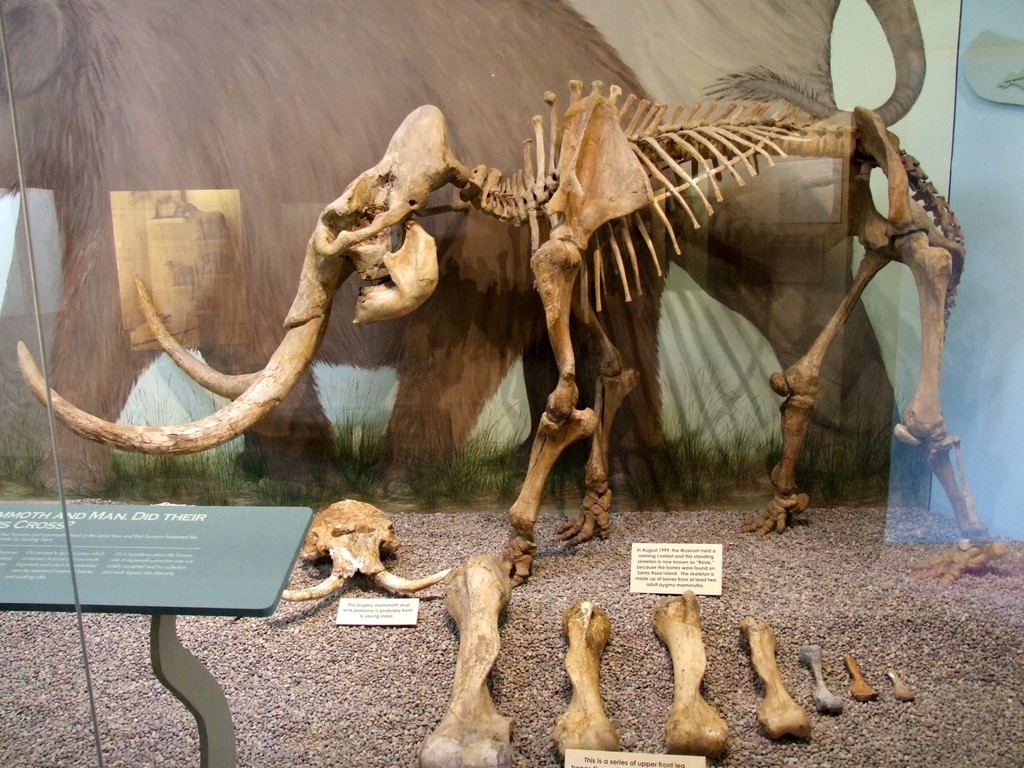
Channel Islands Pygmy Mammoth
Mammuthus exilis
The pygmy mammoth or Channel Islands mammoth (Mammuthus exilis) is an extinct species of dwarf mammoth native to the northern Channel Islands off the coast of southern California during the Late Pleistocene. It was descended from the Columbian mammoth (M. columbi) of mainland North America, which are suggested to have colonised the islands around 250–150,000 years ago. At only 1.72–2.02 m (5.6–6.6 ft) tall at the shoulder, it was around 17% the size of its mainland ancestor. The species became extinct around 13,000 years ago, coinciding with major environmental change and the arrival of humans in the Channel Islands.
From the article Pygmy mammoth on Wikipedia (CC BY-SA), quoted section by section
Description
M. exilis was, on average, 1.72–2.02 m (5.6–6.6 ft) tall at the shoulders and 760–1,350 kg (1,680–2,980 lb) in weight, making it around 17% of the body size of its 3.72–4.2 m (12.2–13.8 ft) tall, 9.2–12.5 t (9.1–12.3 long tons; 10.1–13.8 short tons) ancestor. Like other mammoths, the species exhibited sexual dimorphism, with males being larger than females. The limb bones of the species show isometric growth (preserving length-width ratio) from juveniles to adults, similar to those of living African elephants. In comparison to Columbian mammoths, the femur has a rounded rather than elliptical cross-section, and lacks a lateral tuberosity. The tusks are relatively straight and are around 50% the length and diameter of those of Columbian mammoths.
Range & habitat
Remains of M. exilis have been discovered on three of the northern Channel Islands of California: Santa Cruz, Santa Rosa, and San Miguel, which together with Anacapa were the highest portions of the now mostly submerged superisland of Santa Rosae which existed during times of lowered sea level. The area of the combined island has been estimated at 2,200 square kilometres (850 sq mi), though the area of the island fluctuated as a result of glacial cycles.
Wikipedia: “Distribution”
What it does
During the Last Glacial Period, the mega-island of Santa Rosae is thought to have been forested with coniferous trees of cypress, douglas fir and pine. Dental microwear analysis suggests that species had a primarily browsing based diet on leaves and twigs, as opposed to the more grazing focused diet of its Columbian mammoth ancestors. In comparison to its larger ancestor, it likely had the ability to ascend somewhat steeper slopes. The island exhibited a depauperate fauna that lacked large predators. The Channel Islands fox was not present on the islands during the time of the pygmy mammoth, having only arrived on the islands around 7,300 years ago.
Wikipedia: “Habitat and ecology”
Listen
Looking for field recordings…
Where it lives
Recorded sightings
—
geo-referenced records in GBIF, from museums, herbaria and field observers.
Drag the globe to turn it. Dots are where records exist, not a range map; darker means more records.
In the stacks
Searching the stacks…
Every page naming Mammuthus exilis in the Biodiversity Heritage Library →
This page is assembled live from iNaturalist, GBIF, Wikipedia, the Source Library and the Internet Archive. It is not yet part of the hand-edited codex. iNaturalist taxon 201603.