On eBird ↗
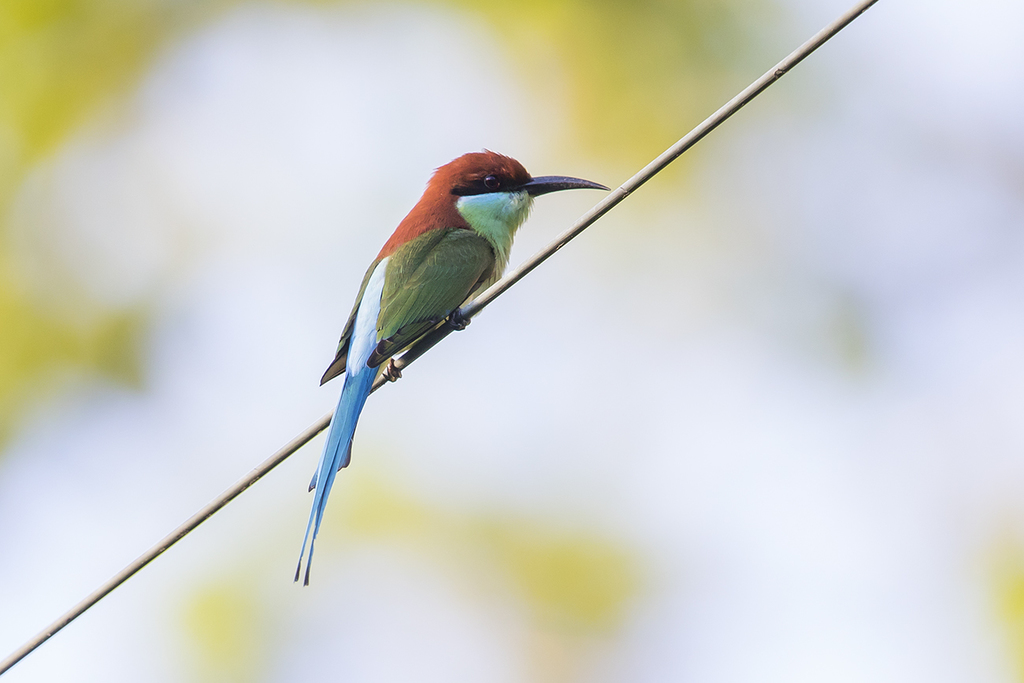
Rufous-crowned Bee-eater
Live sightings near you, the range map, bar charts of when it is seen, and Macaulay Library photos and recordings.
Rufous-crowned Bee-eater
Merops americanus
The rufous-crowned bee-eater (Merops americanus) is a species of bird in the family Meropidae. It is endemic to the Philippines, where it is widely distributed. Despite its scientific name, it is not found in the New World, and its name is likely erroneous.
From the article Rufous-crowned bee-eater on Wikipedia (CC BY-SA), quoted section by section
Description
It was previously considered a subspecies of the blue-throated bee-eater (M. viridis), but was split as a distinct species by the IUCN Red List and BirdLife International in 2014, and the International Ornithological Congress followed suit in 2022. It is still confused with M. viridis as it is still called blue-throated bee-eater by many including eBird. It differs from M. viridis in having a red-brown crown and mantle (rather than dark brown), and a paler greenish-blue throat and cheeks (rather than dark blue).
Wikipedia: “Description and taxonomy”
Range & habitat
It inhabits open country and clearings adjacent to forested areas, including over scrub and cogon fields, using dead trees and telephone wires as perches. The IUCN Red List has assessed this bird as least-concern species as it is common and is able to tolerate open habitat.
== References ==
Wikipedia: “Habitat and conservation status”
What it does
This specific species has yet to be studied in depth. This species is presumed to be an insectivore, and true to its name feeds heavily on bees. This species is considered a pest by bee-keepers. This species breeds from February to May in communal nest burrows on sloping ground and banks. These tunnels go as far as 1 m deep. Average clutch size 3 to 5 eggs.
Wikipedia: “Ecology and behavior”
Listen
Looking for field recordings…
Where it lives
Recorded sightings
—
geo-referenced records in GBIF, from museums, herbaria and field observers.
Drag the globe to turn it. Dots are where records exist, not a range map; darker means more records.
In the stacks
Searching the stacks…
Every page naming Merops americanus in the Biodiversity Heritage Library →
This page is assembled live from iNaturalist, GBIF, Wikipedia, the Source Library and the Internet Archive. It is not yet part of the hand-edited codex. iNaturalist taxon 201077.