On eBird ↗
Puerto Rican Nightjar
Live sightings near you, the range map, bar charts of when it is seen, and Macaulay Library photos and recordings.
Puerto Rican Nightjar
Antrostomus noctitherus
The Puerto Rican nightjar, Puerto Rican whip-poor-will or guabairo (Antrostomus noctitherus) is a bird in the nightjar family found in the coastal dry scrub forests in localized areas of southwestern Puerto Rico. It was described in 1916 from bones found in a cave in north central Puerto Rico and a single skin specimen from 1888, and was considered extinct until observed in the wild in 1961. The current population is estimated as 1,400-2,000 mature birds, which is presumed to be a stable size for this species; therefore, even though it faces pressures from habitat loss it is currently classified as Vulnerable.
From the article Puerto Rican nightjar on Wikipedia (CC BY-SA), quoted section by section
Description
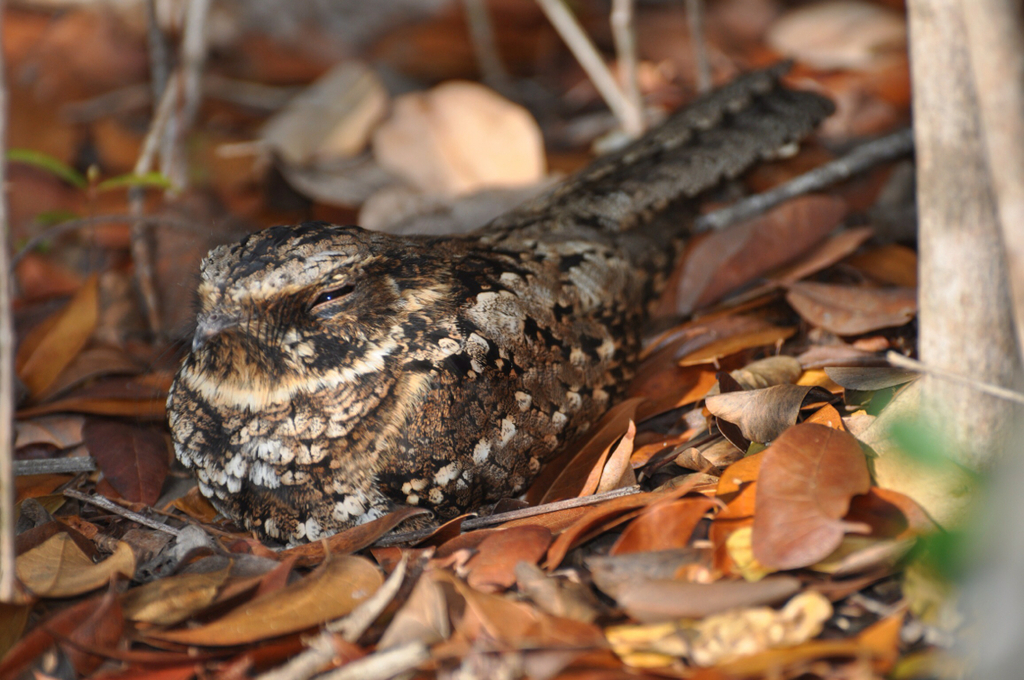
Puerto Rican nightjars, whose song is composed of rapid "whip" notes, are small birds about 22–23 cm in length, weighing 39–41 g. Similar to the Antillean nighthawk, the species has a mottled, black, brown and gray colored plumage which serves as camouflage while the bird is perched on the ground. Males have a black throat with a white thin horizontal line. There are white spots on the lower part of the tail which are visible in flight. Females are of a buff rather than white coloration. Puerto Rican nightjars have large, dark black eyes, a short gray bill, and gray tarsi. Like all nightjars, they possess stiff bristles around the beak to help with the capture of insects in flight.
Range & habitat
The species is likely to have historically occurred in moist limestone and coastal forests in northern Puerto Rico, in addition to the current range of dry limestone, lower cordillera and dry coastal forest. The nightjar is presently mostly found in closed canopy dry forest on limestone soils with abundant leaf litter and an open understory. Lower densities are present in open scrubby forests. Populations have so far been confirmed in three locations in the southwest of the island: Susúa State Forest, Guánica Dry Forest and Guayanilla Hills. The first nesting record of the Puerto Rican nightjar in Maricao State Forest was reported in 2005.
Wikipedia: “Distribution and habitat”
What it does
The Puerto Rican nightjar feeds on beetles, moths and other insects that it catches in flight. It nests on the ground under closed canopies and needs an abundant leaf layer to hold the eggs. The peak months for nesting activity are April–June. The clutch is usually of 1–2 eggs, which are light brown with darker brown or purple patches. The eggs have an incubation period of 18–20 days and are primarily incubated by the male. The chicks are a cinnamon downy color and they start to fly at about 14 days after hatching. Like many ground-nesting birds, the nightjar will try to divert the attention of potential predators away from the nest by conspicuously flying away and vibrating its wings. The species may be permanently territorial.
Wikipedia: “Ecology”
In human culture
The Puerto Rican nightjar was first discovered as a single skin specimen found in the Northern part of Puerto Rico in 1888, and rediscovered and correctly identified in 1916 when bones were discovered in a cave in northern Puerto Rico. The species was originally considered already extinct at the time of its discovery. Confirmation of living specimens only occurred in 1961 in the Guánica Dry Forest. Detailed studies of the species started in 1969.
Wikipedia: “History”
Listen
Looking for field recordings…
Where it lives
Recorded sightings
—
geo-referenced records in GBIF, from museums, herbaria and field observers.
Drag the globe to turn it. Dots are where records exist, not a range map; darker means more records.
In the stacks
Searching the stacks…
Every page naming Antrostomus noctitherus in the Biodiversity Heritage Library →
This page is assembled live from iNaturalist, GBIF, Wikipedia, the Source Library and the Internet Archive. It is not yet part of the hand-edited codex. iNaturalist taxon 201070.