On eBird ↗
Malaysian Eared-Nightjar
Live sightings near you, the range map, bar charts of when it is seen, and Macaulay Library photos and recordings.
Malaysian Eared Nightjar
Lyncornis temminckii
The Malaysian eared nightjar or Malay eared nightjar (Lyncornis temminckii) is a species of nightjar in the family Caprimulgidae. It was formerly placed in the genus Eurostopodus. It is known as Taptibau Kecil in Bahasa melayu or Tukang Tabtibau amongst Malaysian indigenous communities. It is dispersed throughout Southeast Asia, primarily occurring in Malaysia, Sumatra, Borneo, Thailand, Indonesia and Singapore. It is a nocturnal insectivorous bird characterised by cryptic colouration of brown and white patterns, to aid it in camouflaging into its environment. Due to the nocturnal nature and feeding habits, it prefers subtropical, tropical and moist lowland forests, and have been recorded from sea-level to 1065 meters. It is easily distinguished by its 'ear-tufts,' giving it an "eared" appearance which led to its name.
From the article Malaysian eared nightjar on Wikipedia (CC BY-SA), quoted section by section
Description
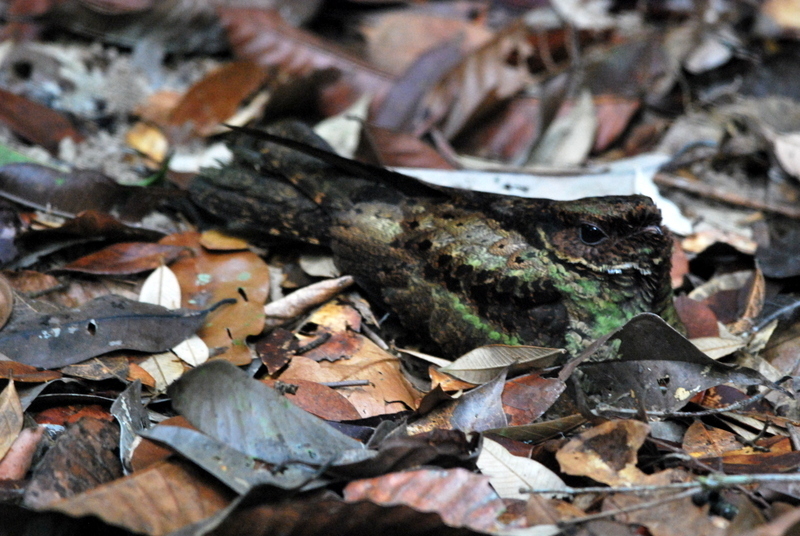
Malaysian eared nightjars are medium-sized within the Lyncornis genus, ranging between 25-28 cm in length. They are smaller than their sister species, the great eared nightjar but larger than most Caprimulgidae birds. Their plumage is cryptically coloured, with deep patterns of browns, black and greys to aid them with camouflaging into the night when they are most actively foraging, whilst also making them difficult to spot while they are resting during the day. Their bodies are buff, tawny (orange-red) and blackish-brown with white speckles along their wings and a white throat patch or white spot on their lower throat, countering their dark body. They have 'ear-tufts,' which are distinctive hair patches at the rear-end of their crown. These ear-tufts stand up when the bird is erect, allowing them to be easily identified, but lie flat when the bird is laying down or crouching into itself, thus allowing them to evade predators. They also have a reflective layer of tissue in their eye known as tapetum lucidum, which gives them night vision by reflecting visible light to the back of their eyes via the retina. With a long wingspan of 197-218 mm and a long tail of 121-218 mm, Malaysian eared nightjars are also powerful and spry fliers.
Adult male. The forehead, crown and nape of an adult male Malaysian eared nightjar is greyish-brown and cinnamon-brown. …
Wikipedia: “Description and identification”
Range & habitat
Due to their insectivorous diet, Malaysian eared nightjars prefer lowland forests, forest edges and dense subtropical and tropical forests. Their distribution spans Southeast Asia, with notable populations in Malaysia where they are found both in the Peninsula and Malaysian Borneo, recorded to inhabit forests characterised by tall hardwood trees, alluvial forests, grassland, swamplands and dense rainforests. The Malaysian eared nightjars are also largely found in Sumatra, where they occur in both primary and secondary forests. The species is also present across Indonesia, Singapore, Thailand and a small population exists in Southern Myanmar. The varied habitats in which the Malaysian eared nightjars are distributed throughout suggests their superior ability to niche partition and adapt to their environments, whether pristine or human-altered.
Wikipedia: “Habitat and distribution”
What it does
The Malaysian eared nightjar are nocturnal species who are inconspicuous and difficult to identify during the day due to their secretive and sedentary nature. They usually roost on the ground, camouflaging into the leaf-litter and woods. Although they occur in lowlands, during dusk, they tend to fly high in the air at elevations above 1000 meters, and hold their wings vertically in a V formation. This is done to intimidate their prey and signify to conspecifics they are commencing foraging. Subsequently, they descend and move swiftly to hunt for food, calling to each other in groups and landing on trees, posts or dead branches to snatch and hunt insects.
Wikipedia: “Diurnal and nocturnal behaviour”
Listen
Looking for field recordings…
Where it lives
Recorded sightings
—
geo-referenced records in GBIF, from museums, herbaria and field observers.
Drag the globe to turn it. Dots are where records exist, not a range map; darker means more records.
In the stacks
Searching the stacks…
Every page naming Lyncornis temminckii in the Biodiversity Heritage Library →
This page is assembled live from iNaturalist, GBIF, Wikipedia, the Source Library and the Internet Archive. It is not yet part of the hand-edited codex. iNaturalist taxon 201063.