On eBird ↗
Rufous Owl
Live sightings near you, the range map, bar charts of when it is seen, and Macaulay Library photos and recordings.
Rufous Owl
Ninox rufa
The rufous owl (Ninox rufa), also known as the rufous boobook, is a species of owl in the family Strigidae. It was described in 1846 by John Gould, an English ornithologist. Its common name reflects the rufous-coloured feathers that these owls are covered with in adulthood. While it is uncommon, the species has a wide range, including Australia, Indonesia, and Papua New Guinea.
The rufous owl is a large owl species, ranging in weight from 700 to 1,700 g (25 to 60 oz), depending on sex and age. It is only slightly smaller than the largest owl in Australia, the powerful owl (Ninox strenua), which typically weighs between 1,050 and 1,700 g (37 and 60 oz). The rufous owl is a generalist nocturnal predator and generally solitary. It is seldom aggressive to humans except in situations in which it feels its nest or offspring are threatened.
From the article Rufous owl on Wikipedia (CC BY-SA), quoted section by section
Description
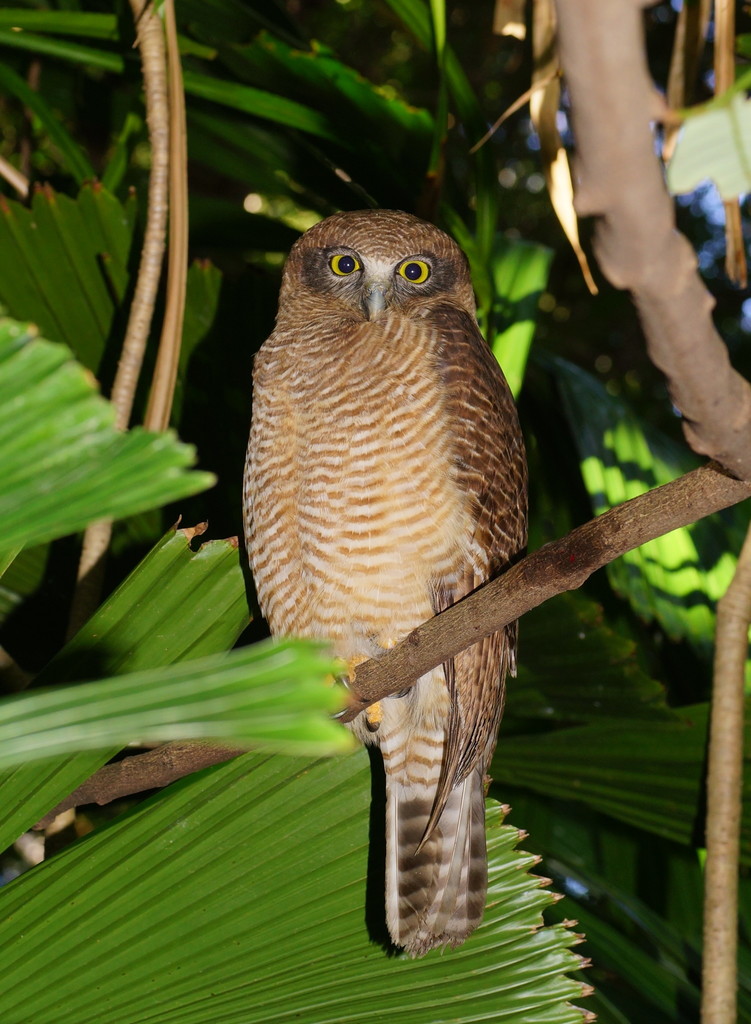
The rufous owl is a large bird, often growing to 46–57 cm (18–22 in) in length, with a wingspan of 100 to 120 cm (39 to 47 in). Females typically weigh 700–1,050 g (25–37 oz), while the males typically weigh 1,050–1,300 g (37–46 oz). Both sexes have relatively small heads compared to their body and tail, but the head of the male is flatter and broader than that of the female. Juveniles are much smaller, usually 49–54 mm (1.9–2.1 in) long at birth, and are covered in downy white pelage. The forehead, neck, back, and upper wings of the adults are usually a dark reddish-brown with light brown barring scattered throughout. The face is dark brown, and the neck, breast and underparts are rufous with thin cream bars. The underside of the wings are light brown with thick cream bars. The hooked bill is light grey and is surrounded by black bristles at its base. It has golden-yellow eyes.
Range & habitat
The rufous owl has a wide geographic range. It is native to the Aru Islands, New Guinea and northern Australia, where it is found in Arnhem Land, the northern Kimberleys, the eastern Cape York Peninsula, and the Mackay Region of eastern Queensland. It is the only exclusively tropical owl in Australia. The global population size of Ninox rufa has yet to be determined, but the species is considered uncommon to rare. The owl inhabits terrestrial ecosystems. It is mainly found in rainforests and the margins of rainforests. Additional habitats may include other forests, moist savannas, and inland wetlands.
Wikipedia: “Distribution and habitat”
What it does
Rufous owls are characterised by having rather shy and elusive natures but are known to become aggressive if threatened. They are almost exclusively nocturnal birds and will remain in their nest or roost during the day. They are generally not very vocal, except during the breeding season. During this time, males and females will communicate to one another using calls of various pitches. The voice of the female is of a higher pitch than the male's.
Breeding. The rufous owl has a regular breeding season from June to September, depending on the warmth of its habitat. To initiate breeding, the male will utter a double call which will attract a female to him. As she flies toward him, the female will give excited trills in return. Eggs are typically laid in a nest located in the trunks or limbs of trees. Some nests are built as high as thirty meters above the ground in order to protect them from ground-dwelling predators. The male owl will select the nest and the female will lay one or two eggs inside. The eggs require 37 days of incubation. Once hatched, the young owls are dependent on their parents for many months, often until the following breeding season. The adult males and females will both aggressively defend their nests against predators and intruders while the young still reside inside.
Feeding. …
Wikipedia: “Behaviour”
Listen
Looking for field recordings…
Where it lives
Recorded sightings
—
geo-referenced records in GBIF, from museums, herbaria and field observers.
Drag the globe to turn it. Dots are where records exist, not a range map; darker means more records.
In the stacks
Searching the stacks…
Every page naming Ninox rufa in the Biodiversity Heritage Library →
This page is assembled live from iNaturalist, GBIF, Wikipedia, the Source Library and the Internet Archive. It is not yet part of the hand-edited codex. iNaturalist taxon 20104.