On eBird ↗
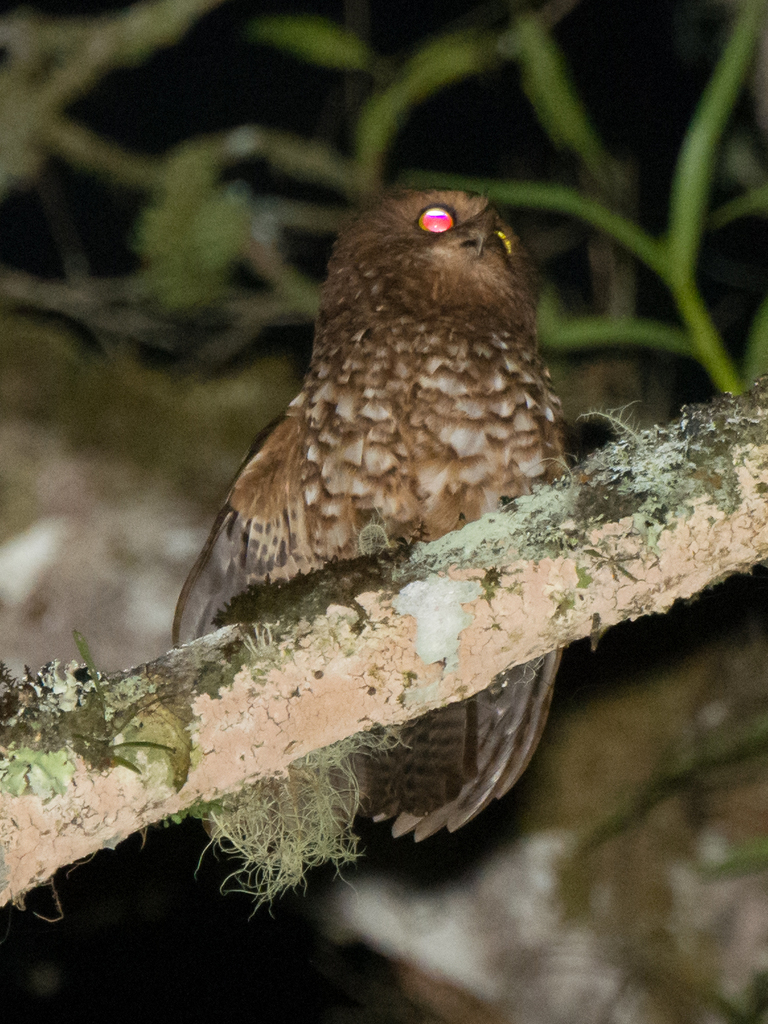
Cinnabar Boobook
Live sightings near you, the range map, bar charts of when it is seen, and Macaulay Library photos and recordings.
Cinnabar Boobook
Ninox ios
The cinnabar boobook (Ninox ios) also known as the cinnabar hawk owl, is a hawk owl endemic to the island of Sulawesi, Indonesia. It was described as a new species to science by American ornithologist Pamela C. Rasmussen in 1999 based on a single specimen collected by Frank Rozendaal from Bogani Nani Wartabone National Park on Minahassa Peninsula, northern Sulawesi, in 1985. Subsequently, it has also been observed in Lore Lindu National Park in central Sulawesi,...
From the article Cinnabar boobook on Wikipedia (CC BY-SA), quoted section by section
Description
The cinnabar boobook was described as a new species to science by American ornithologist Pamela C. Rasmussen in 1999 based on a single specimen collected by Frank Rozendaal from Bogani Nani Wartabone National Park on Minahassa Peninsula, northern Sulawesi, in 1985. It's taxonomic name comes from the Greek word ios (ἰός), meaning "rust," in reference to the color of its plumage. Subsequently, it has also been observed in Gunung Ambag Nature Reserve, also in northern Sulawesi, and in Lore Lindu National Park in central Sulawesi.
Wikipedia: “Description and distribution”
What it does
The four known records of the species indicate it is a nocturnal forest-dwelling species living at mid-altitudes of 1,100 to 1,700 m (3,600 to 5,600 ft). It spends most of its time in the middle or upper canopy. The cinnabar boobook is an insectivore which catches insects in flight. It is capable of hovering for several seconds. The call of the cinnabar boobook, was described by one researcher as "a dry, nasal, hissing, shriek," similar to that of a barn owl.
Wikipedia: “Ecology and behavior”
Listen
Looking for field recordings…
Where it lives
Recorded sightings
—
geo-referenced records in GBIF, from museums, herbaria and field observers.
Drag the globe to turn it. Dots are where records exist, not a range map; darker means more records.
In the stacks
Searching the stacks…
Every page naming Ninox ios in the Biodiversity Heritage Library →
This page is assembled live from iNaturalist, GBIF, Wikipedia, the Source Library and the Internet Archive. It is not yet part of the hand-edited codex. iNaturalist taxon 20103.