On eBird ↗
New Britain Boobook
Live sightings near you, the range map, bar charts of when it is seen, and Macaulay Library photos and recordings.
New Britain Boobook
Ninox odiosa
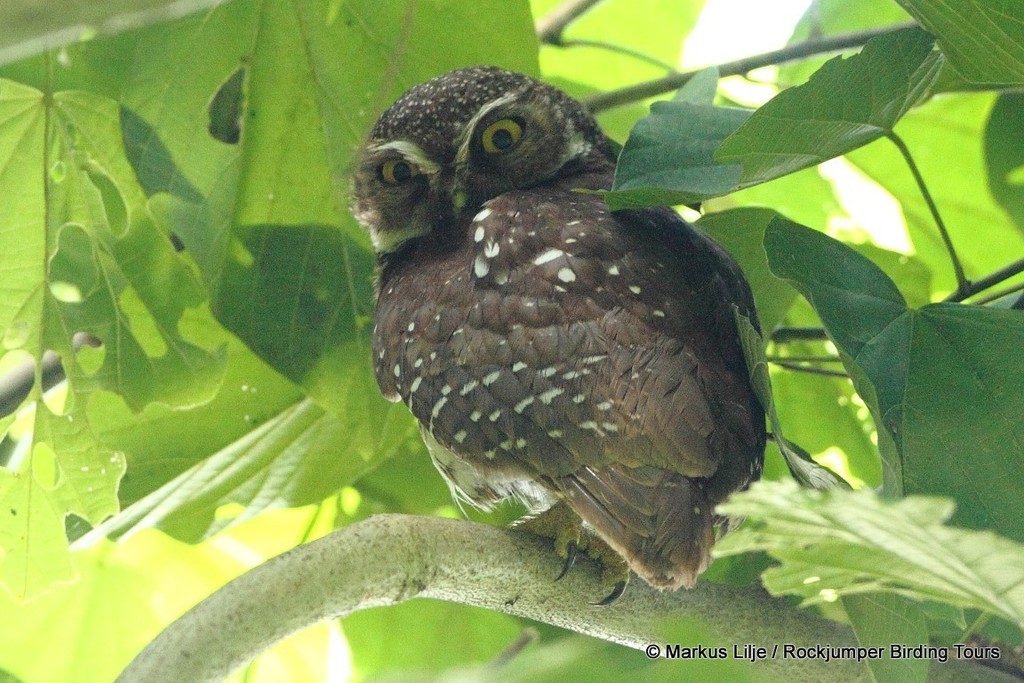
The New Britain boobook (Ninox odiosa), also known as the spangled boobook, russet boobook, New Britain hawk-owl or russet hawk-owl, is a small owl that is endemic to New Britain, the largest island in the Bismarck Archipelago in Papua New Guinea.
From the article New Britain boobook on Wikipedia (CC BY-SA), quoted section by section
Description
The New Britain boobook is a small owl that grows to a length of about 22 cm (9 in). It has finely spotted chocolate-brown plumage, golden eyes and white eyebrows. Its facial disk is brown while the upper breast is marked with a wide brown band with buff or white barrings. The underparts are densely spotted brown. Its call is a series of rapidly repeated "whoo"s, starting at a low pitch which rises and becomes faster and louder.
Range & habitat
This species is found in the lowlands and hills of the New Britain and New Ireland endemic bird areas at elevations of up to 1,200 m (3,940 ft) asl. It is fairly common in its small range and is nocturnal. It roosts during the day alone or in pairs in the middle to upper parts of the forest canopy. It feeds mainly on insects and small mammals.
Wikipedia: “Distribution and habitat”
Listen
Looking for field recordings…
Where it lives
Recorded sightings
—
geo-referenced records in GBIF, from museums, herbaria and field observers.
Drag the globe to turn it. Dots are where records exist, not a range map; darker means more records.
In the stacks
Searching the stacks…
Every page naming Ninox odiosa in the Biodiversity Heritage Library →
This page is assembled live from iNaturalist, GBIF, Wikipedia, the Source Library and the Internet Archive. It is not yet part of the hand-edited codex. iNaturalist taxon 20100.