On eBird ↗
Cape Eagle-Owl
Live sightings near you, the range map, bar charts of when it is seen, and Macaulay Library photos and recordings.
Cape Eagle-Owl
Bubo capensis
The Cape eagle-owl (Bubo capensis) is a species of owl in the family Strigidae. It is one of several large species of the eagle-owl genus Bubo.
From the article Cape eagle-owl on Wikipedia (CC BY-SA), quoted section by section
Description
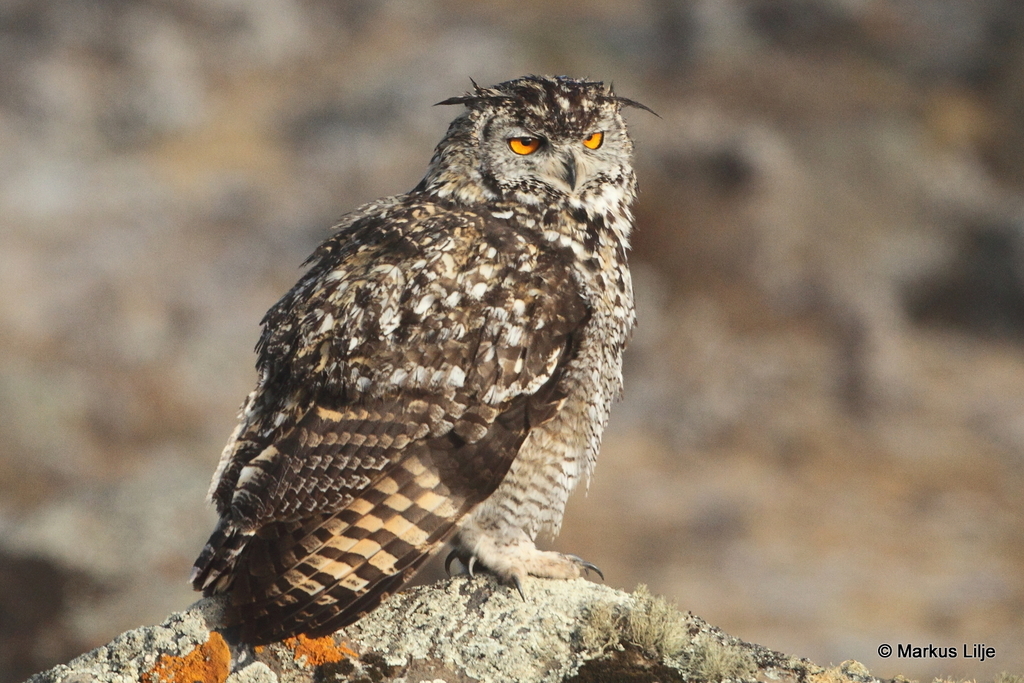
This is a large owl, though intermediate in size among other large Bubo owls. Its total length ranges from 46 to 61 cm (18 to 24 in). Males weigh from 905 to 1,387 g (32 to 49 oz) while the larger females range from 1,240 to 1,800 g (44 to 63 oz). The wing chord measures 34.3–41.8 cm (13.5–16.5 in) while the tail measures 15.5–26.6 cm (6.1–10.5 in). This owl is dark brown above with prominent ear-tufts and yellow or yellowish-orange eyes. It is dark below with the sides of the breast being blotchy brown and the paler chest overlaid with white, black and tawny-fulvous markings, variously. The facial disc is fulvous-brown, with a distinct black or dark brown frame that becomes broader towards the neck. Both the tail and wing feathers are barred with light and dark brown. The toes and tarsi are densely feathered, with the little visible skin being brown above and yellowish below the feet. The song of the male Cape eagle-owl consists of a powerful, explosive hoot, followed by a faint note: boowh-hu. The female's voice is similar but slightly higher pitched. Pairs on occasion will duet. When approaching a female during courtship, the male will let out a trisyllabic cu-coo-cu while bowing to his mate. Both females and young give a nasal, drawn-out chrrreeh while begging for food at the nest. Females cluck slightly while offering food to their young. …
Range & habitat
Its range is limited to the southernmost regions of southern Africa as well as parts of East Africa. Claims that this species is found in the southern Arabian Peninsula are erroneous and presumably due to confusion with Bubo milesi.
Wikipedia: “Range”
What it does
The Cape eagle-owl is nocturnal, roosting by day among rocks, in sheltered rock ledges, or in large rock crevices and caves. They may also roost in trees or even on the ground amongst dense bushes. They have been rarely found roosting in cities like Johannesburg and Pretoria. Often a male and female can be found roosting together, especially just before the breeding season. The predominant prey for the species is mammals. These can range in size from shrews and small rodents to animals the size of hyraxes which are heavier than the birds themselves. Other important prey can include other birds, up to the size of francolins and hamerkops. Opportunistically, the Cape eagle-owl will supplement its diet with reptiles, frogs, scorpions, crabs and large insects. Mole rats are locally often a favorite prey item and 1 to 3 mole rats can be taken each night during the breeding season. A pair with half-grown chicks requires about 600–750 g (1.32–1.65 lb) per night. Hunts are from prominent perches, with the owl gliding in descending flight after prey and killing them with their powerful talons or bill. These territorial owls may exist in close proximity where populations are dense, occurring at 2.5 km2 (2,500,000 m2). The male advertises the territory by calling, with duets being rare in this species. During courtship, the male bows and hoots in front of the upright, silent female. …
Wikipedia: “Behaviour”
Listen
Looking for field recordings…
Where it lives
Recorded sightings
—
geo-referenced records in GBIF, from museums, herbaria and field observers.
Drag the globe to turn it. Dots are where records exist, not a range map; darker means more records.
In the stacks
Searching the stacks…
Every page naming Bubo capensis in the Biodiversity Heritage Library →
This page is assembled live from iNaturalist, GBIF, Wikipedia, the Source Library and the Internet Archive. It is not yet part of the hand-edited codex. iNaturalist taxon 20095.