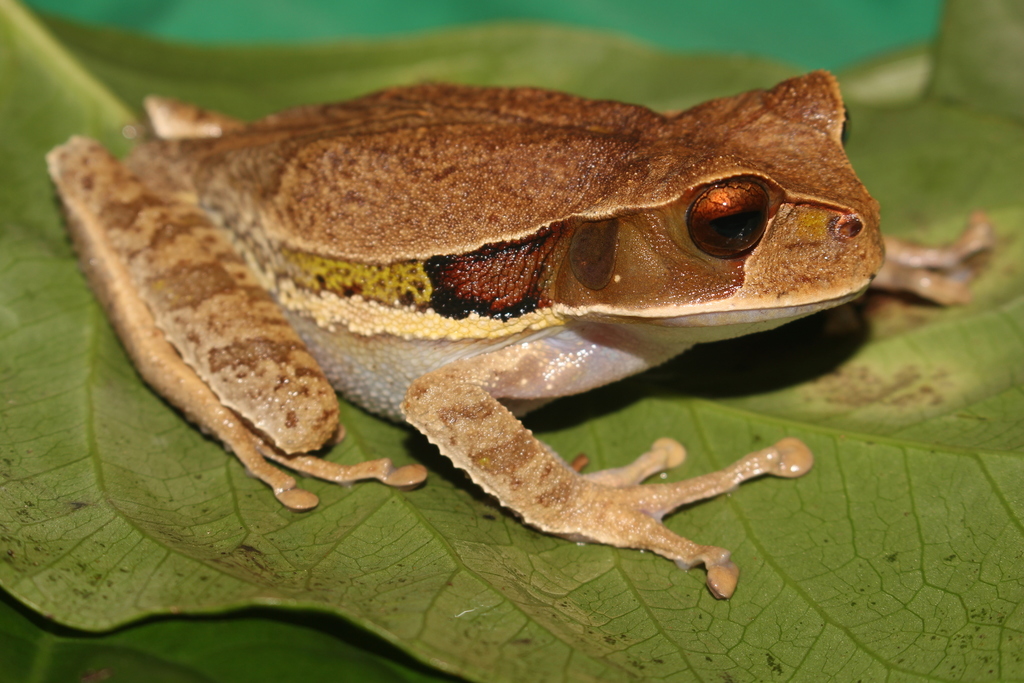
Gastrotheca recava
Gastrotheca recava is a species of frog in the family Hemiphractidae. It is endemic to Brazil.
From the article Gastrotheca recava on Wikipedia (CC BY-SA), quoted section by section
Description
The adult male frog measures 57.08–75.41 mm in snout-vent length and the adult female frog 67.21–84.92 mm. The skin of the dorsum is light brown to beige in color with brown chevrons oriented anteriorly. There is a thin brown intraorbital line. There is a brown line from the nostril to each eye all the way to the ear. There is a red-brown line from the head that fades as it gets to the end of the body. There is a white line from over the mouth to the groin. The dorsal surfaces of the four legs have dark brown lines going across. The hidden surfaces of the hind legs has darker marks.
Range & habitat
This frog lives in closed-canopy primary and secondary forest. People have seen the frog sitting on branches 10 cm (3.9 in) to 500 cm (200 in) above the ground. It has little tolerance to habitat disturbance but has been seen on cacao farms where people have preserved tree cover to provide shade. Scientists have seen the frog between 0 m (0 ft) and 530 m (1,740 ft) above sea level. Scientists have reported the frog in protected places.
Wikipedia: “Habitat”
What it does
The female frog carries her eggs in a pouch on her back. The young emerge as froglets about 0.8 g (0.028 oz) in size.
Wikipedia: “Reproduction”
In human culture
Scientists gave this frog the species name recava because it is Latin for "arched inward." The frog's skull bones arch inward.
Wikipedia: “Etymology”
Listen
Looking for field recordings…
Where it lives
Recorded sightings
—
geo-referenced records in GBIF, from museums, herbaria and field observers.
Drag the globe to turn it. Dots are where records exist, not a range map; darker means more records.
In the stacks
Searching the stacks…
Every page naming Gastrotheca recava in the Biodiversity Heritage Library →
This page is assembled live from iNaturalist, GBIF, Wikipedia, the Source Library and the Internet Archive. It is not yet part of the hand-edited codex. iNaturalist taxon 199733.