On eBird ↗
Sumatran Ground-Cuckoo
Live sightings near you, the range map, bar charts of when it is seen, and Macaulay Library photos and recordings.
Sumatran Ground-Cuckoo
Carpococcyx viridis
The Sumatran ground cuckoo (Carpococcyx viridis) is a large, terrestrial species of cuckoo endemic to the forests of Sumatra in Indonesia. It was first described in 1879 and, despite being identified as a separate species in the 1880s, was formerly considered conspecific with the Bornean ground cuckoo until recently being returned to the status of a unique species. Considered endangered species by the IUCN Red List, it was initially known from just eight specimens and evaded notice from 1916 until 1997, when it was rediscovered and photographed. The Sumatran ground cuckoo's diet is thought to consist of invertebrates, small mammals, and reptiles.
From the article Sumatran ground cuckoo on Wikipedia (CC BY-SA), quoted section by section
Description
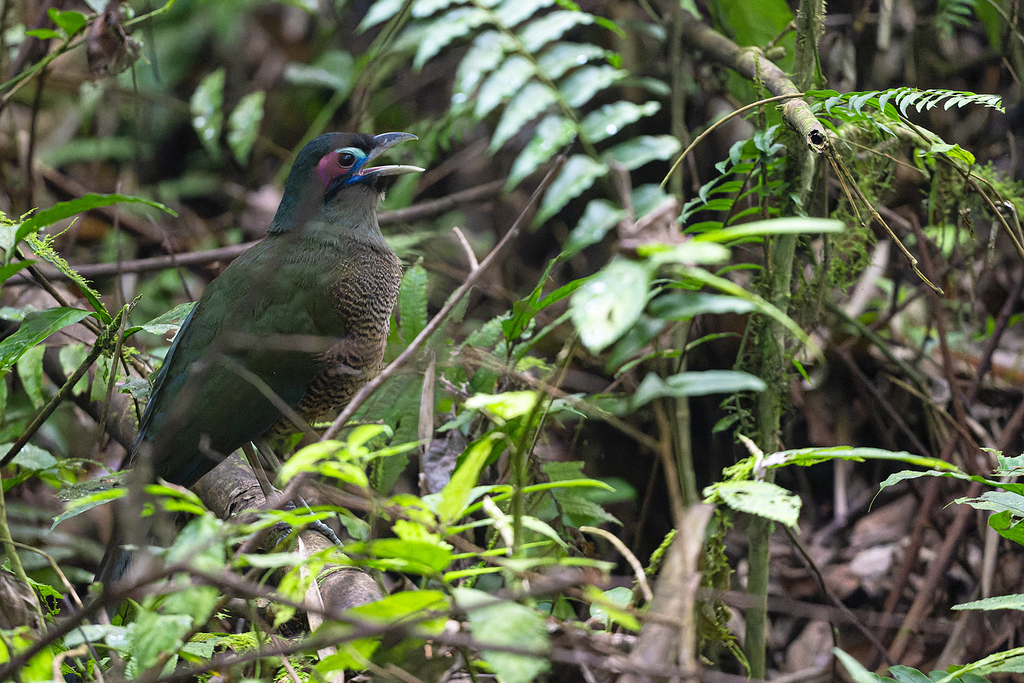
The Sumatran ground cuckoo is a large bird of about 55 cm (22 in) in length. Its wings and long, full tail are glossy greenish-black, while its mantle, upper back, neck sides, lower throat, upper breast, covert feathers, and secondary feathers are dull green. Its crown is black, and the bare skin around its eyes are hues of green, lilac, and blue. Its bill and legs are green, and its underparts below the upper breast are cinnamon buff. BirdLife International describes its voice as follows: "Repeated low whistles (falling then rising in tone: WE-ow-WE), plus issued in a rising series (we-ow-we, we-ow-we, we-ow-we, we-ow-we; each phrase slightly higher than last)."
Range & habitat
The Sumatran ground cuckoo is endemic to the Indonesian island of Sumatra. Notes on early specimen labels as well as recent sightings suggest its favoured habitat is foothills and primary montane forest. It has been found between elevations of 300 and 1,400 m (975 and 4,600 ft), although recent sightings are exclusively from 800–1,000 m (2,600–3,300 ft). Its small population makes it difficult to find, and like the Bornean ground cuckoo, it may exhibit unobtrusive behavior – making sightings even more rare. Most modern-day sightings have taken place in the Barisan Mountains in South Sumatra and the Kerinci Seblat National Park of Jambi province, beginning with an individual photographed in Bukit Barisan Selatan National Park in 1997. An additional unconfirmed sighting took place in the Bukit Rimbang-Baling Wildlife Sanctuary in 2000. In 2007, its call was recorded for the first time by Wildlife Conservation Society biologists after a trapper handed them a bird he had caught. Up to five more sightings were reported nearby between 2007 and 2010. In 2017, a camera trap in Batang Gadis National Park took a photo of a Sumatran ground cuckoo, indicating that a previously unknown population may exist in North Sumatra.
Wikipedia: “Distribution and habitat”
Listen
Looking for field recordings…
Where it lives
Recorded sightings
—
geo-referenced records in GBIF, from museums, herbaria and field observers.
Drag the globe to turn it. Dots are where records exist, not a range map; darker means more records.
In the stacks
Searching the stacks…
Every page naming Carpococcyx viridis in the Biodiversity Heritage Library →
This page is assembled live from iNaturalist, GBIF, Wikipedia, the Source Library and the Internet Archive. It is not yet part of the hand-edited codex. iNaturalist taxon 1995.