- Animals
- ›Arthropods
- ›Crustaceans
- ›Typical Crustaceans
- ›Malacostracans
- ›Decapods, Isopods, and allies
- ›Decapods and Krill
- ›Decapods
- ›Crabs, Lobsters, Shrimps, and Allies
- ›True Crabs
- ›Eubrachyuran Crabs
- ›Heterotrematan Crabs
- ›Swimming Crabs and Allies
- ›Swimming Crabs
- ›Thalamitinae
- ›Charybdis
- ›Charybdis
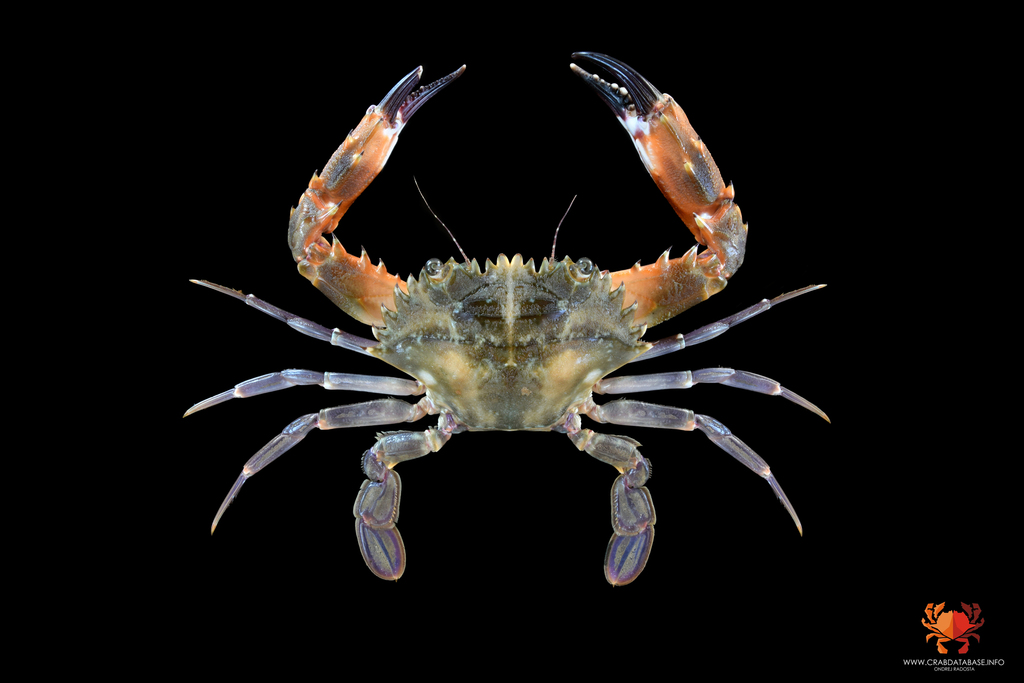
Indo-Pacific Swimming Crab
Charybdis hellerii
Charybdis hellerii, the Indo-Pacific swimming crab or spiny hands is a species of crab from the swimming crab family, the Portunidae. Its native range covers the Indian and Pacific Oceans but it has been introduced to the western Atlantic and has invaded the Mediterranean. It is a commercially exploited species in south-east Asia.
From the article Charybdis hellerii on Wikipedia (CC BY-SA), quoted section by section
Description
Charybdis hellerii has a hexagonal carapace which is convex and covered in long, soft hairs. There are grainy transverse ridges present on frontal, protogastric, mesogastric and branchial regions. There are six prominent frontal teeth: two sharp inner orbitals plus four blunt submedian teeth, the median teeth have an elliptical lower plane which projects beyond the submedian teeth, the lateral teeth are acutely triangular, separated from the submedian teeth by a deep V-shaped cleft. The inner supraorbital lobe is roughly triangular and the outer infraorbital lobe has a convex margin; there are six sharp teeth on the anterolateral margin which have black, brown or red tips and are separated by deep notches and of which the most anterior tooth is the smallest. The basal antennal article is swollen and excludes the antennal flagellum from the orbit. The claws are large, unequal and are covered in short, fine hairs with three spines on the anterior margin of the merus and a small spine at towards the tip. The carpus has a strong spine on the interior margin and three ridges on the external surface; chela has four spines on upper surface and a single spine close to the carpal joint, lower surface smooth. The merus and carpus of the fifth leg has a spine on posterior margin, the posterior margin of the propodus is toothed, the dactyl is oval in shape. …
Range & habitat
Charybdis hellerii occurs in a number of different habitats from the intertidal zone down to around 50 m in depth. It lives in areas with softer substrates like sand or mud flats so long as there are some stones. It also occurs in habitats with hard substrates where it can hide under rocks and among live corals, in tidal rock pools, among meadows of Thalassia and on mangrove roots (Rhizophora mangle). The juveniles have been observed co-existing in association with the bryozoan Schizoporella unicornis.
Wikipedia: “Habitat”
Where it lives
Recorded sightings
—
geo-referenced records in GBIF, from museums, herbaria and field observers.
Drag the globe to turn it. Dots are where records exist, not a range map; darker means more records.
In the stacks
Searching the stacks…
Every page naming Charybdis hellerii in the Biodiversity Heritage Library →
This page is assembled live from iNaturalist, GBIF, Wikipedia, the Source Library and the Internet Archive. It is not yet part of the hand-edited codex. iNaturalist taxon 199399.