On eBird ↗
Central American Pygmy-Owl
Live sightings near you, the range map, bar charts of when it is seen, and Macaulay Library photos and recordings.
Central American Pygmy-Owl
Glaucidium griseiceps
The Central American pygmy owl (Glaucidium griseiceps) is a species of owl in the family Strigidae. It is found in Belize, Colombia, Costa Rica, Ecuador, Guatemala, Honduras, Mexico, Nicaragua, and Panama.
From the article Central American pygmy owl on Wikipedia (CC BY-SA), quoted section by section
Description
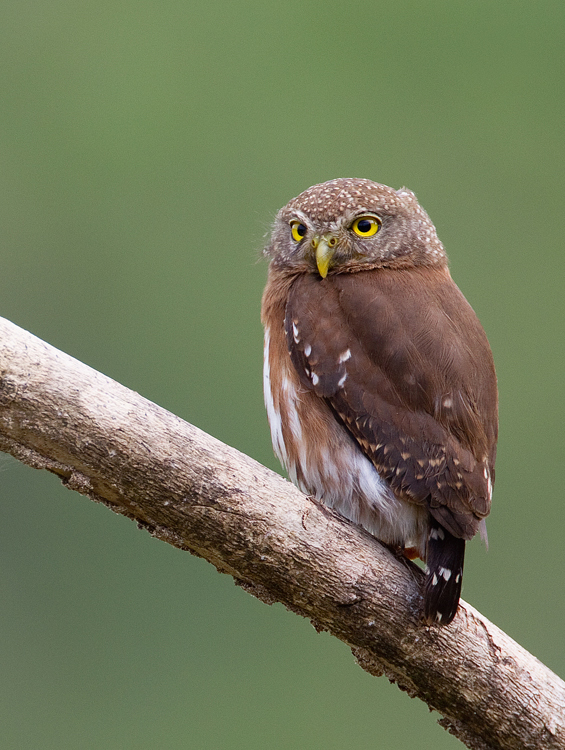
The Central American pygmy owl is 13 to 18 cm (5.1 to 7.1 in) long. Males weigh 50.6 to 58.8 g (1.78 to 2.07 oz) and females about 56 g (2.0 oz). Adults' crown and nape are grayish brown; the crown has buff to whitish spots and the nape dark "false eyes". Their upperparts and tail are rich brown and the tail has pale bars across it. Their underparts are whitish with reddish brown streaks. The juvenile's crown and nape are gray; the crown is unspotted and the nape's false eyes are sooty.
Range & habitat
The Central American pygmy owl is found from Veracruz, Oaxaca, and Chiapas in southern Mexico through Guatemala, Belize, Honduras, Costa Rica, and Panama into northwestern Colombia with a gap in central Nicaragua. A disjunct populations is in far northwestern Ecuador. It inhabits lowland and foothill humid tropical evergreen forest, secondary forest, semi-open areas, and mature cacao plantations. In elevation it ranges from sea level to 1,200 m (3,900 ft) in Mexico and Honduras, 1,300 m (4,300 ft) in Guatemala, and 800 m (2,600 ft) in Costa Rica. In Ecuador it is known only between 200 and 600 m (660 and 1,970 ft).
Wikipedia: “Distribution and habitat”
What it does
Though the Central American pygmy owl is primarily nocturnal, it also often hunts in daytime. Its diet is poorly known but is thought to be large insects, other invertebrates, and small lizards, birds, and mammals.
Wikipedia: “Feeding”
Listen
Looking for field recordings…
Where it lives
Recorded sightings
—
geo-referenced records in GBIF, from museums, herbaria and field observers.
Drag the globe to turn it. Dots are where records exist, not a range map; darker means more records.
In the stacks
Searching the stacks…
Every page naming Glaucidium griseiceps in the Biodiversity Heritage Library →
This page is assembled live from iNaturalist, GBIF, Wikipedia, the Source Library and the Internet Archive. It is not yet part of the hand-edited codex. iNaturalist taxon 19856.