On eBird ↗
Subtropical Pygmy-Owl
Live sightings near you, the range map, bar charts of when it is seen, and Macaulay Library photos and recordings.
Subtropical Pygmy-Owl
Glaucidium parkeri
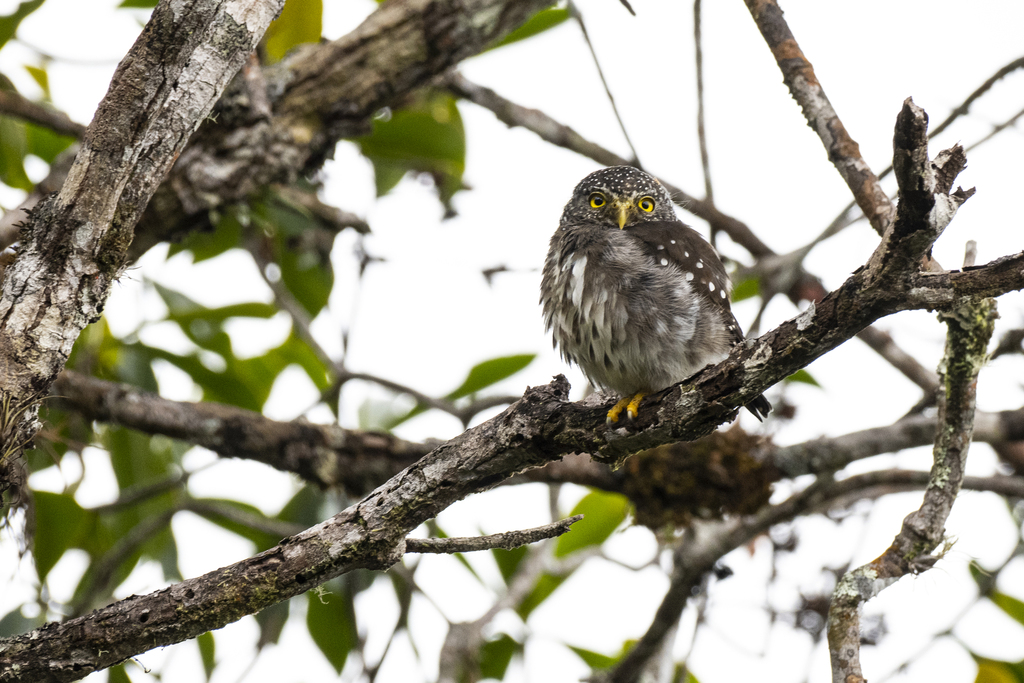
The subtropical pygmy owl (Glaucidium parkeri) is a species of owl in the family Strigidae. It is found in Bolivia, Ecuador, and Peru. Its natural habitat is subtropical or tropical moist montane forests.
From the article Subtropical pygmy owl on Wikipedia (CC BY-SA), quoted section by section
Description
The subtropical pygmy owl is about 14 to 14.5 cm (5.5 to 5.7 in) long; three males had an average weight of 61.6 g (2.17 oz). It has a widespread brown morph and a rare rufous morph. Adults of the former have a grayish-brown crown; the crown and the sides of the face have prominent white spots. Its nape, like those of most Glaucidium pygmy owls, has black "false eyes". The back and rump are dark brown and the tail blackish with spotty white bands. The underparts are white with broad dull reddish-olive brown streaks. The juvenile plumage has not been described.
Range & habitat
The subtropical pygmy owl is found on the east slope of the Andes from far southwestern Colombia through Ecuador and Peru to central Bolivia. In elevation it ranges from 1,100 to 2,000 m (3,600 to 6,600 ft) in Ecuador, between 950 and 1,600 m (3,120 and 5,250 ft) in Peru, and between 600 and 1,600 m (2,000 and 5,200 ft) in Bolivia. It inhabits humid montane forest.
Wikipedia: “Distribution and habitat”
What it does
The subtropical pygmy owl is active both day and night. Nothing has been published about its diet, which is presumed to be large arthropods and small vertebrates.
Wikipedia: “Feeding”
Listen
Looking for field recordings…
Where it lives
Recorded sightings
—
geo-referenced records in GBIF, from museums, herbaria and field observers.
Drag the globe to turn it. Dots are where records exist, not a range map; darker means more records.
In the stacks
Searching the stacks…
Every page naming Glaucidium parkeri in the Biodiversity Heritage Library →
This page is assembled live from iNaturalist, GBIF, Wikipedia, the Source Library and the Internet Archive. It is not yet part of the hand-edited codex. iNaturalist taxon 19804.