On eBird ↗
Whiskered Screech-Owl
Live sightings near you, the range map, bar charts of when it is seen, and Macaulay Library photos and recordings.
Whiskered Screech-Owl
Megascops trichopsis
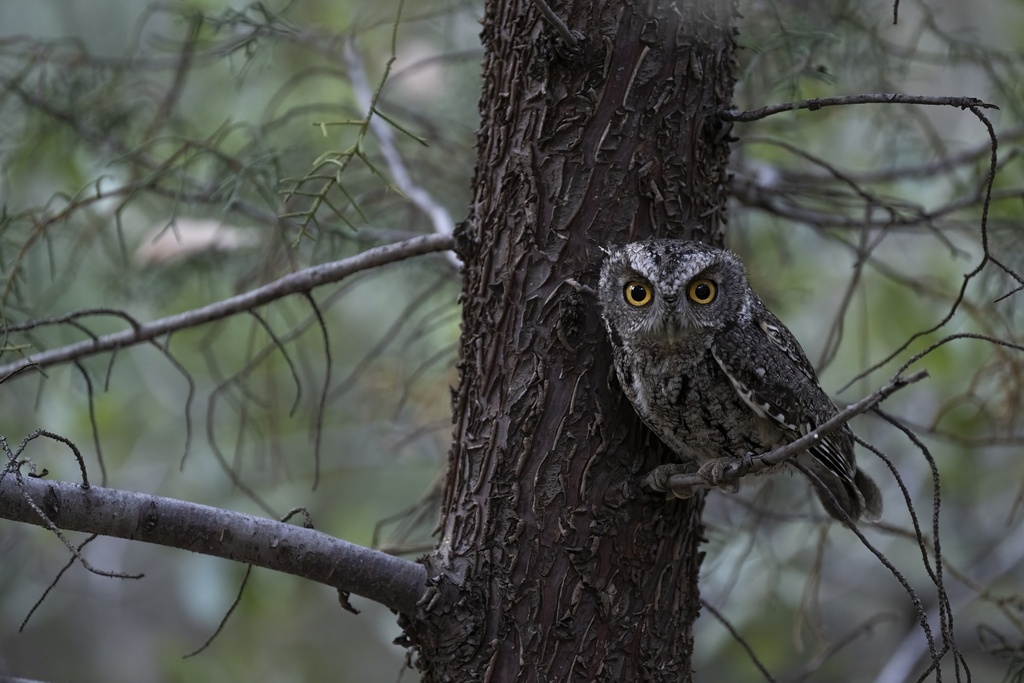
The whiskered screech owl (Megascops trichopsis) is a small screech owl found in North and Central America.
From the article Whiskered screech owl on Wikipedia (CC BY-SA), quoted section by section
Description
Adults occur in 2 color morphs, in either brown or dark grey plumage. They have a round head with ear tufts, yellow eyes and a yellowish bill. The bird looks very similar to a western screech owl, but has heavier barring on the breast, and is slightly smaller in size. They are 6.3 to 7.9 in and have a wingspan of 17.3 in.
Range & habitat
The whiskered screech owl's range extends from southeasternmost Arizona and southwest New Mexico (the Madrean sky islands region) in the United States, southwards through Mexico, Guatemala, El Salvador, Honduras, to north central Nicaragua. Their breeding habitat is dense coniferous or oak woodlands, and coffee plantations usually occurring at higher elevations than the western screech owl.
Wikipedia: “Range and habitat”
What it does
These birds wait on a perch and swoop down on prey; they also capture targeted food items in flight. They mainly eat small mammals and large insects, with grasshoppers, beetles, and moths making up a large portion of their diet but, they also eat katydids and scorpions. They are active at night or near dusk, using their excellent hearing and night vision to locate prey. The most common call is a series of about 8 regularly spaced "boo" notes, slightly higher in the middle, slightly lower at each end. 3 to 4 eggs are usually laid in April or May, usually found in a tree cavity or old woodpecker hole 5 to 7 meters above the ground.
Wikipedia: “Behavior”
Listen
Looking for field recordings…
Where it lives
Recorded sightings
—
geo-referenced records in GBIF, from museums, herbaria and field observers.
Drag the globe to turn it. Dots are where records exist, not a range map; darker means more records.
In the stacks
Searching the stacks…
Every page naming Megascops trichopsis in the Biodiversity Heritage Library →
This page is assembled live from iNaturalist, GBIF, Wikipedia, the Source Library and the Internet Archive. It is not yet part of the hand-edited codex. iNaturalist taxon 19798.