On eBird ↗
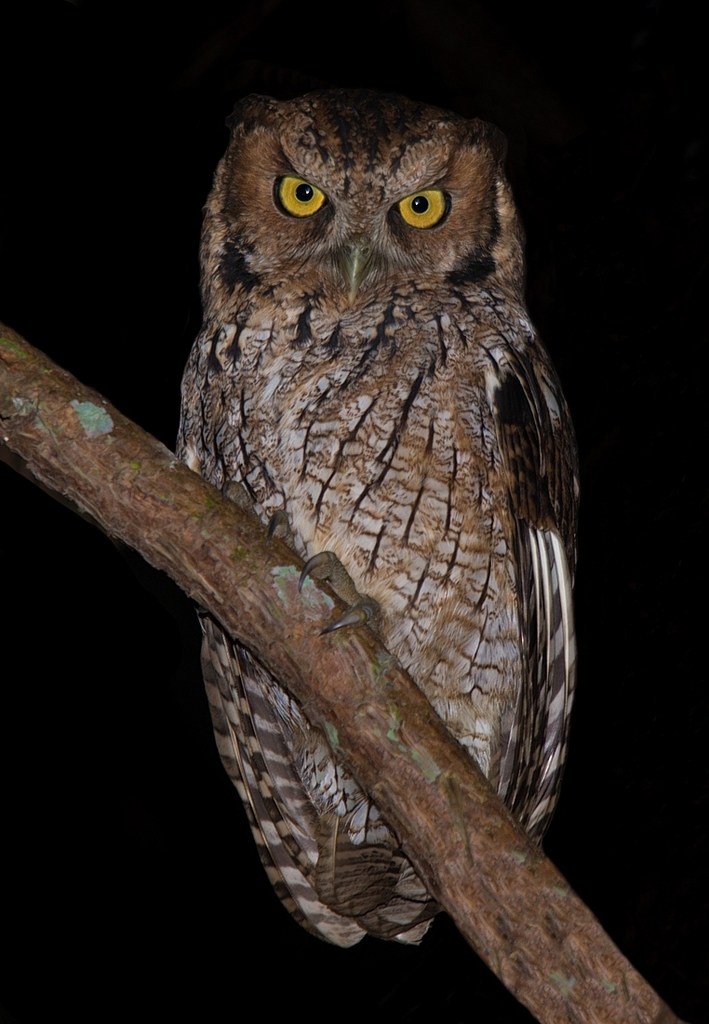
Long-tufted Screech-Owl
Live sightings near you, the range map, bar charts of when it is seen, and Macaulay Library photos and recordings.
Long-tufted Screech-Owl
Megascops sanctaecatarinae
The long-tufted screech owl (Megascops sanctaecatarinae) is a species of owl in the family Strigidae. It is found in Argentina and Brazil. A recent revision of its distribution also includes Uruguay (consequently excluded from the distribution of M. atricapilla).
From the article Long-tufted screech owl on Wikipedia (CC BY-SA), quoted section by section
Description
The long-tufted screech owl is 25 to 28 cm (9.8 to 11 in) long. Males weigh 155 to 194 g (5.5 to 6.8 oz) and females 174 to 211 g (6.1 to 7.4 oz). It is a fairly large and bulky member of Megascops, with stronger feet than most others. It occurs in three color morphs of which the brown one predominates over the gray and rufous. It has very prominent "ear" tufts. The upperparts of the common morph's adult are dark brown with pale, coarse, indistinct vermiculation; its crown is somewhat lighter. The brown facial disc has a darker border. The underparts are a mix of irregular bars, streaks, and vermiculation in shades of brown. The eye is pale yellow to orange-yellow, the bill greenish gray, and the feet pale grayish brown. The plumages of the gray and rufous morphs and the juvenile have not been formally described.
Range & habitat
The long-tufted screech owl is found in the southeastern Brazilian states of Paraná, Santa Catarina, and Rio Grande do Sul, in Misiones Province of northeastern Argentina, and in adjoining northern Uruguay. It inhabits a variety of open and semi-open landscapes. Examples include sparse woodland, pastures with trees, the edges (but not interior) of dense forest, secondary forest, and woodlots near villages. In elevation it mainly occurs between 300 and 1,000 m (980 and 3,300 ft).
Wikipedia: “Distribution and habitat”
What it does
The long-tufted screech owl is primarily nocturnal. It reportedly hunts by dropping from a perch onto prey. Its diet includes arthropods and small vertebrates; rodents, birds, amphibians, and fish are known among the latter.
Wikipedia: “Feeding”
Listen
Looking for field recordings…
Where it lives
Recorded sightings
—
geo-referenced records in GBIF, from museums, herbaria and field observers.
Drag the globe to turn it. Dots are where records exist, not a range map; darker means more records.
In the stacks
Searching the stacks…
Every page naming Megascops sanctaecatarinae in the Biodiversity Heritage Library →
This page is assembled live from iNaturalist, GBIF, Wikipedia, the Source Library and the Internet Archive. It is not yet part of the hand-edited codex. iNaturalist taxon 19784.