On eBird ↗
Great Potoo
Live sightings near you, the range map, bar charts of when it is seen, and Macaulay Library photos and recordings.
Great Potoo
Nyctibius grandis
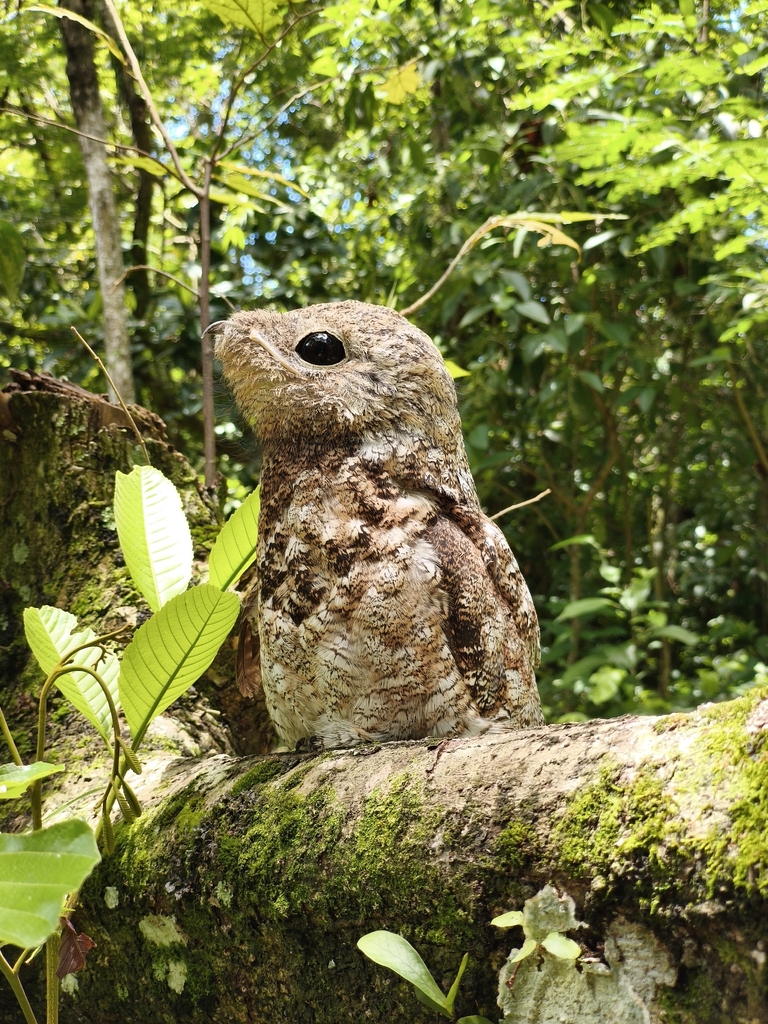
The great potoo or grand potoo (Nyctibius grandis) is the largest potoo species and is widely distributed in Central and South America.
Much like owls, this species is nocturnal. It preys on large insects and small vertebrates, which it captures in sallies from high perches.
From the article Great potoo on Wikipedia (CC BY-SA), quoted section by section
Description
The great potoo has a large head in relation to its body, large, dark brown eyes, and a short but broad beak. Their wings are elliptical in shape, their tail is elongated, and their feathers are white, gray, black, and burgundy. The tail colors match with that of the rest of the body, with the exception of white bars that can be seen going across the tail laterally.
Range in mass: 360 to 650 g (13 to 23 oz) Range in length: 480 to 600 mm (19 to 24 in) Range in wingspan: 700 to 804 mm (27.6 to 31.7 in) Average wingspan: 734.8 mm (28.93 in)
Range & habitat
They range from southern Mexico through northeastern Guatemala and through most of Central America down through South America as far as southeastern Brazil and Bolivia. In general, the great potoo are distributed from humid to semi-humid forested habitats. While this species is widely spread out geographically, there is little to no variation in their appearance, such as size or plumage. The great potoo is found mostly in dense lowland forests, forest edges, and clearings. It may also range into foothills (up to about 1,500 m elevation), second-growth, open woodlands (including plantations) and is sometimes seen around meadows, but they always require trees-etc., for their camouflaged imitative perch. In the day, they are normally found perching or nesting, usually higher than 12 meters (39 ft) above ground level within big trees. The branches they choose to perch on are usually 20 to 30 centimeters (7.9 to 11.8 in) in diameter. At night time, they may go to lower perches 1.5 meters (4.9 ft) above the ground, from which they hunt.
Wikipedia: “Distribution and habitat”
What it does
This nocturnal predator is usually seen perched high above the ground while foraging, hawking when prey is spotted. After the pounce, the potoo almost always returns to its previous perch. Normally, during the day, it perches upright on a tree stump and is overlooked because it resembles part of the stump; this is a camouflage, not just by coloration, but a camouflage by the setting. The Great Potoo can be located at night by the reflection of light from its eyes as it sits vertically on a post, roost, or angled tree trunk. Great potoos are shy and solitary creatures. However, they have begun to perch on man-made things such as plastic bottles. This proves how people continue to affect wildlife and natural habitats in the present day.
Breeding. Breeding has been recorded as typically February to August, but depending on the portion of this bird's range breeding birds can be met with almost year-round. The nest is a slight depression on a thick tree branch, at least 10 m (33 ft) above ground, with a single white (slightly spotted) egg measuring about 5.2 cm × 3.8 cm (2.0 in × 1.5 in). Few details are known of the brooding behavior, but about a month elapses before the offspring is seen alone at the nest. A chick of a few days old weighed 220 g (7.8 oz). …
Wikipedia: “Behavior”
Listen
Looking for field recordings…
Where it lives
Recorded sightings
—
geo-referenced records in GBIF, from museums, herbaria and field observers.
Drag the globe to turn it. Dots are where records exist, not a range map; darker means more records.
In the stacks
Searching the stacks…
Every page naming Nyctibius grandis in the Biodiversity Heritage Library →
This page is assembled live from iNaturalist, GBIF, Wikipedia, the Source Library and the Internet Archive. It is not yet part of the hand-edited codex. iNaturalist taxon 19680.