On eBird ↗
Common Nighthawk
Live sightings near you, the range map, bar charts of when it is seen, and Macaulay Library photos and recordings.
Common Nighthawk
Chordeiles minor
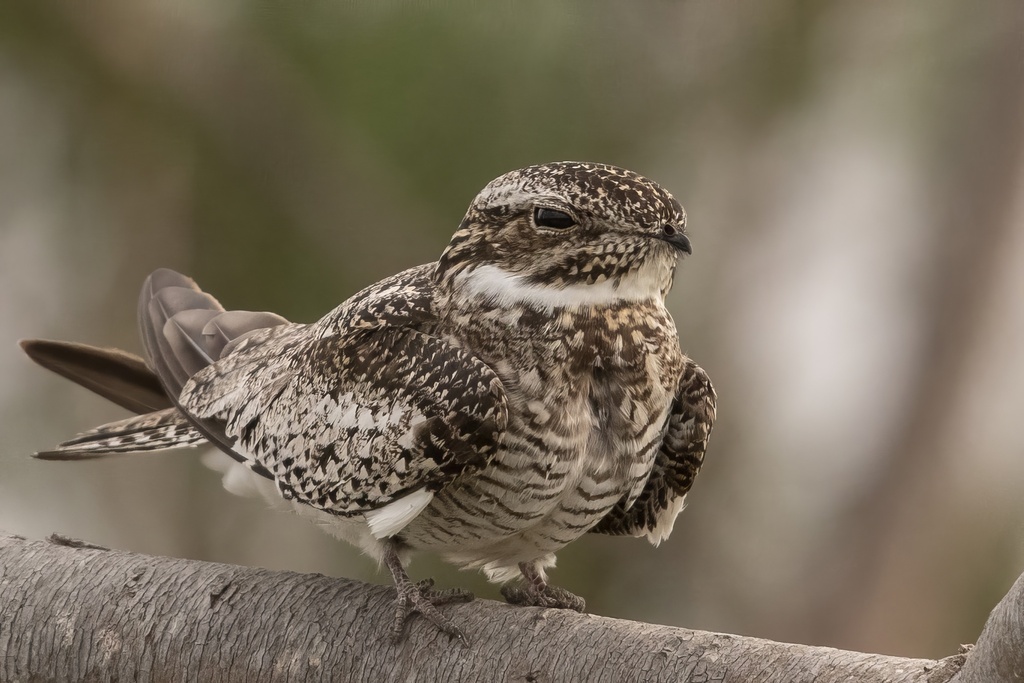
The common nighthawk or bullbat (Chordeiles minor) is a medium-sized crepuscular or nocturnal bird of the Americas within the nightjar (Caprimulgidae) family, whose presence and identity are best revealed by its vocalization. Typically dark (gray, black and brown), displaying cryptic colouration and intricate patterns, this bird is difficult to spot with the naked eye during the day. This bird is most conspicuous when in its buoyant and erratic flight. The most remarkable feature of this aerial insectivore is its small beak that belies the massiveness of its mouth. Some claim appearance similarities to owls. With its horizontal stance and short legs, the common nighthawk does not travel frequently on the ground, instead preferring to perch horizontally, parallel to branches, on posts, on the ground or on a roof. The males of this species may roost together but the bird is primarily solitary. The common nighthawk shows variability in territory size.
This caprimulgid has a large, flattened head with large eyes; facially it lacks rictal bristles. The common nighthawk has long slender wings that at rest extend beyond a notched tail. There is noticeable barring on the sides and abdomen, also white wing-patches.
From the article Common nighthawk on Wikipedia (CC BY-SA), quoted section by section
Description
The common nighthawk is distinguished from other caprimulguids by its forked tail (includes a white bar in males); its long, unbarred, pointed wings with distinctive white patches; its lack of rictal bristles, and the key identifier – their unmistakable calls. These birds range from 21 to 25 cm (8.3 to 9.8 in) in total length and from 51 to 61 cm (20 to 24 in) in wingspan. Body mass can vary from 55 to 98 g (1.9 to 3.5 oz). Among standard measurements, the wing chord is 17.2 to 21.3 cm (6.8 to 8.4 in), the tail is 13 to 15.1 cm (5.1 to 5.9 in), the bill is 0.5 to 0.8 cm (0.20 to 0.31 in) and the tarsus is 1.2 to 1.6 cm (0.47 to 0.63 in). The common nighthawk resembles both the Antillean nighthawk and the lesser nighthawk and occurs at least seasonally in the entire North American range of both of these species. The lesser nighthawk is a smaller bird and displays more buffy on the undertail coverts, where the common nighthawk shows white. Common nighthawks and Antillean nighthawks exhibit entirely dark on the basal portion of the primary feathers, whereas lesser nighthawks have bands of buffy spots. Common and Antillean nighthawks have a longer outermost primary conveying a pointier wing tip than the lesser nighthawk. The common nighthawk forages higher above ground than the lesser nighthawk and has a different call. …
Range & habitat
The common nighthawk may be found in forests, desert, savannahs, beach and desert scrub, cities, and prairies, at elevations of sea level or below to 3,000 m (9,800 ft). Nighthawks prefer to nest in edge and early successional habitats, making them one of only a handful of birds which will live and hunt in burned or clearcut patches of forest. The common nighthawk is drawn into urban built-up areas by insects. The common nighthawk is the only nighthawk occurring over the majority of northern North America. Food availability is likely a key factor in determining which and when areas are suitable for habitation. The common nighthawk is not well adapted to survive in poor conditions, specifically low food availability. Therefore, a constant food supply consistent with warmer temperatures is a driving force for migration and ultimately survival. It is thought that the bird is not able to enter torpor, although recent evidence suggests it does.
Migration. During migration, common nighthawks may travel 2,500 to 6,800 kilometres (1,600 to 4,200 mi). They migrate by day or night in loose flocks, frequently numbering in the thousands; flocks have not been observed with a visible leader. The enormous distance travelled between breeding grounds and wintering range is one of the North America's longer migrations. …
Wikipedia: “Distribution and habitat”
What it does
Frequent flyers, the long-winged common nighthawk hunts on the wing for extended periods at high altitudes or in open areas. Crepuscular, flying insects are its preferred food source. The hunt ends as dusk becomes night, and resumes when night becomes dawn. Nighttime feeding (in complete darkness) is rare, even on evenings with a full moon. The bird displays opportunistic feeding tendencies, although it may be able to fine-tune its meal choice in the moments before capture. Common nighthawks have been shown to prefer eating Coleopterids (beetles) and Hymenopterids (bees, ants, and wasps), seeking these insects out in their habitats. While the most common type of insects in their diets are Lepidopterans (butterflies and moths), they actively avoid eating Dipterids (flies). Vision is presumed to be the main detection sense; no evidence exists to support the use of echolocation. The birds have been observed to converge on artificial light sources in an effort to forage for insects enticed by the light. The average flight speed of common nighthawks is 23.4 km/h (14.5 mph).
Wikipedia: “Food and feeding”
In human culture
The term "nighthawk", first recorded in the King James Bible version of 1611, was originally a local name in England for the European nightjar. Its use in the Americas referring to members of the genus Chordeiles and related genera was first recorded in 1778. The common nighthawk is sometimes called a "bull-bat", due to its perceived "bat-like" flight, and the "bull-like" boom made by its wings as it pulls from a dive. They, in addition to other nightjars, are also sometimes called "bugeaters", for their insectivore diet. The common nighthawk is likely the reason that Nebraska's state nickname was once the "Bugeater State", and its people were known as "bugeaters". The Nebraska Cornhuskers college athletic teams were also briefly known the Bugeaters, before adopting their current name, which was also adopted by the state as a whole. A semi-professional soccer team in Nebraska, Nebraska Bugeaters FC, now uses the moniker.
Wikipedia: “Names and etymology”
Listen
Looking for field recordings…
Where it lives
Recorded sightings
—
geo-referenced records in GBIF, from museums, herbaria and field observers.
Drag the globe to turn it. Dots are where records exist, not a range map; darker means more records.
In the stacks
Searching the stacks…
Every page naming Chordeiles minor in the Biodiversity Heritage Library →
This page is assembled live from iNaturalist, GBIF, Wikipedia, the Source Library and the Internet Archive. It is not yet part of the hand-edited codex. iNaturalist taxon 19577.