On eBird ↗
Long-tailed Nightjar
Live sightings near you, the range map, bar charts of when it is seen, and Macaulay Library photos and recordings.
Long-tailed Nightjar
Caprimulgus climacurus
The long-tailed nightjar (Caprimulgus climacurus) is a species of nightjar in the family Caprimulgidae. It is found in Africa where it occurs in Angola, Benin, Burkina Faso, Cameroon, Central African Republic, Chad, Republic of the Congo, Democratic Republic of the Congo, Ivory Coast, Eritrea, Ethiopia, Gabon, Gambia, Ghana, Guinea, Guinea-Bissau, Kenya, Liberia, Mali, Mauritania, Niger, Nigeria, Senegal, Sierra Leone, Sudan, Tanzania, Togo, and Uganda.
From the article Long-tailed nightjar on Wikipedia (CC BY-SA), quoted section by section
Description
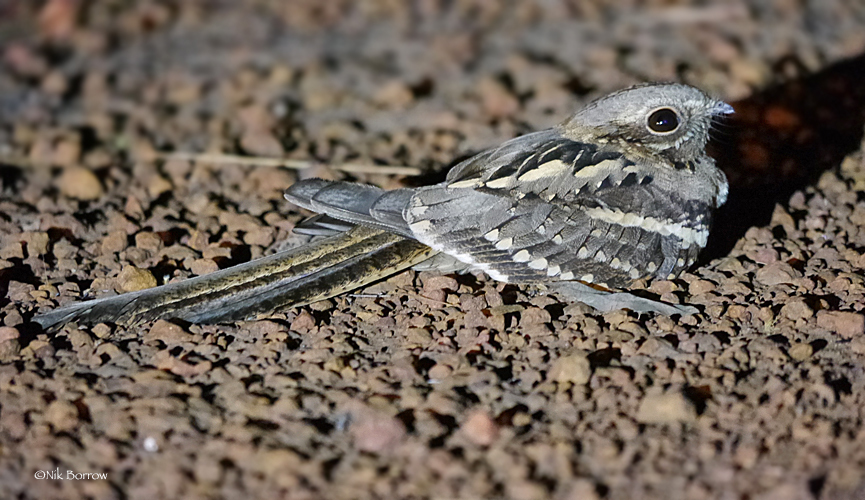
The long-tailed nightjar ranges from about 29–43 cm in size and is sexually dimorphic. It has a long, graduated tail, with its size ranging from 200-304 mm in males and 156-256 mm in females. Its plumage is primarily rufous-brown to gray-brown in colour, but has pale bands (white in males, buff in females) across the forewing, as well as along the trailing edge of the flight feathers. The males can also have a white throat patch and brown bills, legs and feet. A sexually immature Long-tailed Nightjar looks more similar to a female, however its plumage tends to be paler. The identification characteristics of the Long-tailed Nightjar are similar to those of the slender-tailed nightjar (Caprimulgus clarus) and the square-tailed nightjar (Caprimulgus fossii). Specifically, when the long-tailed Nightjar is non-breeding or moulting, their tails can be shorter. However, these species can be distinguished as they tend to occur in non-overlapping geographic areas and also have different songs. The song of the Long-tailed Nightjar is composed of a rapid, higher-pitched and sustained churring, at a frequency of about 42–43 units per second, which is much quicker than both the Slender-tailed Nightjar (7–8.6 units per second) and the Square-tailed nightjar (16–18 units per second). …
Range & habitat
The long-tailed nightjar is found in the Afrotropical realm in multiple African countries including Angola, Benin, Burkina Faso, Cameroon, Central African Republic, Chad, Republic of the Congo, Democratic Republic of the Congo, Ivory Coast, Eritrea, Ethiopia, Gabon, Gambia, Ghana, Guinea, Guinea-Bissau, Kenya, Liberia, Mali, Mauritania, Niger, Nigeria, Senegal, Sierra Leone, Sudan, Tanzania, Togo and Uganda. It is found mainly in open areas of the northern Afrotropics. This includes roadsides, savannas, semi-arid deserts and lowland forest clearings. It can often be found in the company of the standard-winged nightjar (Macrodipteryx longipennis).
Wikipedia: “Habitat and distribution”
What it does
The laying season of the long-tailed nightjar varies depending on geographic location. The laying season is from March to September in Gambia and Senegal, May to August in northern Nigeria, January to October in southern Nigeria, March to August in Mali, March to June in northeastern Congo and February to April or April to June in eastern Africa.
No nest is built for the eggs, rather a clear patch of land, approximately 4 x 5 cm in size, is chosen. Nest locations include bare land, open soil, sand, clear patches between pebbles or leaf-litter, beside pathways, in a thicket or under small bushes in fields. The clutch size is typically two eggs. The eggs are ellipsoidal in shape, matte in finish and colouration varying from whitish, cream, buff or pinkish – typically matching the ground colour. Additionally, grey, grey-purple and chestnut brown blotches and thick marbling fill in the egg's surface, further aiding with camouflage .The incubating bird tends to rest flat on top of the eggs with its eyelids closed.
Wikipedia: “Reproduction”
Listen
Looking for field recordings…
Where it lives
Recorded sightings
—
geo-referenced records in GBIF, from museums, herbaria and field observers.
Drag the globe to turn it. Dots are where records exist, not a range map; darker means more records.
In the stacks
Searching the stacks…
Every page naming Caprimulgus climacurus in the Biodiversity Heritage Library →
This page is assembled live from iNaturalist, GBIF, Wikipedia, the Source Library and the Internet Archive. It is not yet part of the hand-edited codex. iNaturalist taxon 19531.