- Animals
- ›Arthropods
- ›Crustaceans
- ›Typical Crustaceans
- ›Barnacles and Copepods
- ›Barnacles and Allies
- ›Barnacles
- ›Normal Barnacles
- ›Thoracican Barnacles
- ›Symmetrical Sessile Barnacles
- ›Balanoidea
- ›Balanidae
- ›Archaeobalaninae
- ›Conopea
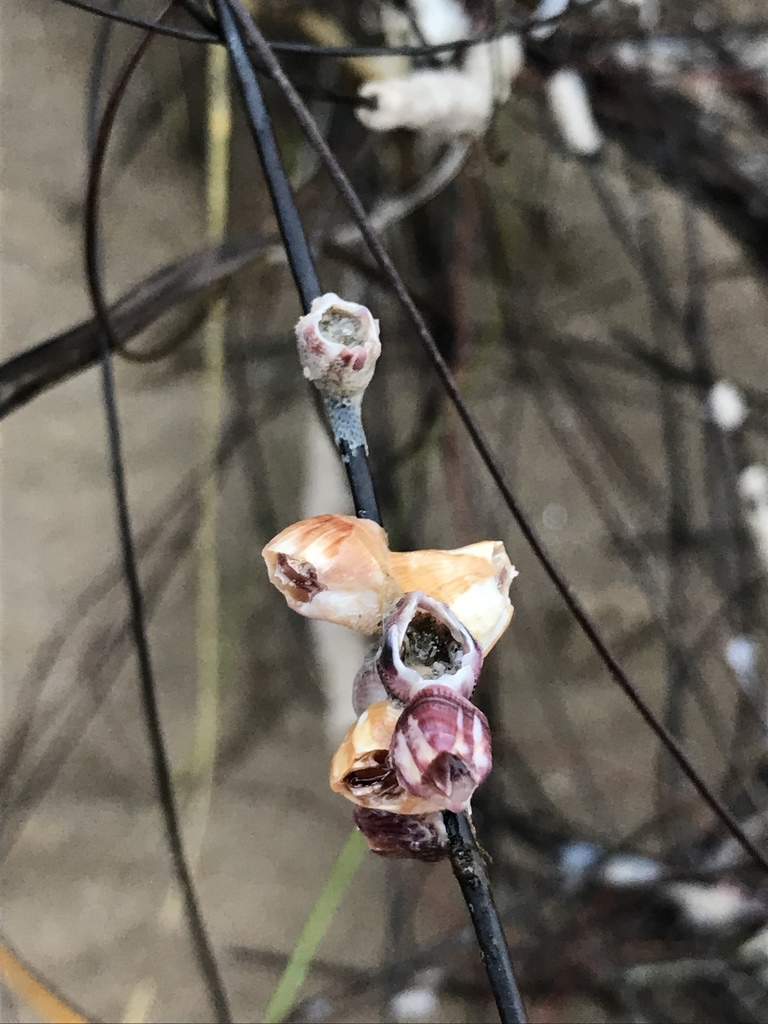
Seawhip Barnacle
Conopea galeata
Conopea galeata is a species of colonial barnacle in the family Archaeobalanidae. It lives exclusively on gorgonians in the western Atlantic Ocean, the Caribbean Sea and the Gulf of Mexico.
From the article Conopea galeata on Wikipedia (CC BY-SA), quoted section by section
Description
Conopea galeata grows to a diameter of about 1.5 cm (0.6 in). The basal plate by which it adheres to its host gorgonian is boat-shaped. The other main plates are the carina and the carinolaterals, but these are not visible because the coenenchyme (soft tissue) of the host overgrows the plates of the barnacle, apart from a gap through which the crustacean extends its cirri to feed. The plates have brown and white markings, but the barnacle may take on the gorgonian's colouring, which may be some shade of red, purple, orange, yellow or white. The species is androdioecious.
Range & habitat
Conopea galeata is found in the southeastern United States, the Caribbean Sea and the Gulf of Mexico where it grows on the sea whip Leptogorgia virgulata, which is found growing on reefs and rocks at depths down to about 20 m (66 ft).
Wikipedia: “Distribution and habitat”
What it does
A number of different invertebrates live in symbiosis with L. virgulata. Besides C. galeata, these include a small shrimp Neopontonides beaufortensis, a nudibranch Tritonia wellsi, a bivalve mollusc Pteria colymbus, two species of copepod and a gastropod mollusc Simnialena uniplicata. The gorgonian uses chemical defences to prevent barnacles, bryozoans and algae from growing on the twigs, exuding protective chemicals which inhibit settlement of their larvae. However, the larvae of C. galeata settle on the old egg masses of the snail S. uniplicata, before drilling down to the gorgonian's axis and anchoring themselves in place. When the egg mass has disintegrated, the coenenchyme grows to envelop the barnacle, apart from a narrow opening. The presence of the barnacle causes a significant bump on its host.
== References ==
Wikipedia: “Ecology”
Where it lives
Recorded sightings
—
geo-referenced records in GBIF, from museums, herbaria and field observers.
Drag the globe to turn it. Dots are where records exist, not a range map; darker means more records.
In the stacks
Searching the stacks…
Every page naming Conopea galeata in the Biodiversity Heritage Library →
This page is assembled live from iNaturalist, GBIF, Wikipedia, the Source Library and the Internet Archive. It is not yet part of the hand-edited codex. iNaturalist taxon 195046.