On eBird ↗
Golden Nightjar
Live sightings near you, the range map, bar charts of when it is seen, and Macaulay Library photos and recordings.
Golden Nightjar
Caprimulgus eximius
The golden nightjar (Caprimulgus eximius) is a species of nightjar in the family Caprimulgidae. It is found in Sahel region in northern Sub-Saharan Africa.
From the article Golden nightjar on Wikipedia (CC BY-SA), quoted section by section
Description
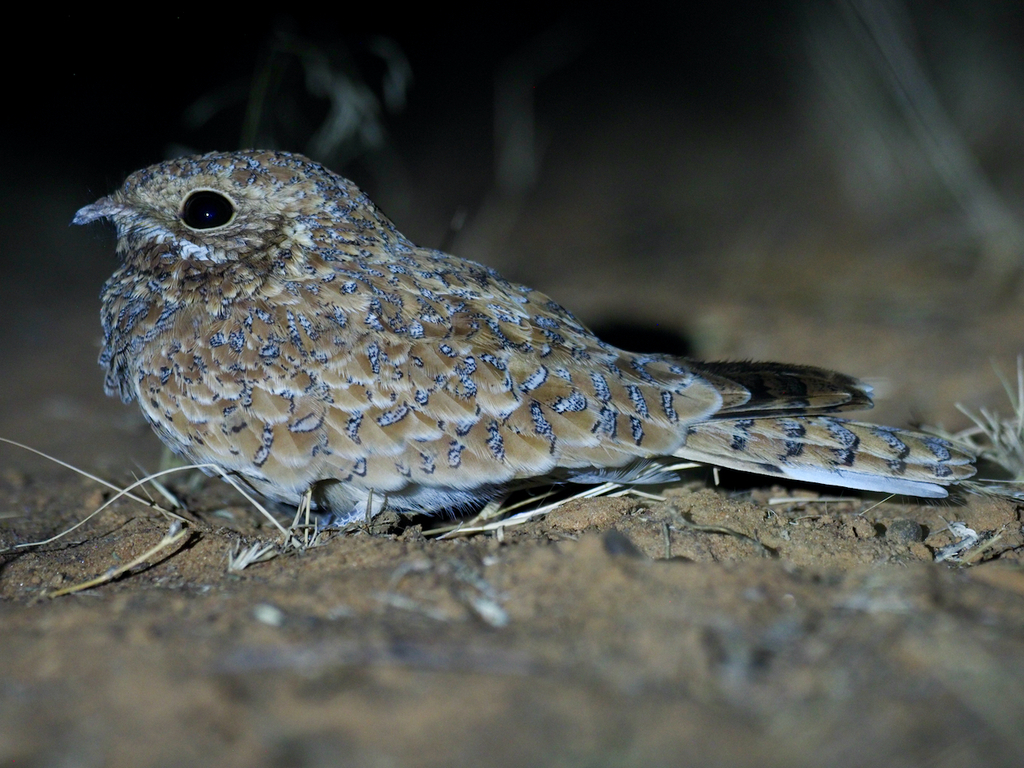
The golden nightjar is a distinctively coloured, smallish nightjar which measures 23–25 cm in length. When at rest the golden nightjar appears large headed and the upperparts and wing coverts are tawny buff marked with greyish-white, dark brown edged and speckled, square shaped spots. It has a large whitish patch on its throat, the upper breast is similarly marked to the upperparts but this fades towards the unmarked tawny-buff lower breast and belly. In flight it shows a large white spot towards the tips of the wings and in poor light it appears very pale. Both sexes are alike.
Voice. The golden nightjar's song is low pitched churr which may last quite a long time and is delivered at dawn and dusk from the ground.
Range & habitat
The golden nightjar occurs from northern Senegal and Mauritania in the west eastwards to Sudan. In 2015 a female golden nightjar was seen and it, or another, was later found dead in southern Western Sahara and in 2016 a number of birds were noted in the same area suggesting that it may host a breeding population. In 2019, the breeding of the species in the area was confirmed. These were the first records of this species in the Palearctic.
Wikipedia: “Distribution”
Listen
Looking for field recordings…
Where it lives
Recorded sightings
—
geo-referenced records in GBIF, from museums, herbaria and field observers.
Drag the globe to turn it. Dots are where records exist, not a range map; darker means more records.
In the stacks
Searching the stacks…
Every page naming Caprimulgus eximius in the Biodiversity Heritage Library →
This page is assembled live from iNaturalist, GBIF, Wikipedia, the Source Library and the Internet Archive. It is not yet part of the hand-edited codex. iNaturalist taxon 19444.