- Animals
- ›Chordates
- ›Vertebrates
- ›Mammals
- ›Therians
- ›Placental Mammals
- ›Ungulates, Carnivorans, and Allies
- ›Bats
- ›Yangochiroptera
- ›Vespertilionoid Bats
- ›Bent-winged Bats
- ›Miniopterus
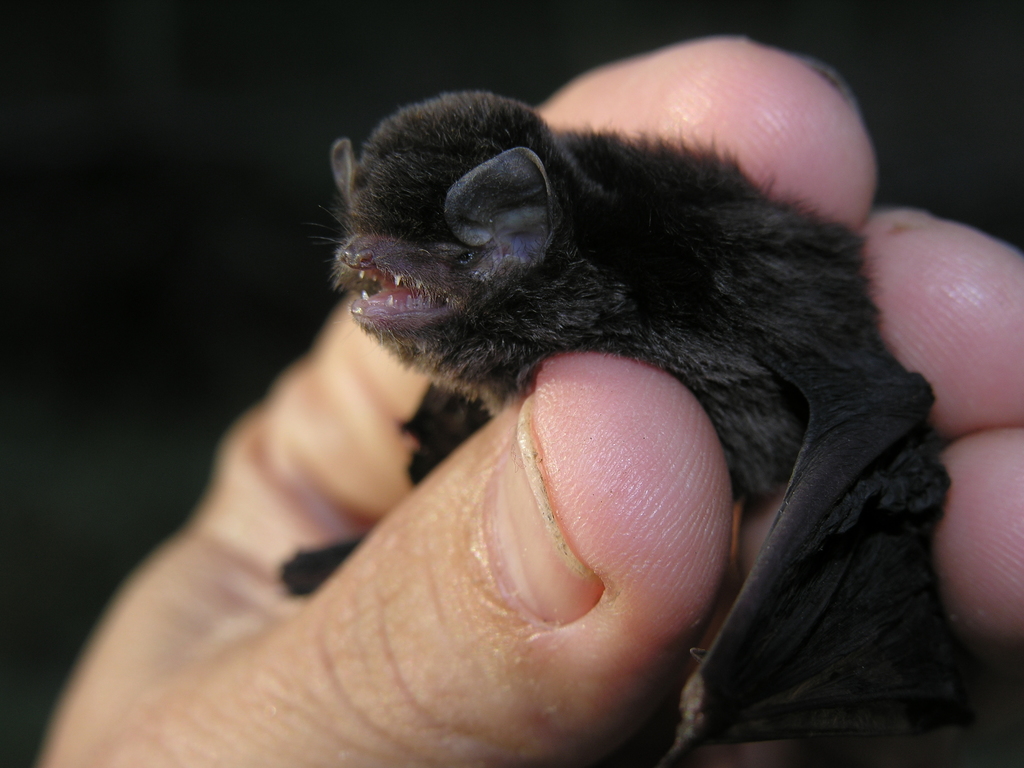
Madagascar Long-fingered Bat
Miniopterus brachytragos
Miniopterus brachytragos is a bat in the genus Miniopterus that occurs in northern and western Madagascar. Populations of this species have historically been included in Miniopterus manavi, but molecular data published in 2008 and 2009 indicate this supposed species in fact consists of five separate species, including the newly described M. brachytragos. Up to four species of this group may occur in the same place. M. brachytragos has been found in dry and wet forests from sea level to 320 m (1,050 ft) altitude.
Miniopterus brachytragos is a small, brown Miniopterus; its forearm length is 35 to 38 mm (1.4 to 1.5 in). The hairs of the underparts have buff tips. The short tragus (a projection in the outer ear) is an important distinguishing feature. The uropatagium (tail membrane) is well-furred and the palate is concave.
From the article Miniopterus brachytragos on Wikipedia (CC BY-SA), quoted section by section
Description
Miniopterus brachytragos is a small, short-tailed Miniopterus with short and relatively thin fur. The fur of the upperparts is dark brown and the hairs on the underparts have buff tips. Miniopterus mahafaliensis is similar in color, but other small Malagasy Miniopterus are darker. The ears are haired above, but virtually naked below and end in a rounded tip. The tragus (a projection on the inner side of the outer ear) is short and has a broad base, sometimes with a crest at the side. It ends in a pointed to slightly rounded tip, which is covered with hairs that are not readily visible to the unaided eye. The short tragus easily distinguishes M. brachytragos from other Malagasy Miniopterus. The wing membrane is also brown, but the uropatagium (tail membrane) is lighter. The wing membrane and uropatagium are attached to the upper leg at the same level, above the ankle. The uropatagium is relatively densely covered with hairs, particularly on the upper side. M. manavi and M. mahafaliensis also have a densely haired uropatagium, but in M. aelleni and M. …
Range & habitat
Miniopterus brachytragos is known from several ecologically different sites. In the Namoroka region, it has been recorded at 100 to 200 m (330 to 660 ft) altitude in dry forest and gallery forest. Another specimen was caught in forest in a karst region in Bemaraha. Near Daraina in the northeast, the species occurs in eastern humid forest mixed with dry forest at 320 m (1,050 ft). At another northeastern site, on the Masoala Peninsula, it was found in lowland gallery forest near sea level. On Nosy Komba, its habitat consists of dry forest mixed with introduced Mangifera indica (mango tree). Little is known of the ecology of M. brachytragos, but species of Miniopterus generally feed on insects, breed seasonally, and roost in large colonies in caves.
Wikipedia: “Distribution and ecology”
Listen
Looking for field recordings…
Where it lives
Recorded sightings
—
geo-referenced records in GBIF, from museums, herbaria and field observers.
Drag the globe to turn it. Dots are where records exist, not a range map; darker means more records.
In the stacks
Searching the stacks…
Every page naming Miniopterus brachytragos in the Biodiversity Heritage Library →
This page is assembled live from iNaturalist, GBIF, Wikipedia, the Source Library and the Internet Archive. It is not yet part of the hand-edited codex. iNaturalist taxon 194019.