On eBird ↗
New Caledonian Owlet-nightjar
Live sightings near you, the range map, bar charts of when it is seen, and Macaulay Library photos and recordings.
New Caledonian Owlet-nightjar
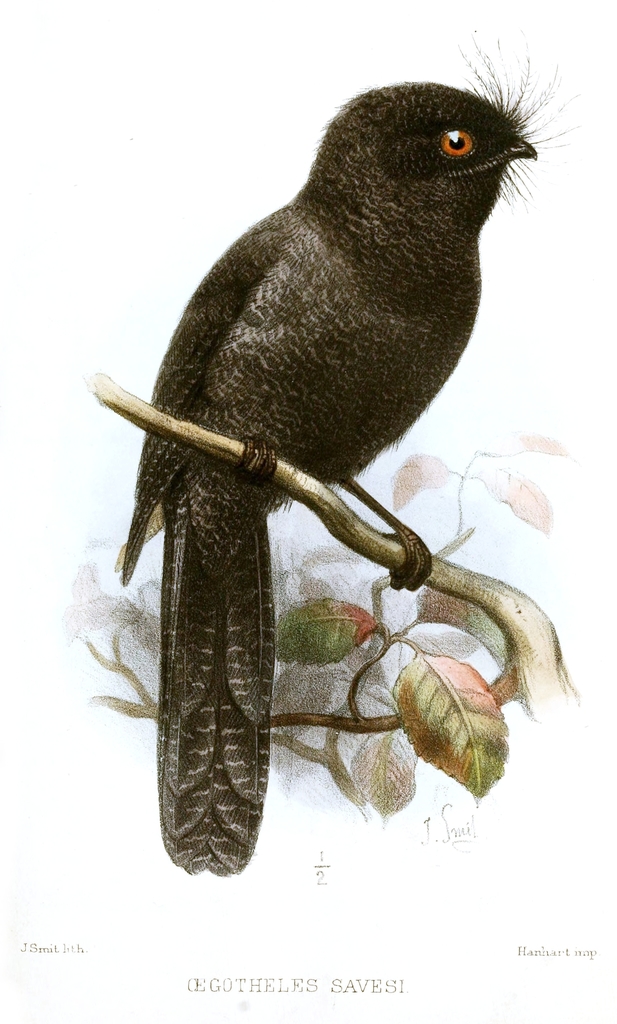
Aegotheles savesi
The New Caledonian owlet-nightjar (Aegotheles savesi), also known as the enigmatic owlet-nightjar, is a large owlet-nightjar with vermiculated grey-brown and black plumage. It has a long, slightly rounded tail, short, rounded wings, and long, stout legs. Its voice is unknown, but other owlet-nightjar species make churring and whistling sounds. It is the second-largest known owlet-nightjar (only the extinct New Zealand owlet-nightjar was larger), much larger than the Australian owlet-nightjar.
The New Caledonian owlet-nightjar is endemic to New Caledonia's Melaleuca savanna and humid forests. Other owlet-nightjars are solitary, nest in holes in trees, and forage from a perch, both flying out to catch flying insects (hawking) and descending onto prey on the ground or on trunks and branches. It is unknown if these habits apply to the New Caledonian owlet-nightjar, but this species is larger and has longer legs than the other species, so it may be more terrestrial. Although according to the last sighter of the bird, Jonathan Ekstrom it was observed to be hawking in the trees, the two features suggesting it likely still partakes in both the same behaviours to an extent. It is also similar however much larger than the Australian Owlet Nightjar.
From the article New Caledonian owlet-nightjar on Wikipedia (CC BY-SA), quoted section by section
In human culture
The first known specimen was collected in the village of Tonghoué in the evening of the 11th of April 1880 after one flew into the bedroom of a resident. It was presented to M. Saves who in turn handed it over to Edgar Leopold Layard. Eventually the specimen was purchased by the Liverpool Museum in 1896. Another specimen was rediscovered in the early 21st Century in an Italian museum dating back to 1915 On the island of Maré, according to Jonathan Ekstrom, a confirmed sighting was reported in 1939 after one was shot (Macmillan 1938/39). This specimen has not been recovered nor did Macmillan mention what became of it. A potential sighting occurred in 1960 when one was shot near Païta, close to the original sighting. Daniel Letocart also claims to have found one in the early 1950s. Both sightings are unconfirmed. A third potential sighting has been mentioned by Hannecart and Letocart (1983). Olson, Balouet and Fisher (1987) also mention the abundance of fossils, suggesting the bird was widespread throughout the archipelago, specifically on the islands Grand Terre and Maré. As info is scarce, it is possible it may have inhabited other islands according to fossil records. After logging ceased in 1993, 7500 hectares of land was designated as 'Reserve Speciale de Faune et de Flore de la Ni-Kouakoue' in 1995. …
Wikipedia: “History”
Listen
Looking for field recordings…
Where it lives
Recorded sightings
—
geo-referenced records in GBIF, from museums, herbaria and field observers.
Drag the globe to turn it. Dots are where records exist, not a range map; darker means more records.
In the stacks
Searching the stacks…
Every page naming Aegotheles savesi in the Biodiversity Heritage Library →
This page is assembled live from iNaturalist, GBIF, Wikipedia, the Source Library and the Internet Archive. It is not yet part of the hand-edited codex. iNaturalist taxon 19364.