On eBird ↗
Pileated Parrot
Live sightings near you, the range map, bar charts of when it is seen, and Macaulay Library photos and recordings.
Pileated Parrot
Pionopsitta pileata
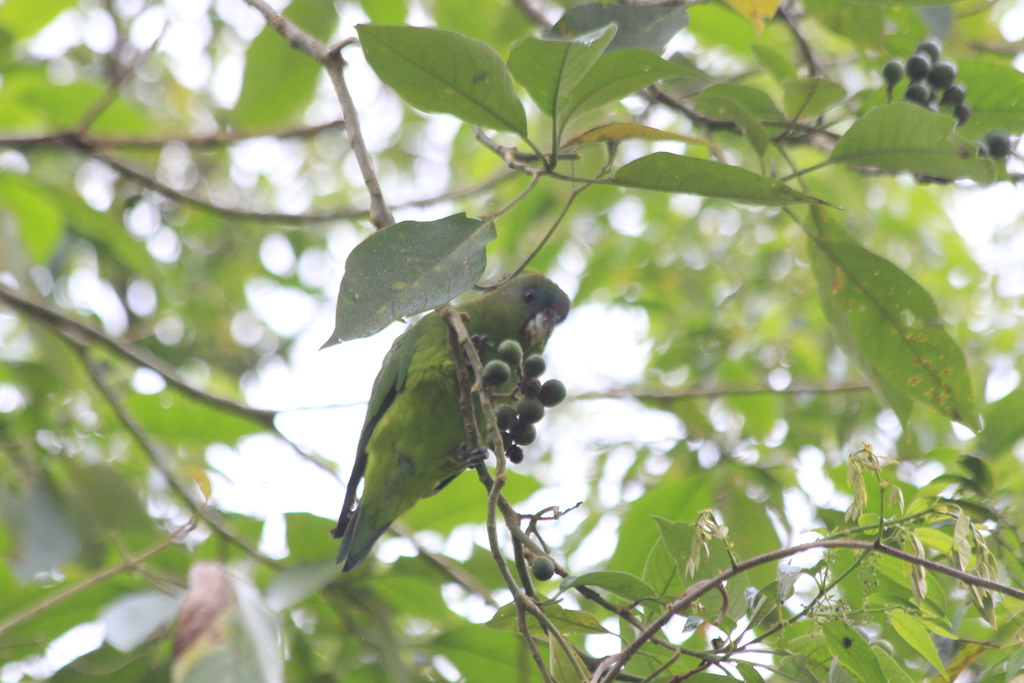
The South American pileated parrot (Pionopsitta pileata), also known as the red-capped parrot (leading to easy confusion with the Australian Purpureicephalus spurius), is a medium-small species of parrot with a total length of about 22 cm (8.7 in). It is found in or near the Atlantic Forest in south-eastern Brazil, far north-eastern Argentina and eastern Paraguay. A local name in Paraguayan Guaraní is cúiu cúiu.
From the article Pileated parrot on Wikipedia (CC BY-SA), quoted section by section
Description
The pileated parrot is 20 to 22 cm (7.9 to 8.7 in) long and weighs 98 to 120 g (3.5 to 4.2 oz). Adults have an essentially all green body, with a yellowish abdomen. Their primaries, primary coverts, and the edges and tips of their tail feathers are dull blue. Males have a red forehead, crown, lores, and upper ear coverts. Females do not have any red but do have a faint blue wash on the forehead and breast. Immature males have less red on the head than adults, and females have less blue on the wings.
Range & habitat
The pileated parrot is found in southeastern Brazil from Bahia south and into eastern Paraguay and Argentina's Misiones Province. It mostly inhabits humid forest but also occurs in somewhat more open and dryer forest dominated by Araucaria and partially cleared landscapes. In elevation it is found from sea level to 1,500 m (4,900 ft).
Wikipedia: “Distribution and habitat”
What it does
Little is known about the pileated parrot's feeding behavior or diet. It is known to feed on fruits and seeds of several families of plants, and also on Eucalyptus bark.
Wikipedia: “Feeding”
Listen
Looking for field recordings…
Where it lives
Recorded sightings
—
geo-referenced records in GBIF, from museums, herbaria and field observers.
Drag the globe to turn it. Dots are where records exist, not a range map; darker means more records.
In the stacks
Searching the stacks…
Every page naming Pionopsitta pileata in the Biodiversity Heritage Library →
This page is assembled live from iNaturalist, GBIF, Wikipedia, the Source Library and the Internet Archive. It is not yet part of the hand-edited codex. iNaturalist taxon 19169.