On eBird ↗
Red-and-green Macaw
Live sightings near you, the range map, bar charts of when it is seen, and Macaulay Library photos and recordings.
Red-and-green Macaw
Ara chloropterus
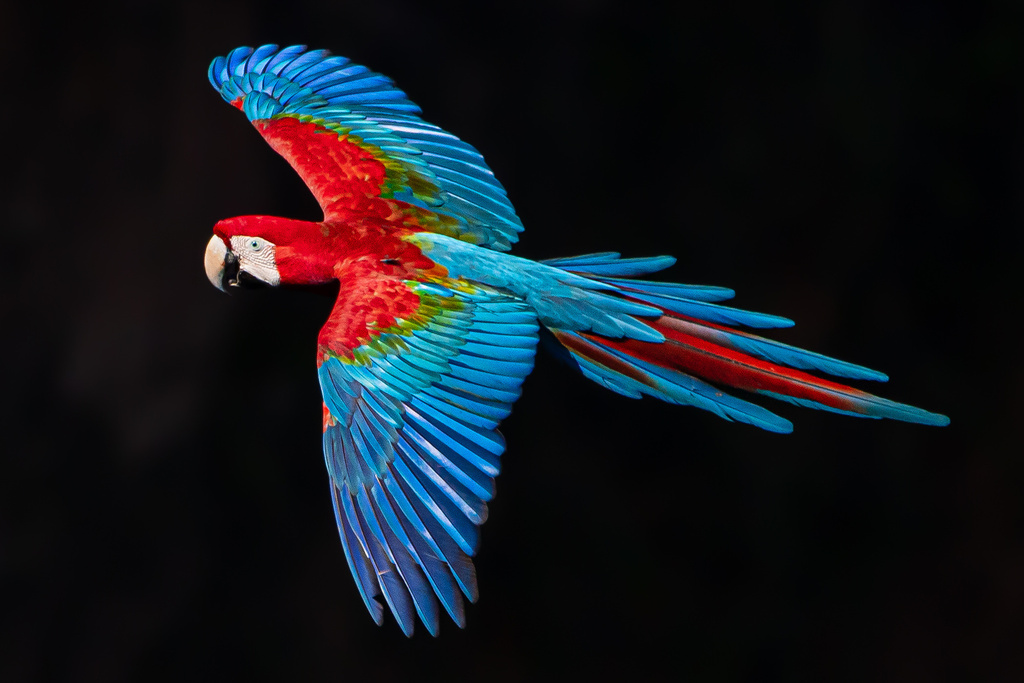
The red-and-green macaw (Ara chloropterus), also known as the green-winged macaw, is a large, mostly-red macaw of the genus Ara. It is popular in aviculture, and is the second most commonly kept macaw species after the blue-and-yellow macaw. However, they are not as common in captivity as the blue-and-yellow, and are much more expensive; prices are often double that of the blue-and-gold.
This is the largest of the genus Ara, widespread in the forests and woodlands of northern and central South America. However, in common with other macaws, in recent years there has been a marked decline in its numbers due to habitat loss and illegal capture for the parrot trade.
From the article Red-and-green macaw on Wikipedia (CC BY-SA), quoted section by section
Description
The green-winged macaw can be readily distinguished from the scarlet macaw. While the breast of both birds are bright red, the upper-wing covert feathers of the green-winged macaw is mostly green (as opposed to mostly yellow, or a strong mix of yellow and green in the scarlet macaw). In addition, the green-winged macaw has characteristic red lines around the eyes formed by rows of tiny feathers on the otherwise bare white skin patch; this is one of the biggest differences from a scarlet macaw to the casual viewer. Iridescent teal feathers are surrounded by red on the tail. If seen together, the green-winged macaw is clearly larger than the scarlet macaw as well. In terms of length, this species is second only in size to the hyacinth macaw, the largest of the macaws. The red-and-green macaw attains a total body length of 90 to 95 cm (35 to 37 in) in adults. Twelve adults were found to average 1,214 g (2.676 lb). A weight range of between 1,050 and 1,708 g (2.315 and 3.765 lb) has been reported. While its weight range is broadly similar to that of the hyacinth, the average weight of the red-and-green macaw is slightly surpassed by both the hyacinth and great green macaws, and amongst all living parrots additionally by the kākāpō.
What it does
The green-winged macaw generally mates for life. The female typically lays two or three eggs in a nest made in a hole in a tree. The female incubates the eggs for about 28 days, and the chicks fledge from the nest about 90 days after hatching.
Wikipedia: “Behavior”
Listen
Looking for field recordings…
Where it lives
Recorded sightings
—
geo-referenced records in GBIF, from museums, herbaria and field observers.
Drag the globe to turn it. Dots are where records exist, not a range map; darker means more records.
In the stacks
Searching the stacks…
Every page naming Ara chloropterus in the Biodiversity Heritage Library →
This page is assembled live from iNaturalist, GBIF, Wikipedia, the Source Library and the Internet Archive. It is not yet part of the hand-edited codex. iNaturalist taxon 19016.