On eBird ↗
Red-browed Amazon
Live sightings near you, the range map, bar charts of when it is seen, and Macaulay Library photos and recordings.
Red-browed Amazon
Amazona rhodocorytha
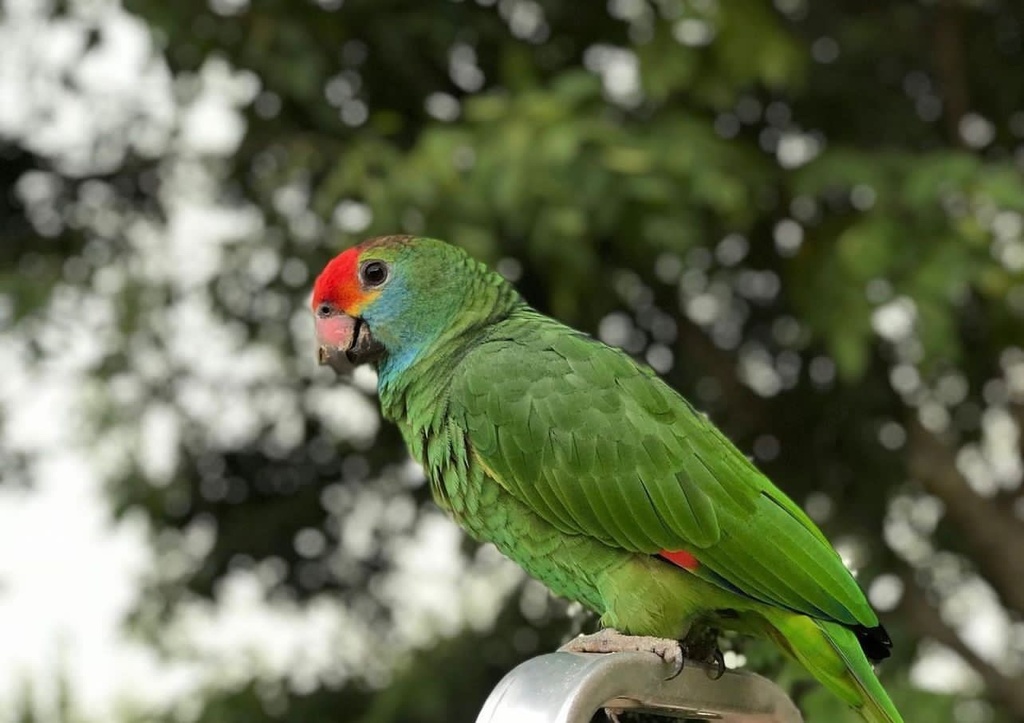
The red-browed amazon (Amazona rhodocorytha) is a species of parrot in the family Psittacidae. It is endemic to Atlantic Forest in eastern Brazil. It has been considered a subspecies of the blue-cheeked amazon (Amazona dufresniana), but today all major authorities consider them separate species. It is threatened both by habitat loss and by being captured for the trade in wild parrots.
From the article Red-browed amazon on Wikipedia (CC BY-SA), quoted section by section
Description
The red-browed amazon has a bright red crown fading to purplish-brown at the back. The cheeks and throat are blue and the wing and body plumage is green with dark markings on the back of the neck. Black and red patches can be seen on the wings when they are spread and the tail feathers have red markings and are tipped with yellow. The beak and legs are grey and the iris of the eye is orange-brown.
Range & habitat
The red-browed amazon is endemic to tropical forests in eastern Brazil. It used to be widespread across the region but is now restricted to some of the larger remaining forest blocks. The largest of these is in the state of Espírito Santo and the bird is also present in three forest areas in south east Bahia and five in the states of Rio de Janeiro and Minas Gerais. Another location is in the north of the state of São Paulo and a further one in São Miguel dos Campos in the east of the state of Alagoas. The rest of this state seems to be suitable habitat but it has not been observed to be present there recently.
Wikipedia: “Distribution and habitat”
What it does
The red-browed amazon feeds in small groups on fruit, berries, seeds and buds which it finds in the rainforest canopy. Breeding takes place between September and November. A pair of red-browed amazons maintain a territory and the nest is usually made in a cavity in a tree, the same site being used year after year. In captivity, a clutch of four eggs are usually laid, incubation takes 24 days and the young are fledged 34 days after hatching.
Wikipedia: “Behaviour”
Listen
Looking for field recordings…
Where it lives
Recorded sightings
—
geo-referenced records in GBIF, from museums, herbaria and field observers.
Drag the globe to turn it. Dots are where records exist, not a range map; darker means more records.
In the stacks
Searching the stacks…
Every page naming Amazona rhodocorytha in the Biodiversity Heritage Library →
This page is assembled live from iNaturalist, GBIF, Wikipedia, the Source Library and the Internet Archive. It is not yet part of the hand-edited codex. iNaturalist taxon 18997.