On eBird ↗
White-fronted Amazon
Live sightings near you, the range map, bar charts of when it is seen, and Macaulay Library photos and recordings.
White-fronted Amazon
Amazona albifrons
The white-fronted amazon (Amazona albifrons) also known as the white-fronted parrot, or by the adopted slang term spectacled amazon parrot, is a Central American species of parrot. Not to be confused with the red-spectacled amazon. They can imitate a range from 30 to 40 different sounds. Like other large parrots, the white-fronted parrot has a long potential life span, usually around 40 years.
From the article White-fronted amazon on Wikipedia (CC BY-SA), quoted section by section
Description
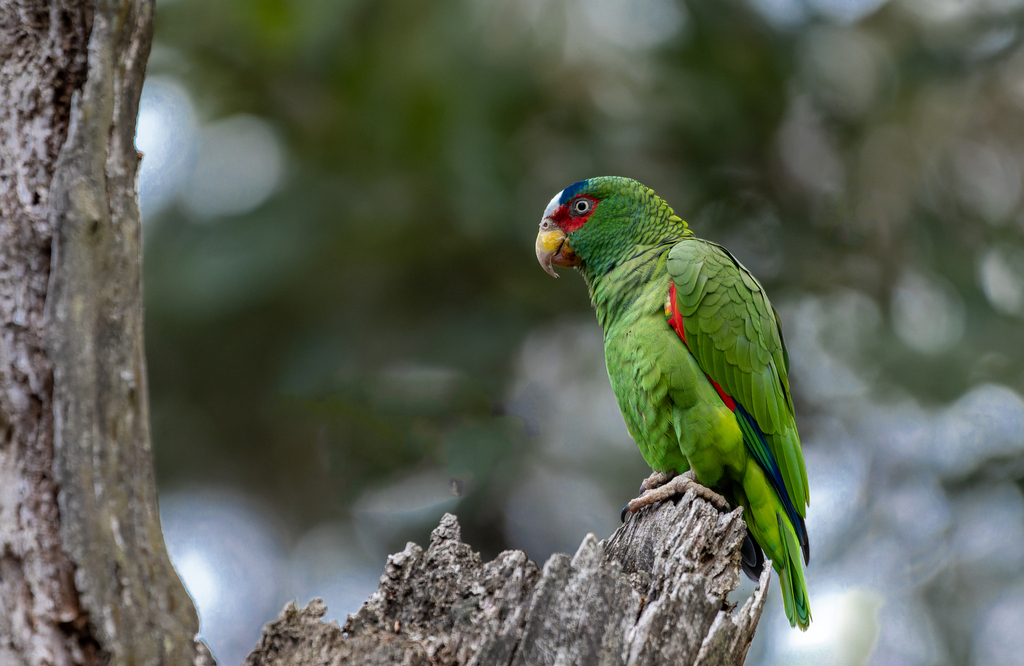
The white-fronted amazon, at about 25 cm (9.8 in) long, is the smallest of the amazon parrots. This species is named for the bright white patch of feathers on its forehead, although the amount of white varies from individual to individual. They have mostly green plumage with some blue colouring on their outspread wings. They have bright red colouring around their eyes (in some individuals almost like spectacles) and blue colouring behind the patch of white on their foreheads. Together with the red-spectacled amazon and the yellow-lored amazon, it is the only amazon species in which adult males and females easily can be distinguished by external appearance (sexual dimorphism): Males have bright red feathers on their "shoulders" (alula), while females have green "shoulders". Juveniles have pale grey irises and less red on their face and the white area is replaced with a smaller yellowish area.
Range & habitat
The white-fronted amazon is native to Central America and Mexico; and is most often seen in small flocks of up to 20 birds. They are seen in a variety of different habitats from wet regions such as rainforests, to drier areas such as cactus savannahs. In the wild, they are not shy and people are often able to approach them. Flocks may congregate and people have seen groups that number into the hundreds. These groups may also contain flocks from other species such as the red-lored amazon. A population has been seen in southern Texas, probably escapees, and a small feral population has been observed living in southern California. Introduced breeding populations have also been reported in Puerto Rico.
Wikipedia: “Distribution and habitat”
In human culture
The white-fronted amazon is sometimes kept by humans as a companion parrot or aviary bird. When tame, it is typically a sociable, affectionate, playful and intelligent bird that can learn to talk and often forms a close bond with its owner. Like many parrots, it is a long-lived species - potentially living for over 50 years in captivity. However it is also a loud, noisy bird that is unsuitable for apartment dwelling and requires regular exercise, play opportunities and social interaction in order to thrive. The World Parrot Trust recommends that the white-fronted amazon be kept in an enclosure with a minimum length of 3 metres.
Wikipedia: “Aviculture”
Listen
Looking for field recordings…
Where it lives
Recorded sightings
—
geo-referenced records in GBIF, from museums, herbaria and field observers.
Drag the globe to turn it. Dots are where records exist, not a range map; darker means more records.
In the stacks
Searching the stacks…
Every page naming Amazona albifrons in the Biodiversity Heritage Library →
This page is assembled live from iNaturalist, GBIF, Wikipedia, the Source Library and the Internet Archive. It is not yet part of the hand-edited codex. iNaturalist taxon 18995.