On eBird ↗
Cuban Amazon
Live sightings near you, the range map, bar charts of when it is seen, and Macaulay Library photos and recordings.
Cuban Amazon
Amazona leucocephala
The Cuban amazon (Amazona leucocephala), also known as the Cuban parrot and the rose-throated parrot, is a medium-sized mainly green parrot found in woodlands and dry forests of Cuba, the Bahamas and Cayman Islands in the Caribbean. Although they have been observed in the wild in Puerto Rico, they are probably the result of escaped pets, and no reproduction has been recorded.
From the article Cuban amazon on Wikipedia (CC BY-SA), quoted section by section
Description
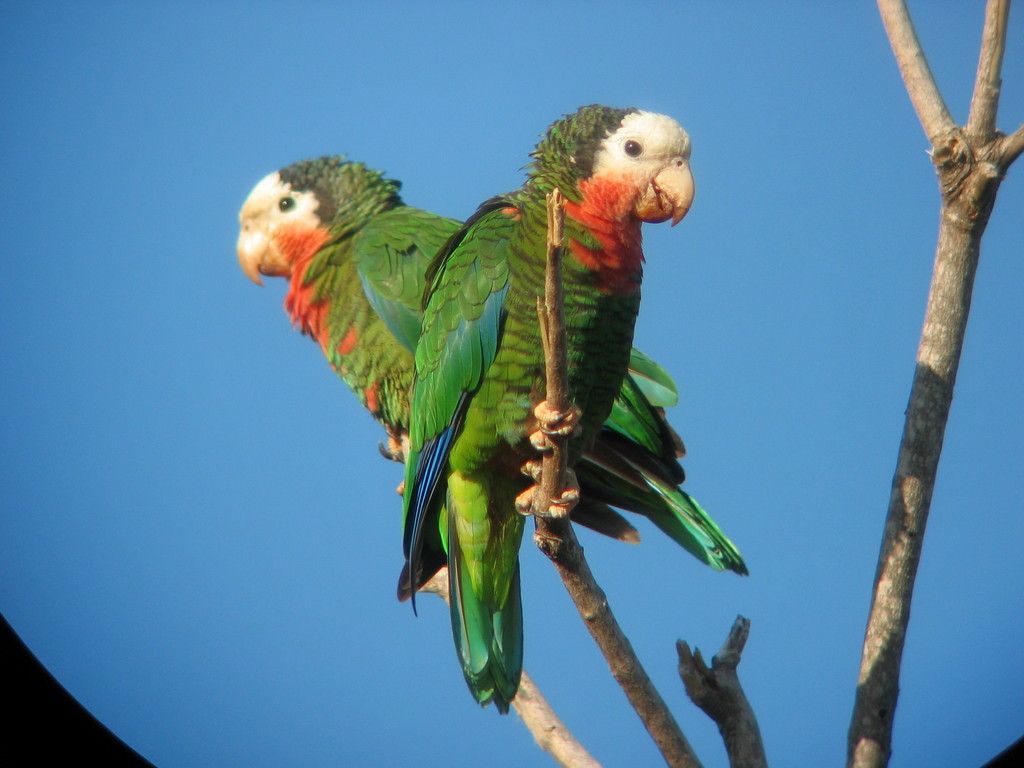
The Cuban amazon is a medium-sized parrot 28–33 centimetres (11–13 in) long. It is mainly green with some blue feathers in its wings. The green feathers are edged with a terminal black rim. Its lower face, chin and throat are rosy pink, and its forehead and eye-rings are white. The extent of the various colours of the head, the extent of the rosy pink on the upper chest, and the extent of the dull red on the abdomen vary between the subspecies. Its irises are pale olive-green, its beak is horn-coloured, and the feathers over the ears are blackish. The legs are pink. The juvenile has little or no red on the abdomen, less black edging on the green feathers, and some of the feathers on the top of its head may be pale yellow rather than white.
Range & habitat
The Cuban amazon lives in different habitats on different islands. It was once found throughout Cuba, but it is now mainly confined to the forested areas of the main island and Isla de la Juventud. There are about 10,000 individuals in Cuba, including an estimated 1,100–1,320 on Isla de la Juventud. On the Cayman Islands the parrot lives in dry forest and on agricultural land. The population living on Grand Cayman numbers about 3,400 individuals (2006 survey), and the population on Cayman Brac consists of 400–500 individuals. The population on Little Cayman was extirpated in the 1940s. The populations were estimated at 3,550 individuals on Abaco and 6,350 on Inagua in 2006. The populations on the Acklins and Crooked Islands were extirpated in the 1940s, while it, based on fossil remains and archeological findings, historically also has been present on several other islands in the Bahamas (e.g., New Providence and San Salvador) and on Grand Turk Island.
Wikipedia: “Distribution and habitat”
What it does
In the winter Cuban amazons gather in flocks, and disperse into pairs during the breeding season.
Diet. The Cuban amazon feeds on a number of fruits and seeds including the fruits of palm trees and West Indian mahogany (Swietenia mahagoni) seeds.
Breeding. The breeding season is from March to September. Cuban amazons nest in tree cavities throughout most of its range, the only exception being that the parrots living on the Abaco Islands nest underground in limestone solution holes, where they are protected from pineyard wildfires. Two to four white eggs are laid, which are incubated by the female for 26–28 days.
Wikipedia: “Behavior”
In human culture
The Cuban amazon was seldom-seen in aviculture outside of Cuba and Florida (where it was bred in captivity by Cuban immigrants) until the 1980s, and is considered one of the more difficult to breed amazon parrots, with aggressive behaviour from cock birds towards their mates and their own chicks a relatively common occurrence. The species is also a popular pet in Russia, as many pet parrots were brought back from Cuba by Russian soldiers following the collapse of the Soviet Union. Despite increased availability in recent times, the Cuban amazon is still one of the highest-priced of all amazons. Several colour mutations have been observed in captive-bred stock. In the Cayman Islands, Cuban amazons (locally known as Cayman parrots) are sometimes removed from the wild and illegally kept as pets. In 2020, the authorities held an amnesty during which parrot owners could legally register their pets, which were then given health checks and fitted with microchips and leg bands in order to identify and distinguish them from wild birds. 326 parrots were registered during this amnesty.
Wikipedia: “Aviculture”
Listen
Looking for field recordings…
Where it lives
Recorded sightings
—
geo-referenced records in GBIF, from museums, herbaria and field observers.
Drag the globe to turn it. Dots are where records exist, not a range map; darker means more records.
In the stacks
Searching the stacks…
Every page naming Amazona leucocephala in the Biodiversity Heritage Library →
This page is assembled live from iNaturalist, GBIF, Wikipedia, the Source Library and the Internet Archive. It is not yet part of the hand-edited codex. iNaturalist taxon 18988.