On eBird ↗
Vinaceous-breasted Amazon
Live sightings near you, the range map, bar charts of when it is seen, and Macaulay Library photos and recordings.
Vinaceous-breasted Amazon
Amazona vinacea
The vinaceous-breasted amazon (Amazona vinacea), also called the vinaceous-breasted parrot and occasionally simply vinaceous amazon/parrot is an endangered species of bird in subfamily Arinae of the family Psittacidae, the African and New World parrots. It is found in Argentina, Brazil, and Paraguay.
From the article Vinaceous-breasted amazon on Wikipedia (CC BY-SA), quoted section by section
Description
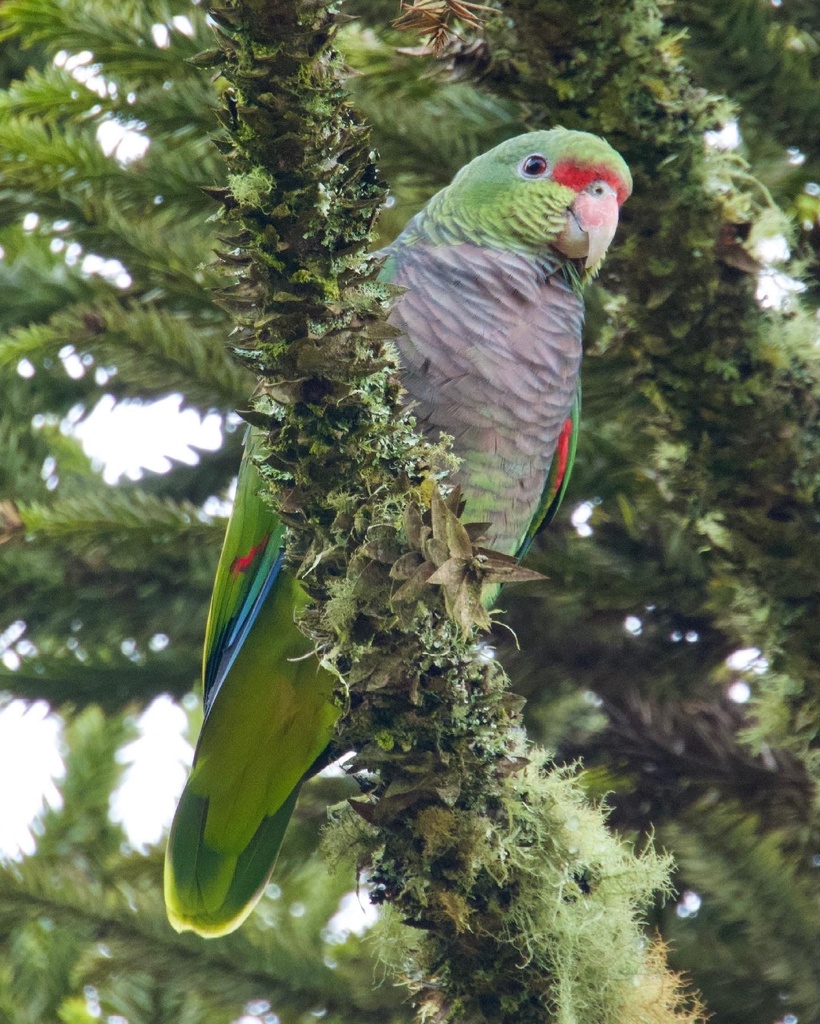
The vinaceous-breasted amazon is 30 to 36 cm (12 to 14 in) long. It is mostly green, with red lores and forehead, a turquoise nape, and a lilac breast. Its carpal edge, speculum, and base of the outer tail feathers are red. Its primaries have blue to black ends. Its bill has a rosy pink to red base and a horn-colored tip. Its iris is red-orange to chestnut surrounded by pale gray skin and its legs and feet are gray.
Range & habitat
The vinaceous-breasted amazon has a disjunct distribution. It is found in scattered locations generally from Brazil's São Paulo state south into Rio Grande do Sul, eastern Paraguay, and far northeastern Argentina's Misiones Province. It formerly occurred as far north as Bahia and south to Argentina's Corrientes Province. It inhabits a wide variety of landscapes within the Atlantic Forest biome but seems to concentrate in mixed forest with large amounts of paraná pine (Araucaria angustifolia). It also occurs in small forest patches, young secondary forest, pastures and grasslands with scattered trees, plantations of introduced pine and Eucalyptus, and around towns.
Wikipedia: “Distribution and habitat”
What it does
The vinaceous-breasted amazon forages mostly in tree-tops and often in flocks. Seeds of paraná pine are a primary food source during winter but the species has been observed feeding on seeds, fruits, buds, and flowers of more than 30 plant species both native and introduced.
Wikipedia: “Feeding”
Listen
Looking for field recordings…
Where it lives
Recorded sightings
—
geo-referenced records in GBIF, from museums, herbaria and field observers.
Drag the globe to turn it. Dots are where records exist, not a range map; darker means more records.
In the stacks
Searching the stacks…
Every page naming Amazona vinacea in the Biodiversity Heritage Library →
This page is assembled live from iNaturalist, GBIF, Wikipedia, the Source Library and the Internet Archive. It is not yet part of the hand-edited codex. iNaturalist taxon 18986.