- Animals
- ›Chordates
- ›Vertebrates
- ›Birds
- ›Parrots
- ›Old World Parrots
- ›Lories, Lorikeets, Budgerigar and Fig-Parrots
- ›Lorius
On eBird ↗
Black-capped Lory
Live sightings near you, the range map, bar charts of when it is seen, and Macaulay Library photos and recordings.
Black-capped Lory
Lorius lory
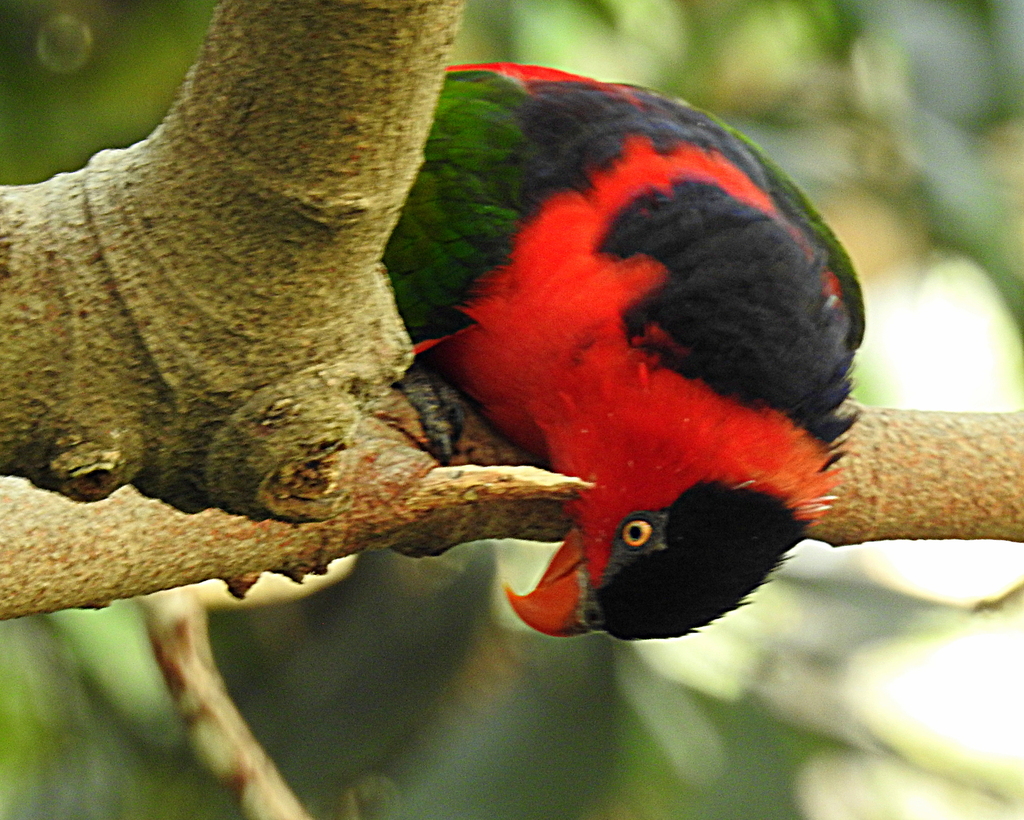
The black-capped lory (Lorius lory) also known as western black-capped lory or the tricolored lory, is a parrot found in New Guinea and adjacent smaller islands. It is a colourful and relatively robust lory (31 cm (12 in)). There are seven subspecies, all with green wings, red heads and body around the wing, a black cap, grey-black cere, yellow underwings, and blue legs and belly. Most also have a blue nape and mantle (area between wings on the back). It remains overall widespread and common, but the subspecies cyanuchen is relatively rare, with fewer than 5,000 individuals remaining.
From the article Black-capped lory on Wikipedia (CC BY-SA), quoted section by section
What it does
The black-capped lory inhabits the primary forest and forest edges in most lowland areas up to 1,000 m (3,300 ft) (sporadically to 1,750 m (5,740 ft)), but not monsoon forest or coconut plantations. It is usually found in pairs and occasionally in groups of 10 or more. Their diet includes pollen, nectar, flowers, fruit and insects.
Wikipedia: “Behavior”
Listen
Looking for field recordings…
Where it lives
Recorded sightings
—
geo-referenced records in GBIF, from museums, herbaria and field observers.
Drag the globe to turn it. Dots are where records exist, not a range map; darker means more records.
In the stacks
Searching the stacks…
Every page naming Lorius lory in the Biodiversity Heritage Library →
This page is assembled live from iNaturalist, GBIF, Wikipedia, the Source Library and the Internet Archive. It is not yet part of the hand-edited codex. iNaturalist taxon 18950.