- Animals
- ›Chordates
- ›Vertebrates
- ›Birds
- ›Parrots
- ›Old World Parrots
- ›Broad-tailed Parrots and Allies
- ›Platycercus
On eBird ↗
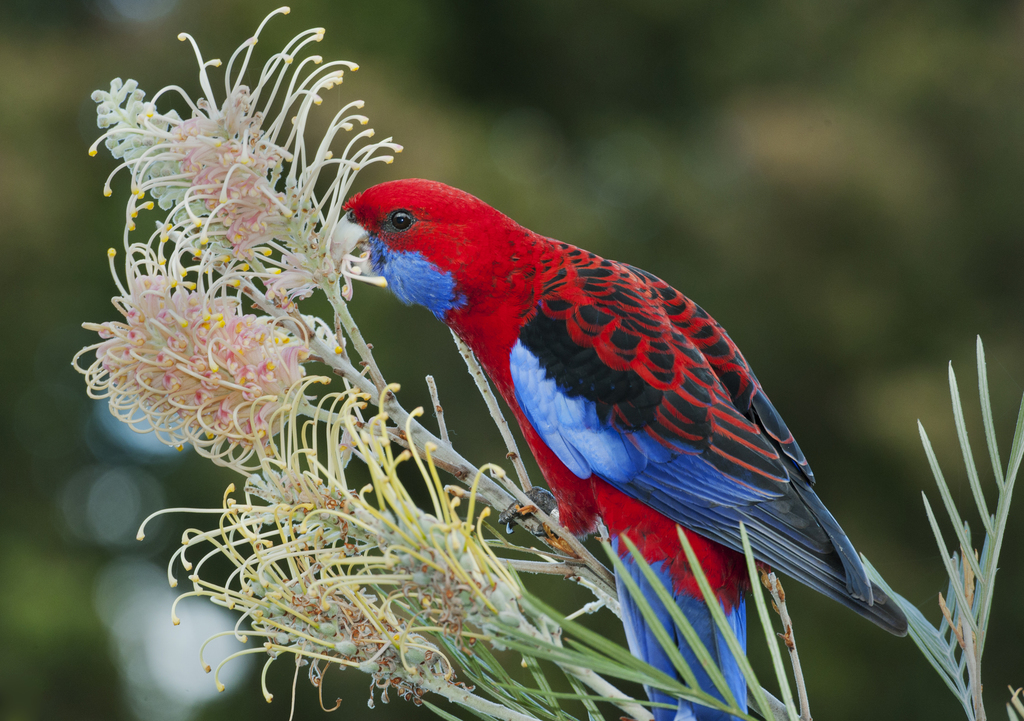
Crimson Rosella
Live sightings near you, the range map, bar charts of when it is seen, and Macaulay Library photos and recordings.
Crimson Rosella
Platycercus elegans
The crimson rosella (Platycercus elegans) is a parrot native to eastern and south eastern Australia which has been introduced to New Zealand and Norfolk Island. It is commonly found in, but not restricted to, mountain forests and gardens. The species as it now stands has subsumed two former separate species, the yellow rosella and the Adelaide rosella. Molecular studies show one of the three red-coloured races, P. e. nigrescens, is genetically more distinct.
From the article Crimson rosella on Wikipedia (CC BY-SA), quoted section by section
Description
Platycercus elegans is a medium-sized Australian parrot at 36 cm (14 in) long, much of which is tail. There are seven subspecies, three of which are actually crimson. The red is replaced by yellow in the case of var. flaveolus and a mixture of red, orange and yellow in the Adelaide rosella. Adults and juveniles generally show strikingly different colouration in south-eastern populations, with predominantly greenish-olive body plumage on the juvenile, most persistent on the nape and breast. Juveniles are said to 'ripen' as they get older and turn from green to red. All races have blue cheeks and black-scalloped blue-margined wings and predominantly blue tail with predominantly red coloration. The crimson rosella's blue tail feathers are one of the favourite decorations of the satin bowerbird. The bill is pale grey and the iris dark brown. There is very little sexual dimorphism in crimson rosellas. The most noticeable difference between sexes is that males are up to 15% larger, and have a relatively larger and wider beak.
Subspecies. P. elegans elegans, the nominate race of Victoria and eastern New South Wales. P. elegans nigrescens, occurring on Queensland's northeastern coast, and P. elegans melanoptera on Kangaroo Island. …
Range & habitat
The crimson rosella occurs from southeastern South Australia, through Tasmania, Victoria and coastal New South Wales into southeastern Queensland. A disparate population occurs in North Queensland. Around 1910, a small number of crimson rosellas were released off the Otago Heads, New Zealand, along with eastern rosellas. These interbred and by the 1950s no pure crimson rosellas remained. This mixed population has remained there ever since. Crimson rosellas were also present in Wellington City from 1963 through the early 1990s as an introduced species. Two crimson rosellas were also recorded from the Tararua foothills in 1971. It is now thought to be extinct in the wild in New Zealand. Crimson rosellas were taken to Norfolk Island as cage birds during the first penal settlement. Escaping into the wild, they were reported before 1838, and became numerous by 1900. There they are often known as "red parrots", to distinguish them from the native Norfolk Island parakeet or "green parrots". Crimson rosellas are common in coastal and mountain forests at all altitudes. They primarily live in forests and woodlands, preferring older and wetter forests. They can be found in tropical, subtropical, and temperate rainforests, both wet and dry sclerophyll forests, riparian forests, and woodlands, all the way from sea level up to the tree line. …
Wikipedia: “Distribution and habitat”
What it does
Almost all rosellas are sedentary, although occasional populations are considered nomadic; no rosellas are migratory. Outside of the breeding season, crimson rosellas tend to congregate in pairs or small groups and feeding parties. The largest groups are usually composed of juveniles, who will gather in flocks of up to 20 individuals. When they forage, they are conspicuous and chatter noisily. Rosellas are monogamous, and during the breeding season, adult birds will not congregate in groups and will only forage with their mate. According to a new study crimson rosellas can identify birds of their own subspecies based on the smell of other birds.
Feeding. Crimson rosellas forage in trees, bushes, and on the ground for the fruit, seeds, nectar, berries, and nuts of a wide variety of plants, including members of the Myrtaceae, Asteraceae, and Rosaceae families. Despite feeding on fruits and seeds, rosellas are not useful to the plants as seed-spreaders, because they crush and destroy the seeds in the process of eating them. Their diet often puts them at odds with farmers whose fruit and grain harvests can be damaged by the birds, which has resulted in large numbers of rosellas being shot in the past. Adelaide rosellas are known to feed on dormant cherry flower buds. …
Wikipedia: “Behaviour”
Listen
Looking for field recordings…
Where it lives
Recorded sightings
—
geo-referenced records in GBIF, from museums, herbaria and field observers.
Drag the globe to turn it. Dots are where records exist, not a range map; darker means more records.
In the stacks
Searching the stacks…
Every page naming Platycercus elegans in the Biodiversity Heritage Library →
This page is assembled live from iNaturalist, GBIF, Wikipedia, the Source Library and the Internet Archive. It is not yet part of the hand-edited codex. iNaturalist taxon 18921.