- Animals
- ›Chordates
- ›Vertebrates
- ›Birds
- ›Parrots
- ›Old World Parrots
- ›Broad-tailed Parrots and Allies
- ›Platycercus
On eBird ↗
Pale-headed Rosella
Live sightings near you, the range map, bar charts of when it is seen, and Macaulay Library photos and recordings.
Pale-headed Rosella
Platycercus adscitus
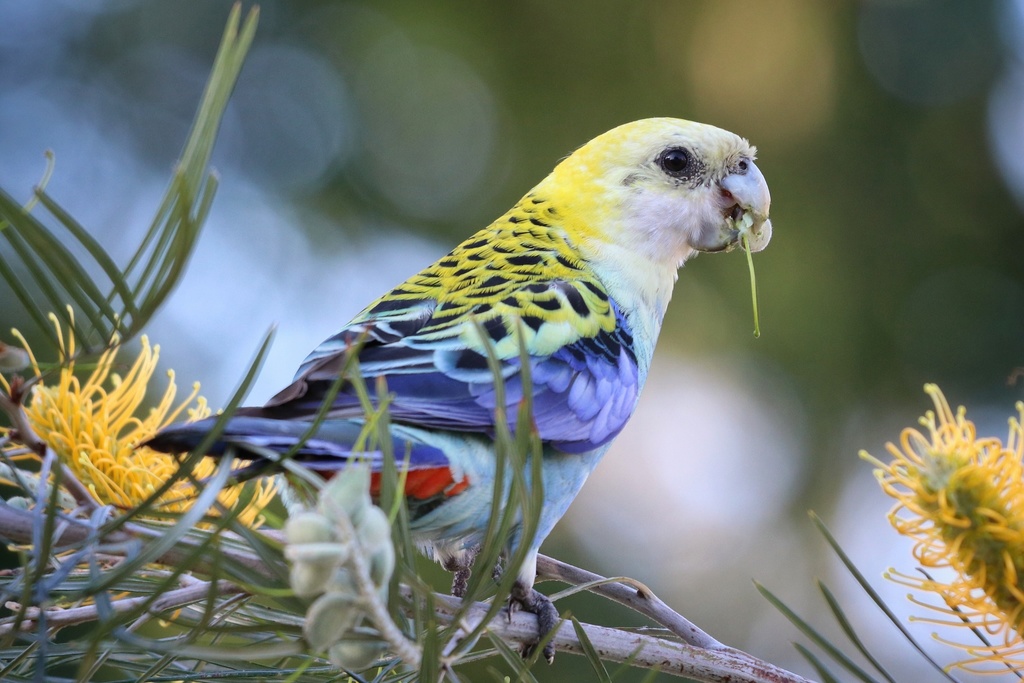
The pale-headed rosella (Platycercus adscitus), is a broad-tailed parrot of the genus Platycercus native to northeastern Australia. It is a moderate-size parrot with a pale yellow head, predominantly white cheeks, scalloped black and gold back and pale blue underparts. Two subspecies are recognised, although some authorities consider it to be conspecific with the eastern rosella of southeastern Australia.
Found in open woodland, it feeds on seeds and fruit. As with other rosellas, the pale-headed rosella nests in hollows of large trees. It readily adapts to aviculture and is sold as a cagebird.
From the article Pale-headed rosella on Wikipedia (CC BY-SA), quoted section by section
Description
The pale-headed rosella is 33 cm (13 in) long, which includes the 15 cm length of its tail. Its underparts are pale blue, and upper breast and head are pale cream-yellow, the tail which is blue-black and green and the vent which is blood red. The feathers of the nape, scapulars and back are black edged with bright yellow, giving rise to a scalloped appearance. In these margins of the northern race, the yellow is paler with a pale blue tinge. The cheeks are wholly white in the southern subspecies, and partly flushed with blue in the lowerparts in the northern subspecies. The bill is pale blue-white and the legs dark grey. The eyes are yellow-brown. The sexes are similar in appearance, although the female is slightly smaller and duller.
Range & habitat
The nominate subspecies adscitus is found from the Cape York Peninsula south through to Cardwell in central-northern Queensland. There is a broad range of intermediate forms, while the southern subspecies palliceps extends from Townsville and points inland south into northeastern New South Wales to the vicinity of the Clarence River. It is common throughout its range. Its preferred habitat is open forest, but has adapted well to human modification of the rural landscape and may even become a pest to orchards and cereal crops. Watering troughs help the species in the dryer western limits of its range. It was also introduced to Hawaii in 1877, but had died out there by the late 1920s.
Wikipedia: “Distribution and habitat”
What it does
It eats grass and tree seeds and fruits, including river red-gum (Eucalyptus camaldulensis), river she-oak (Casuarina cunninghamiana), snow-in-summer (Melaleuca linariifolia) and other melaleucas, and rough cockleburr (Xanthium strumarium). Birds are partial to the introduced Scotch thistle (Onopordum acanthium).
Wikipedia: “Feeding”
In human culture
The species is relatively hardy and easy to keep in cultivation. It can be aggressive and so is recommended to be segregated from other birds in captivity.
Wikipedia: “Aviculture”
Listen
Looking for field recordings…
Where it lives
Recorded sightings
—
geo-referenced records in GBIF, from museums, herbaria and field observers.
Drag the globe to turn it. Dots are where records exist, not a range map; darker means more records.
In the stacks
Searching the stacks…
Every page naming Platycercus adscitus in the Biodiversity Heritage Library →
This page is assembled live from iNaturalist, GBIF, Wikipedia, the Source Library and the Internet Archive. It is not yet part of the hand-edited codex. iNaturalist taxon 18917.