- Animals
- ›Chordates
- ›Vertebrates
- ›Birds
- ›Parrots
- ›Old World Parrots
- ›Long-tailed Parrots and allies
- ›Psittacula
On eBird ↗
Newton's Parakeet
Live sightings near you, the range map, bar charts of when it is seen, and Macaulay Library photos and recordings.
Newton's Parakeet
Psittacula exsul
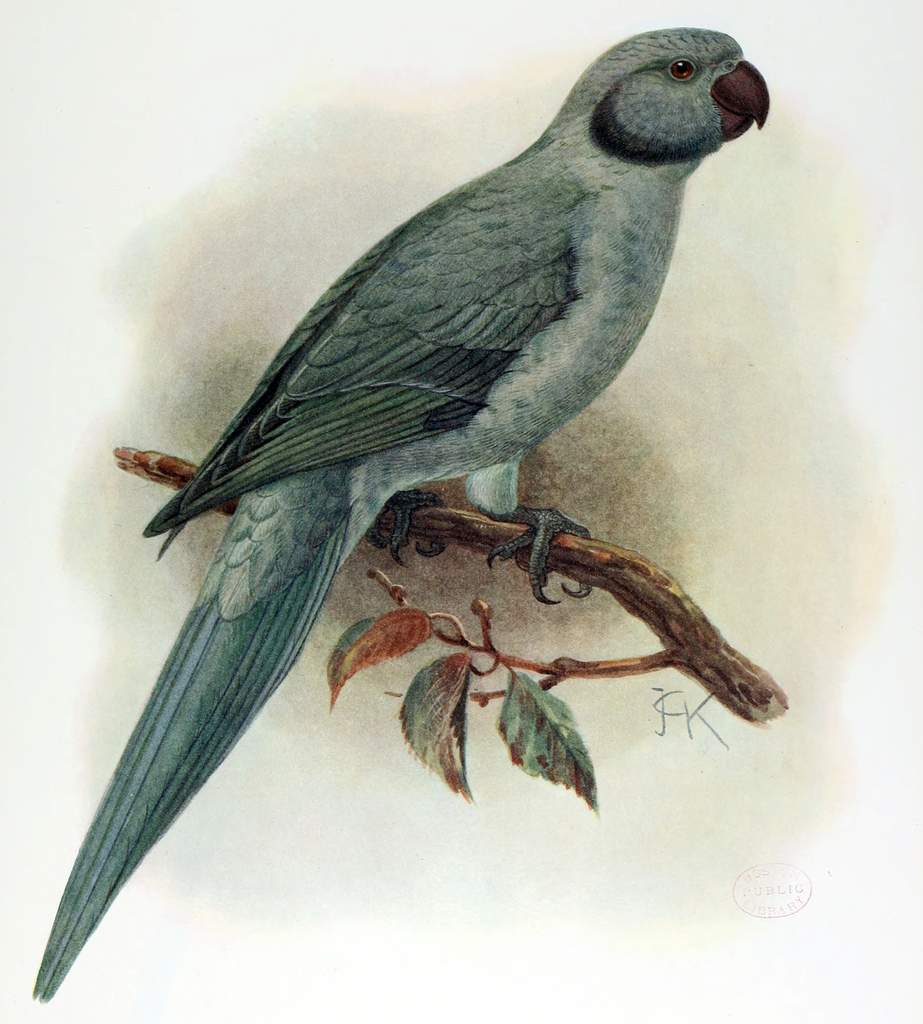
Newton's parakeet (Psittacula exsul), also known as the Rodrigues parakeet or Rodrigues ring-necked parakeet, is an extinct species of parrot that was endemic to the Mascarene island of Rodrigues in the western Indian Ocean. Several of its features diverged from related species, indicating long-term isolation on Rodrigues and subsequent adaptation. The rose-ringed parakeet of the same genus is a close relative and probable ancestor. Newton's parakeet may itself have been ancestral to the endemic parakeets of nearby Mauritius and Réunion.
Around 40 centimetres (16 in) long, Newton's parakeet was roughly the size of a rose-ringed parakeet. Its plumage was mostly greyish or slate blue in colour, which is unusual in Psittacula, a genus containing mostly green species. The male had stronger colours than the female and possessed a reddish instead of black beak, but details of a mature male's appearance are uncertain; only one male specimen is known, and it is believed to be immature. Mature males might have possessed red patches on the wing like the related Alexandrine parakeet. Both sexes had a black collar running from the chin to the nape, but this was clearer in the male. The legs were grey and the iris yellow. Some 17th-century accounts indicate that some members of the species were green, which would suggest that both blue and green colour morphs occurred, but no definitive explanation exists for these reports. Little is known about its behaviour in life, but it may have fed on the nuts of the bois d'olive tree, along with leaves.
From the article Newton's parakeet on Wikipedia (CC BY-SA), quoted section by section
Description
Newton's parakeet was about 40 cm (16 in) long – roughly the size of the rose-ringed parakeet. The wing of the male specimen was 198 mm (7.8 in), the tail 206 mm (8.1 in), the culmen 25 mm (0.98 in), and the tarsus was 22 mm (0.87 in). The wing of the female specimen was 191 mm (7.5 in), the tail 210 mm (8.3 in), the culmen 24 mm (0.94 in), and the tarsus was 22 mm (0.87 in). The male specimen was greyish blue (also described as "slatey blue") tinged with green, and darker above. The head was bluer, with a dark line running from the eye to the cere. It had a broad black collar running from the chin to the nape, where it became gradually narrower. The underside of the tail was greyish, the upper beak was dark reddish brown, and the mandible was black. The legs were grey and the iris yellow. The female was similar but had a greyer head and a black beak. The black collar was not so prominent as that of the male and did not extend to the back of the neck. The general appearance of Newton's parakeet was similar to the extant Psittacula species, including the black collar, but the bluish grey colouration set it apart from other members of its genus, which are mostly green. …
What it does
Almost nothing is known about the behaviour of Newton's parakeet, but it is probable that it was similar to that of other members of its genus, such as the echo parakeet. Leguat mentioned that the parrots of the island ate the nuts of the bois d'olive tree (Cassine orientalis). Tafforet also stated that the parrots ate the seeds of the bois de buis shrub (Fernelia buxifolia), which is endangered today, but was common all over Rodrigues and nearby islets during his visit. Newton's parakeet may have fed on leaves as the related echo parakeet does. The fact that it survived long after Rodrigues had been heavily deforested shows that its ecology was less vulnerable than that of, for example, the Rodrigues parrot. Leguat and his men were hesitant to hunt the parrots of Rodrigues because they were so tame and easy to catch. Leguat's group took a parrot as a pet and were able to teach it to speak:
Hunting and Fishing were so easie to us, that it took away from the Pleasure. We often delighted ourselves in teaching the Parrots to speak, there being vast numbers of them. …
Wikipedia: “Behaviour and ecology”
Listen
Looking for field recordings…
Where it lives
Recorded sightings
—
geo-referenced records in GBIF, from museums, herbaria and field observers.
Drag the globe to turn it. Dots are where records exist, not a range map; darker means more records.
In the stacks
Searching the stacks…
Every page naming Psittacula exsul in the Biodiversity Heritage Library →
This page is assembled live from iNaturalist, GBIF, Wikipedia, the Source Library and the Internet Archive. It is not yet part of the hand-edited codex. iNaturalist taxon 18909.