- Animals
- ›Chordates
- ›Vertebrates
- ›Ray-finned Fishes
- ›Spiny-rayed fishes
- ›Gobies, cardinalfishes and allies
- ›Gobies and allies
- ›Mudskippers and Allies
- ›Rock-climbing gobies
- ›Sicyopus
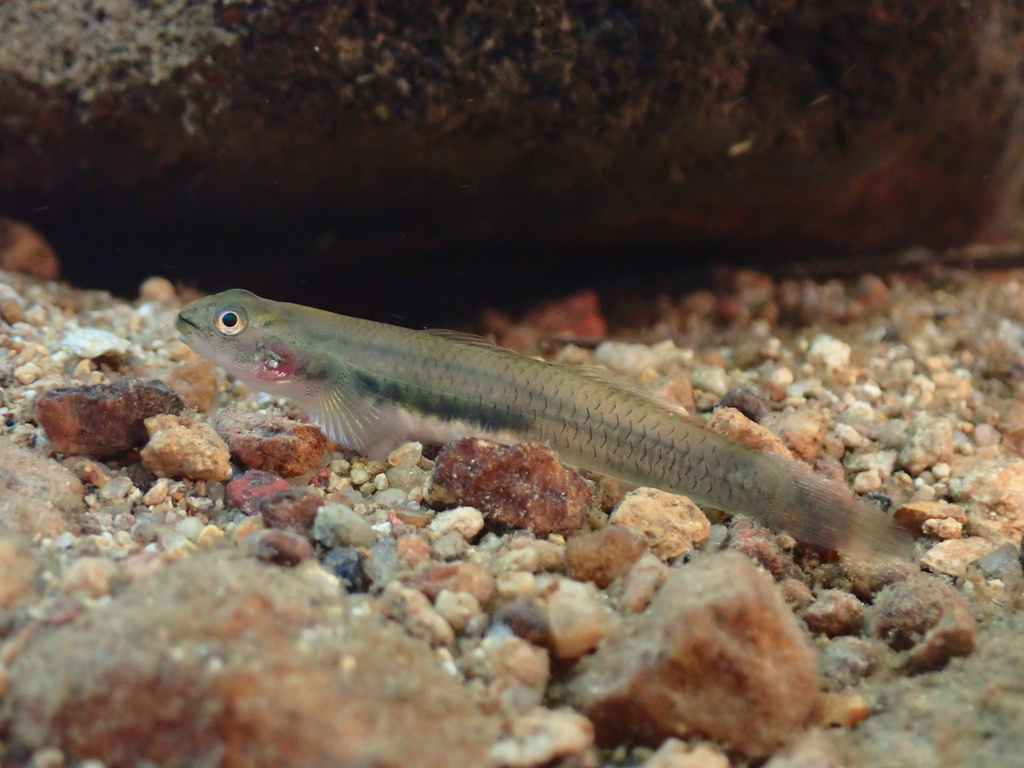
Ornate Fish
Sicyopus zosterophorus
Sicyopus zosterophorus is a species of amphidromous goby in the family Oxudercidae. It is widely distributed throughout the Indo-Pacific region, where it inhabits clear, fast-flowing streams, particularly in forested areas with rocky substrates. Like other amphidromous gobies, it migrates between freshwater and marine environments during different stages of its life cycle and feeds primarily on small aquatic invertebrates.
From the article Sicyopus zosterophorus on Wikipedia (CC BY-SA), quoted section by section
Description
Sicyopus zosterophorus has a fusiform (streamlined) body shape typical of fast-flowing stream gobies. The first dorsal fin contains seven spines, while the second dorsal fin has nine soft rays. The anal fin consists of one spine and nine soft rays. The species typically possesses 33–34 longitudinal scales, 11–12 transverse scales, and 2–6 predorsal scales. The maxilla extends beyond the midline of the eye, with a prominent upper jaw and fleshy lips. The gill opening is relatively small, extending only from the upper to the lower margin of the pectoral fin base. The head is naked above and behind the eye. Predorsal and postpectoral scales are cycloid, while the remainder of the body is covered with ctenoid scales. The spines of the first dorsal fin are approximately equal in length. Males and unsexed individuals may reach a maximum standard length of 4.5 cm, while females have been recorded up to 4.2 cm standard length.
Range & habitat
Sicyopus zosterophorus is widely distributed across the Indo-Pacific. It occurs in Indonesia (including Bali, Sulawesi, New Guinea, and Halmahera), Timor-Leste, the Philippines, Papua New Guinea, Taiwan, Palau, mainland China, and southern Japan (Yaku-shima, Iriomote, and Okinawa). The species is also found in northern Australia and several Pacific island groups, including the Solomon Islands, New Caledonia, Vanuatu, and Fiji
Wikipedia: “Distribution”
What it does
Sicyopus zosterophorus is an amphidromous goby inhabiting marine, freshwater, and brackish environments, typically at depths of 0–5 m. Adults are primarily found in rocky, steep-gradient creeks, usually within 20 km of the sea, where substrates are dominated by bedrock with scattered rocks and boulders. These streams are characterised by clear, well-oxygenated water, minimal aquatic vegetation, and occasional leaf litter, conditions that promote rich biofilm growth on submerged surfaces. Members of the genus Sicyopus are highly specialised to short, tropical coastal streams, often located above waterfalls or cataracts, which restricts access to most other fish species. Despite this isolation, S. zosterophorus may co-occur and coexist with other gobies, such as Sicyopus cebuensis, Lentipes armatus, Sicyopterus lagocephalus, and Stiphodon surrufus, and invertebrates like amphidromous Macrobrachium shrimp and neritid snails. Its successful colonisation of these niche habitats is facilitated by morphological adaptations and a remarkable breeding strategy, including the ability to climb waterfalls. Unlike many gobies that graze on biofilm, "Sicyopus zosterophorus" is a specialised predator with a diet largely composed of insects, including chironomid larvae and hymenopterans. Crustaceans, plant material, and phytoplankton make up smaller portions of its diet. …
Wikipedia: “Habitat and ecology”
In human culture
The genus name Sicyopus is derived from Greek, from sikyos (or sikya), meaning "cucumber", and pous, meaning "foot". The name likely refers to the elongated body shape or the fused pelvic fins that form a suction disc characteristic of gobies in this group. The specific epithet zosterophorus is derived from Greek, from zoster, meaning "belt" or "girdle", and phoros, meaning "bearing" or "carrying". The name is thought to refer to banding or belt-like markings present on the body of the species. While occasionally available in the aquarium trade under names like flaming arrow goby, belted rockclimbing goby, or ornate goby, it is often misidentified under the invalid name Sicyopus zosterophorum.
Wikipedia: “Etymology”
Where it lives
Recorded sightings
—
geo-referenced records in GBIF, from museums, herbaria and field observers.
Drag the globe to turn it. Dots are where records exist, not a range map; darker means more records.
In the old herbals & bestiaries

In the stacks
Searching the stacks…
Every page naming Sicyopus zosterophorus in the Biodiversity Heritage Library →
This page is assembled live from iNaturalist, GBIF, Wikipedia, the Source Library and the Internet Archive. It is not yet part of the hand-edited codex. iNaturalist taxon 188398.